
10 American V8 Coupes Worth Building Over Restoring Stock
A numbers-matching Dodge Challenger Hemi R/T is a six-figure ride all day long and is always worth restoring to factory-fresh condition, but the base model with a 318ci V-8 is fairly worthless in perfect condition, and would be a poor choice for a stock restoration. The thing about most classic muscle cars is that the vast majority of them were sold with weak-sauce V-8s, and while they look every bit as cool as their monster big-block counterparts, they aren’t terribly collectible or valuable. They do, however, represent an opportunity for budget-conscious enthusiasts to own killer classics, because, let’s face it, none of us will ever own a Hemi ‘Cuda, but a base-model Barracuda is in the cards.

Since these cars are never going to be worth all that much, keeping them all-original doesn’t make a lot of sense when you can seriously upgrade their underpowered engines and have something that is pure joy. Any kind of decent restoration probably starts at around $40,000, so if you end up with a car that’s worth less, it will be a pointless endeavor. On the other hand, you could spend half that much to build an impressive set of wheels that will put a grin on your face every time you fire it up. Here are some of the coolest classic V-8 coupes that are just itching for a custom build, versus a money-sucking original restoration.
10
1973 Ford Mustang
High Retail Value: $38,400
J.D. Powerreports that the high retail price for a plain-Jane 1973 Ford Mustang is almost $40,000, which is absurd. Great condition Mach 1s with 351ci V-8s regularly sell at auction in the low $20,000 range and a base fastback with a 302ci V-8 is like a $10,000 and under car. It would be insane to restore a car like this to Concours condition, and just as nuts not to drop a Gen 4 Coyote 5.0-liter V-8 under the hood. With a six-speed transmission swap, ECU, and all the other components that go along with a modern engine, a skilled builder could get this done for under $25,000.

Celebrating 60 Years Of The Dodge Charger: The Ultimate Muscle Car
The Dodge Charger was the defining ride of the Golden Age of American Muscle and six decades later it still rules the streets.
9
1969 Dodge Charger
High Retail Value: $37,100

When it comes to classic Mopar muscle, numbers-matching cars are the be-all-end-all, but there is an exception on second-gen Dodge Chargers. We tend to think that all of these glorious street machines were packing 440 Magnums or 426 Hemis, but the base came with a 230-horsepower two-barrel carb 318ci V-8, which is clearly an insult to the car’s aggressive style. Because you’d be out of your mind to touch a 440 or Hemi, the 318 has become a popular resto-mod target. As luck would have it, HotCars’ very own Mopar Guru Hank O’Hop took an original 318-equipped ’69 Charger and metamorphosed it into something that does those sexy second-gen Coke bottle curves justice. With a Gen III Hemi stroked out to 426ci, Pypes Performance Exhaust, pro-touring suspension, and upgrades to everything that matters, Hank’s ’69 is a 650-horsepower menace that is vastly more fun than a numbers-matching 318 slug.
8
1969 Buick GS 350
High Retail Value: $35,000

The Buick Gran Sport is one of the most criminally overlooked Golden Age muscle cars and represents one of the best values for a classic street machine. Something like a 1969 GS 400 Stage 1 is relatively cheap with a Hagerty Concours condition value of $60,600, but that’s still a car that is worth an original restoration. A ’69 GS 350, on the other hand, wouldn’t even hit $30,000 with a frame-off 100-point resto, which is actually a blessing in disguise. The 345-horsepower GS 400 is in desperate need of a power upgrade but is more or less untouchable, while the 280-horsepower GS 350 is ripe for an engine swap. The question is, what engine is this car begging for? You could go the obvious route and find a 455ci big-block that made the 1970 Buick GSX such a beast, but a 500-plus horsepower 6.2-liter LS3 crate engine and Tremec Magnum 6-speed transmission sounds a lot cooler.
7
1965 Chevrolet Chevelle
High Retail Value: $33,700

No, this one is not a misprint, as the 1965 Chevrolet Chevelle is a build-worthy classic V-8 coupe. An exquisite ’65 SS Z16, of which only 201 were produced, is a quarter of a million-dollar ride and shouldn’t be messed with, but a base model with a 220-horsepower 283ci V-8 ain’t worth much and is begging for more ponies. The thing about the early Chevelles was that there was nothing in the VIN or fender tag that identified them as SS models or specified the displacement of the V-8 engine they left the factory with, so it’s easy to fake an SS 396. Don’t be that person and instead, consider a Chevy 350, the king of all buildable small-blocks, stroked to 383ci with a hotter cam, aluminum heads, dual-plane intake, and performance exhaust. Builders love the 350 because it is so easy to get 400 or 500 horsepower out of it with the turn of a wrench, and equipped in the ’65 Chevelle would make something that could embarrass an SS 396.
The Holy-Grail Chevrolet Muscle Car That Practically Doesn’t Exist Anymore
Even Indian Jones would have a hard time finding Biblicly rare 1965 Chevy Malibu Chevelle SS Z16.
6
1976 Ford Gran Torino
High Retail Value: $16,600

That red with white vector stripes 1976 Ford Gran Torino pictured above is a replica of the iconic car from the hit Starsky & Hutch TV series, and despite being infinitely cool, it’s not particularly valuable. It sold for $17,000 in 2021, with another selling a couple of years earlier for $17,050, so clearly it’s a car on the downslide. Even one actually associated with the buddy cop show only dropped the gavel for $27,500, so this is a car that can be modded without negatively affecting its value. Realistically, this one does need some wrenching, because its 150-ish horsepower 351 made it woefully underpowered. So much so that the production crew had to modify the stunt cars and install better gears just so they could light the tires and do power slides. You could get some more power out of the 351 on this project, but a Ford 460ci big-block, which can be built into a 500–600 horsepower monster, would be far more exciting and definitely suits the bruising nature of the “Stripped Tomato.”
5
1970 Dodge Coronet 500
High Retail Value: $15,700

1970 Dodge Coronet R/Ts and Super Bees with Hemis or Six-Packs are big-money rides, but they’re practically giving away Coronet 500s. With the same sheet metal and grille, this is a miserly Mopar fan’s chance for a killer replica that shows mercy on their bank accounts. A ’70 Coronet 500 could be optioned with a 383ci or 440ci big-block, but was most likely to have a stock 230-horsepower 318ci V-8. If you can find a 383 or 440 car, it’s worth keeping those engines, not because a numbers-matching Coronet 500 is an auction darling, but rather because those are great engines that can easily be made even greater. For the 318 project, the obvious swap is a 426 Hemi crate engine, which would be a strong choice, but for something more unconventional, consider dropping in a 550-horsepower 3.0-liter twin-turbo Hurricane I-6, which was briefly referred to by Dodge as the “Six-Pack.” There’s a certain demented beauty in a fake Super Bee equipped with a fake Six-Pack, and it would definitely be a conversation starter as well as a formidable performer.
4
1971 Plymouth Duster
High Retail Value: $13,100

Once the cheapest classic Mopar money could buy, the 1971 Plymouth Duster 340 is now crossing the $100,000 mark at auctions for low-mileage perfect examples. Yet, great condition 340s are still the budget Mopar muscle cars, with that Sublime beauty pictured above selling for only $18,700, and several others for even less. Finding a ’71 Duster with a 318ci V-8, yields an even lower price and the basis for a fun project. Keep in mind, this isn’t a flippable build, but rather one for someone who wants an extremely cool ride that won’t put them in the poorhouse. Swapping out the 318 for a 340 would be pointless because it wouldn’t increase the value of the Duster, and it wouldn’t be a radical leap in performance. A Gen III Hemi 5.7-liter V-8 is 345 cubic inches, which is close enough, and with up to 395-horsepower would turn the compact, lightweight ’71 Duster into a 12-second car for pocket change.
3
1988 Ford Mustang LX
High Retail Value: $6,675

The Fox Body Mustang was the defining ride of the entire 1980s, which is another way of saying Ford sold boatloads of these iconic pony cars, which is another way of saying they are abundant and not valuable in any way. Even GTs or LXs with 5.0-liter V-8s are sub-$10,000 cars in excellent shape. A 1988 Mustang LX hatchback with the stock 90-horsepower 2.3-liter I-4 is worth so little that an owner would probably pay you to take it, which is why it is one of the ultimate project cars. Installing a Ford Modular 5.0-liter Coyote V-8 into a Fox Body Mustang is practically an entry-level engine swap, because it’s so straightforward, which is exactly why it makes the most sense. Maybe someone who needs a bigger challenge might attempt a Viper V-10 swap, but the Coyote is exactly what this one calls for. The original 5.0-liter produced 225 horsepower, which was good for the time, but more than doubling that output is great for our time.
Why The Fox Body Mustang Is The Next High-Value Muscle Car
With the Fox Body Mustang shifting into “Gotta Have” mode, prices for the iconic ’80s ride are set to explode.
2
1987 Buick Regal Limited
High Retail Value: $4,950

With an underrated 245-horsepower 3.8-liter turbocharged V-6, the 1987 Buick GNX was completely ferocious and the only factory 13-second car of the ’80s. Buick made 547 of these amazing rides, and it seems like everyone who bought one sat on it in hopes of big-time flip, as both Hagerty and Bring a Trailer have dozens of super-low-mileage listings. It’s a shame nobody ever really got to enjoy these cars, and now that they sell in the hundreds of thousands, it’s unlikely anyone ever will. Making a GNX clone, however, can provide the visceral experience of unleashing one of these machines on the streets for next to nothing. A 1987 Buick Regal, which is the basis of the GNX, is worth so little that nobody has ever had the nerve to list one for auction. An inexpensive ’87 Regal Limited occasionally pops up, and they have the added bonus of being equipped with a 3.8-liter turbo V-6, albeit a weaker version. This one could be as easy as installing a better turbocharger or, for some real fun, give it a 650-horsepower 6.2-liter supercharged LT4.
1
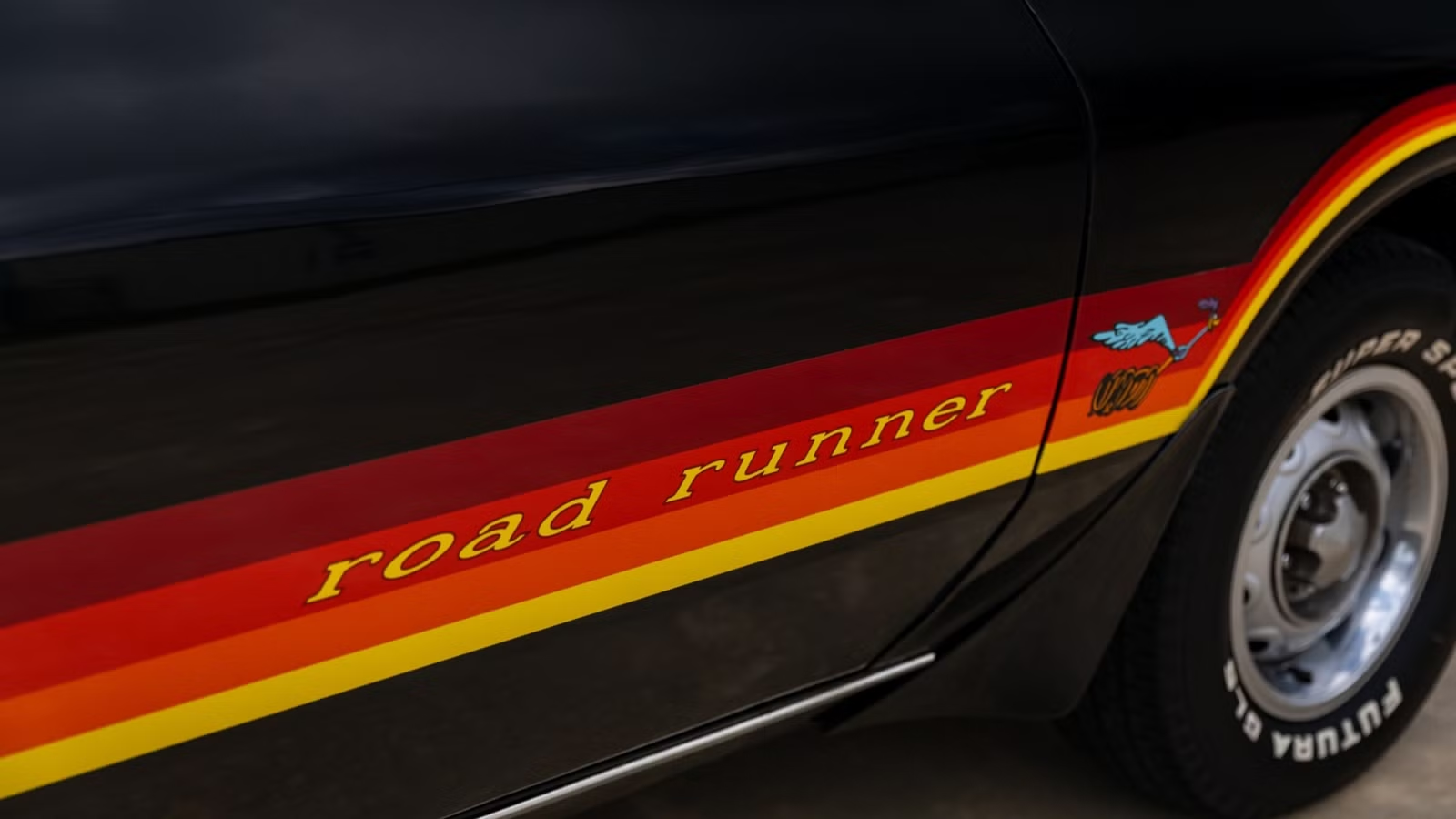
1978 Plymouth Road Runner
High Retail Value: $1,600

The Plymouth Road Runner, introduced in 1968, was one of themost iconic muscle carsof the Golden Age, but most people kind of lost track of it after 1972 or so. Almost nobody remembers that it eventually became the performance trim on the Plymouth Volaré, and the hottest-looking set of wheels during the 1970s Malaise Era. Obviously, restoring the 175-horsepower 360ci V-8 to factory specs isn’t going to deliver a valuable ride, but giving it some modern power to match its retro styling will result in something people will never stop asking you about. Since this is a Mopar, clearly a Gen III Hemi is going in this project, which only leaves the question as to which one. There’s a certain type of Mopar maniac who would go with a 800+ horsepower 6.2-liter supercharged Hemi Hellcat V-8, and that would be something to see, but there’s an even better fit. The 6.1-liter Hemi V-8 produces 425 hp, which is exactly what a ’68 Hemi Road Runner cranked out, and in the much lighter ’78 would have this legend ruling the streets again.
Sources: Bring a Trailer, Hagerty, J.D. Power

Related posts


Latest Post


No Comments