
The Perfect Middle Ground Between Sport And Touring
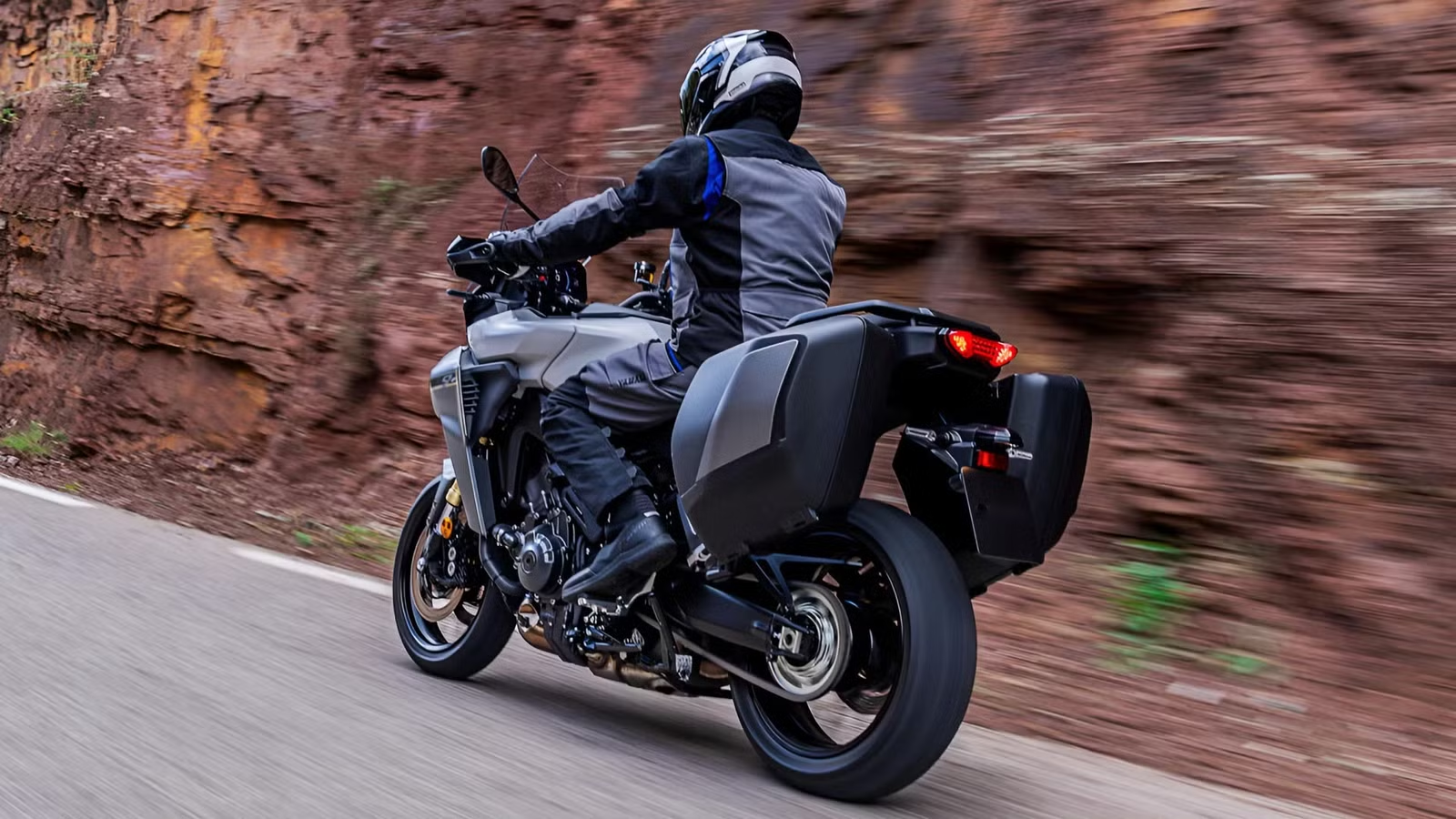
Riders have spent years being forced to choose between two extreme ends of a spectrum – the pure adrenaline of a sport bike or the sensible comfort of a tourer. If they wanted razor-sharp handling with explosive acceleration, they bought a sport bike. The trade-off was cramped ergonomics and the kind of seat that became unbearable after a couple of hours.

Touring motorcycles solved those problems with plush seats, large fairings, luggage, and highway comfort, but they often sacrificed the excitement that makes motorcycling special in the very first place. That is why the modern sport-touring category has become one of the most compelling segments in motorcycling, and few bikes capture that balance better than Yamaha’s latest mid-weight sport-tourer.
The Rise Of The ‘Sport-Touring’ Sweet Spot
Sport bikes deliver thrills, but at the cost of comfort. Touring motorcycles prioritize comfort, but sacrifice excitement. A well-executed sport-tourer aims to combine the best qualities of both. Historically, the sport-touring category was dominated by heavy-displacement behemoths weighing well over 600 pounds. While those machines excelled on open interstates, their massive curb weights and sluggish handling made them exhausting to navigate through dense city traffic.


The rise of the middleweight sport-touring ‘sweet spot’ bridges this generational divide. By trimming away unnecessary bulk while retaining a potent engine and sophisticated electronic rider aids, manufacturers have created a category that delivers genuine sportbike thrills alongside true touring stamina. These machines don’t force you to pick an identity; instead, they adapt seamlessly to whatever mood or journey you throw at them.
Riders Want One Motorcycle That Can Do Almost Everything

In today’s economic climate, owning multiple single-purpose motorcycles – a dedicated track machine, a weekend cruiser, and a long-haul tourer – is an expensive luxury that few riders can afford. Garages are shrinking, insurance rates are rising, and riders increasingly demand a single-capable machine. This shift in consumer priority has placed versatility at the center of engineering. The demand is for a motorcycle that can do it all, from handling Monday-to-Friday office commutes, slicing through technical canyon roads on Saturday morning, to packing up hard luggage for a 1,000-mile road trip on Sunday, and this Japanese motorcycle does exactly that.
The Yamaha Tracer 9 Is Built Around Versatility To Bridge The Sport And Touring Gap
MSRP: $12,599

The Japanese motorcycle in context is the Yamaha Tracer 9. Originally introduced to North American riders under the ‘FJ-09’ moniker before adopting its global ‘Tracer’ badge, this model was engineered from day one to combine the hooligan spirit of Yamaha’s popular naked bikes with the versatility of a continental tourer. Over the years, Yamaha has refined the Tracer formula, constantly shaving weight, updating styling, and cramming high-end tech into an accessible package.

With a starting price of $12,599, the 2026 Yamaha Tracer 9 positions itself as a relatively affordable entry into the premium middleweight sport-touring world while still offering a substantial list of standard equipment. What makes the Tracer 9 interesting is that it does not try to imitate a full-size touring motorcycle. Instead, Yamaha has focused on keeping the bike relatively light, agile, and engaging while adding the comfort and tech needed for serious long-distance riding.
The Crossplane Triple Engine Brings True Sports Bike Character

At the heart of the Tracer 9 is Yamaha’s legendary 890cc liquid-cooled CP3 (Crossplane 3-cylinder) DOHC engine. Widely acclaimed for its crisp throttle response and distinctive exhaust note, this arguably provides the perfect configuration for a sport-tourer. Unlike many parallel-twin rivals that focus primarily on efficiency and low-end torque, this inline-triple motor delivers a much more charismatic experience with a broad spread of power that feels exciting across the rev range.

Producing 117 horsepower at 10,000 RPM and 68.6 pound-feet of peak torque at 7,000 RPM, the engine comes mated to a six-speed manual gearbox. It also gets the option of Yamaha’s automated manual transmission (Y-AMT) in some other global markets. Whether you are executing a quick overtake on the interstate, pulling out of a slow hairpin turn, or cruising comfortably at legal speeds, the power delivery of the Tracer 9 is linear, instant, and thoroughly addicting. It also gets an assist and slipper clutch, a ride-by-wire throttle system, and an optional quickshifter.
Upright Ergonomics Make Long-Distance Riding Effortless

Performance alone is never enough for a great sport-tourer, and Yamaha has paid equal attention to rider comfort as well. The Tracer 9’s riding position is upright and neutral, which is exactly what sport-tourers should be aiming for. With an adjustable seat height offering two adjustments (33.3 inches to 33.9 inches), the bike is relatively accessible for all sorts of riders. Even the Tracer 9’s chassis architecture is tailored for all-day endurance.

Yamaha has built the bike around a lightweight aluminum Deltabox frame, maintaining high torsional rigidity for sharp, precise handling while keeping the overall wet weight around a manageable 483 pounds. Suspension duties are handled by adjustable KYB 41mm inverted front forks with 5.1 inches of travel and a KYB rear shock with 5.2 inches of travel. Moreover, the braking performance matches the bike’s pace, backed by dual 298mm hydraulic discs up front and a 267mm disc at the rear with standard cornering ABS.
Technology That Enhances Both Performance And Touring Comfort

Yamaha didn’t skimp on electronic sophistication for the Tracer 9. In fact, the sheer amount of technology Yamaha has included as standard equipment in this motorcycle is mind-boggling for the price. The centerpiece is a 7-inch full-color TFT display with smartphone connectivity. Governed by a six-axis Inertial Measurement Unit (IMU), it boasts a comprehensive suite of rider aids, including lean-sensitive traction control, slide control, lift control, and cornering ABS.

For touring duties, the Tracer 9 comes factory-equipped with electronic cruise control, an adjustable windscreen, handguards, and integrated 30-liter color-matched hard panniers, one on each side. Yamaha also offers a robust catalog of optional official accessories, including heated grips, comfort seats, top cases, and lower crash guards, allowing owners to tailor the motorcycle for long-haul touring as per their taste.
The Yamaha Tracer 9 Might Be The Ultimate Do-It-All Motorcycle
When stacked against its closest market rivals, the Tracer 9’s value proposition becomes even clearer. Competitors like the Honda NT1100 or Kawasaki Versys 1100 offer great touring amenities, but they are significantly heavier, bulkier, and lack the raw, playful agility offered by Yamaha’s CP3 engine. On the other end, sub-liter adventure bikes like the BMW F 900 XR offer similar middle-weight proportions, but often require thousands of dollars in optional packages to match the standard equipment level of the Tracer 9. By successfully blending sub-500-pound agility, a characterful 117-horsepower inline-triple, and real-world touring comfort for $12,599, the Yamaha Tracer 9 doesn’t just sit in the middle ground between sport and touring – it owns it.
Source: Yamaha

Related posts


Latest Post


No Comments