
The Forgotten Chevy Cop Car That Out-Handled 1975’s Muscle Cars
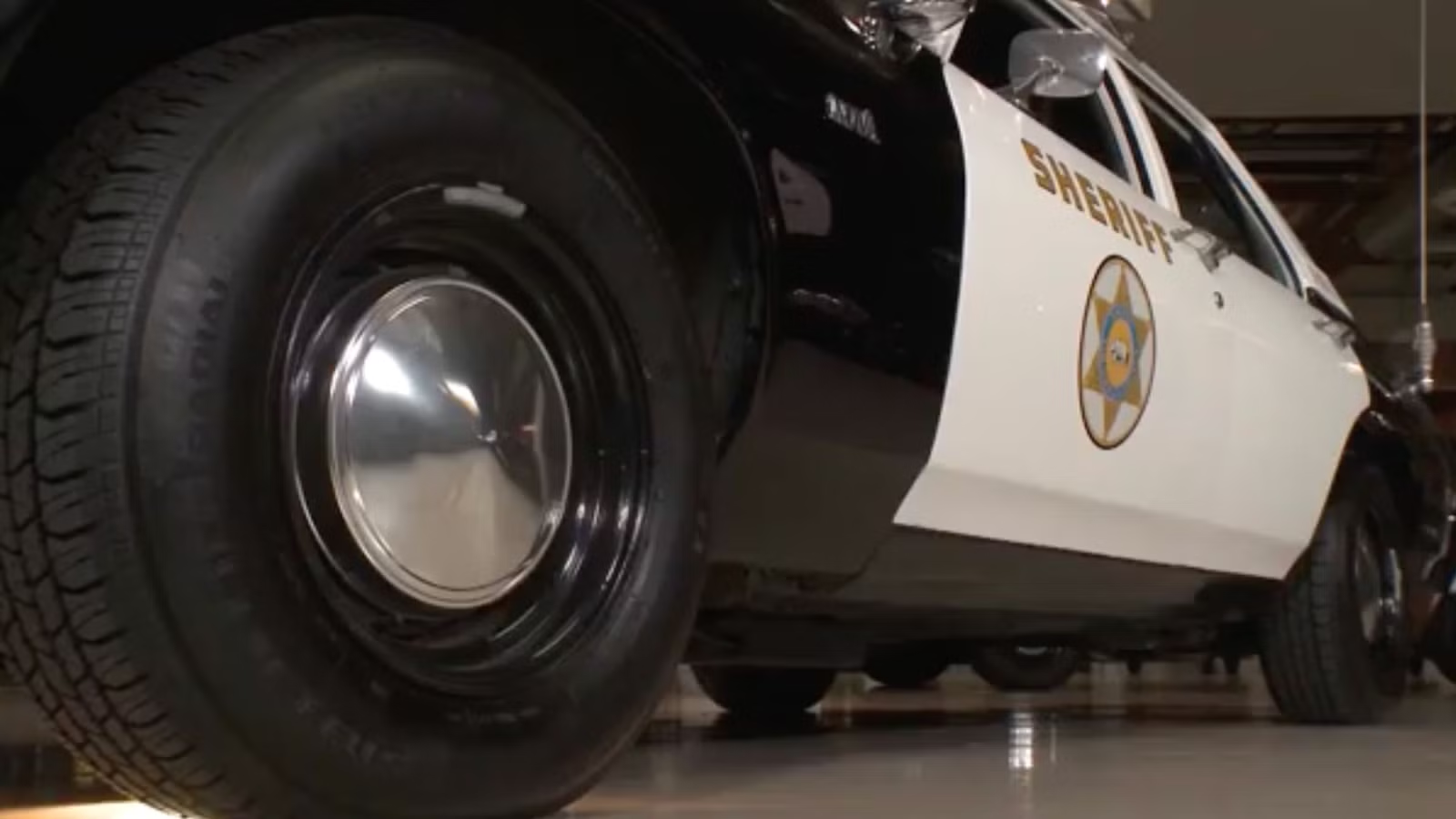
The late 1970s led to massive shifts in the American automotive industry, but not by choice. Between skyrocketing fuel costs and increasingly stringent federal emissions standards, the days of gas-guzzling cruisers with engines as massive as their dimensions were quickly coming to an end. To ease the strain that everyday commuters felt at the gas pump, automakers were tasked with producing vehicles that were smaller, lighter, and more efficient than ever before. This extended to police car fleets, as their large cruisers were not efficient enough.
Full-Sized Cruisers Face A Fuel Crisis

For decades, the formula for the American pursuit vehicle remained straightforward and largely unchanged. Manufacturers took massive full-sized sedans, such as the Chevrolet Impala or Ford Custom 500, and dropped a big-block V8 under the hood alongside suspension reinforcements and stronger brakes. These traditional land yachts excelled at highway cruising, but their massive engines were notorious for guzzling fuel during extended idling and stop-and-go city traffic. Over time, strict federal emissions mandates led to limited exhaust flow, heavy bumpers, and lower engine output, but the police car philosophy managed to continue its usual big-block blueprint.
Eventually, the onset of an American fuel crisis finally managed to move the needle for meaningful changes in pursuit vehicle design. In 1973, the OPEC oil embargo sent shock waves through the automotive industry overnight, and surging fuel prices quickly rendered full-sized vehicles obsolete. Law enforcement agencies across the country depended on their fleets of giant, V8-powered cruisers, but the financial toll of operating these inefficient sedans around the clock quickly became too significant to sustain. Police departments sought a smaller, more fuel-efficient sedan that could keep up with older cruisers while outlasting them between refueling stops.
The Nova 9C1 Is The Fuel-Sipping Solution


With the fuel crisis threatening traditional cruisers, law enforcement leadership at the Los Angeles County Sheriff’s Department (LASD) began the search for a more nimble, more efficient alternative. The LASD established a specialized evaluation unit to test compact and mid-sized sedans available at the time against the outgoing full-sized cruisers.
During this time, Chevrolet responded to calls for a change in police cruiser philosophy with the newly engineered RPO 9C1. The package was built on the platform of the fourth-generation Nova compact sedan and was developed specifically for fleet pursuit duties. Introduced publicly for the 1975 model year, the Nova 9C1 set out to deliver precisely what law enforcement officials had requested. It featured a modern unibody design with a front subframe, giving it a much more compact footprint than the older land yachts that had been on patrol for decades. It also shed hundreds of pounds compared to its full-sized counterparts, but it still maintained ample room for officers, equipment, and suspect transport.

The gleaming highlight of the 9C1 package sat under the hood. Chevrolet fitted the Nova 9C1 with a 5.7-liter LM1 V8 engine featuring specialized factory tuning and a heavy-duty four-barrel carburetor, enabling the police cruiser to outrun standard Novas equipped with smaller inline-sixes or older, low-output V8s. The small-block LM1 was engineered to maximize low-end torque and high-rpm output, while complying with strict California emissions regulations and dramatically cutting fuel costs for police fleets. The engine was mated to a heavy-duty Turbo Hydra-Matic 350 automatic transmission and a 3.08 Positraction rear axle, allowing the 9C1 to successfully achieve its goal of delivering sufficient power without suffering from the astronomical fuel consumption that plagued larger cruisers.
Performance That Outclassed Muscle Cars

While the Nova 9C1 was born out of a necessity for greater fuel efficiency, the compact cruiser was not slow by any measure. By the time it reached police fleets in 1975, standard muscle cars were undergoing massive declines in power. Increasingly strict safety regulations weighed them down with heavy bumpers, and emissions regulations further suffocated them with severely limited exhaust systems, so the segment began to fade out as a result. Though the Nova 9C1 was not available to the general public like its muscle car contemporaries, it packed factory performance hardware that put dedicated performance cars to shame.
To ensure that the Nova 9C1 could balance its remarkable efficiency with proper high-speed performance, Chevrolet engineers raided the General Motors parts bin. The standard Nova’s steering system was replaced with the highly responsive, fast-ratio variable system from the Camaro Z28, resulting in sharp turn-in and precise road feedback. To sharpen cornering performance and minimize body roll, the four-door sedan’s chassis was reinforced with stiffened anti-sway bars front and rear, as well as heavy-duty coil springs, upgraded shock absorbers, and firm rear leaf spring bushings. To strengthen the compact cruiser’s stopping power with minimal fade, Chevrolet fitted the 9C1 with massive front disc brakes from GM’s full-sized sedans.
Chevrolet’s efforts beneath the sheet metal became clear during LASD fleet testing. The Nova 9C1’s compact body and chassis reinforcements allowed it to deliver excellent handling during slalom tests, and its braking performance far surpassed that of full-sized cruisers. While it returned a rather average 0-60 mph time of around 9.0 seconds, the Nova excelled in pursuit speeds between 30 mph and 65 mph, and it reached an astonishing top speed of around 120 mph.
An Overlooked Factory Sleeper

The Nova 9C1 refrained from flaunting its outstanding performance, instead hiding it beneath an unassuming exterior design. To the average onlooker, the 9C1 looked like nothing more than a basic four-door economy car. It lacked the commanding dimensions of other police cruisers, and a slightly lower stance due to its upgraded suspension was one of very few subtle details that quietly hinted at the cruiser’s high-performance hardware. Another subtle detail for the observant eye was the sedan’s thick tire sidewalls, which wrapped around its heavy-duty steel wheels.
For enthusiasts and aftermarket builders alike, the Nova 9C1’s utilitarian looks lay the groundwork for a brilliant sleeper sedan blueprint. The compact cruiser packed a stiffened chassis, heavy-duty brakes, and a small-block V8 into a humble four-door body that forgoes obvious cues such as wide body kits or aggressive hood scoops. Drivers who encountered the Nova 9C1 and remained unaware of its underlying performance capabilities would not underestimate it for long once they found themselves in a high-speed pursuit.
Exceedingly Rare In Modern Times

Despite Chevrolet building as many as 13,800 units of the Nova 9C1 between 1975 and 1978, very few of these compact police cruisers have managed to survive, which significantly limits enthusiast access to this four-door performance sedan bargain. As with any police vehicle, the 9C1 endured brutal conditions with continuous duty cycles that included long periods of idling, followed by sudden high-speed pursuits that the sedan had to tolerate without warning. Once retired from service around the 100,000-mile mark, most 9C1s were fully decommissioned, repainted, and often driven into the ground by taxi companies or individual owners until they ended up in scrapyards. As a result, only 28 original Nova 9C1s are known to remain in existence, and a clean LASD example with original equipment is an extremely rare find.
Today, the surviving 28 units are celebrated as the pursuit cars that saved police fleets at a time when the traditional full-sized cruiser no longer sufficed, forever changing the philosophy of the American police car.
Source: Chevrolet

Related posts




Latest Post


No Comments