
The Ford Work-Truck Inline-Six That Makes Over 600 HP On The Stock Block
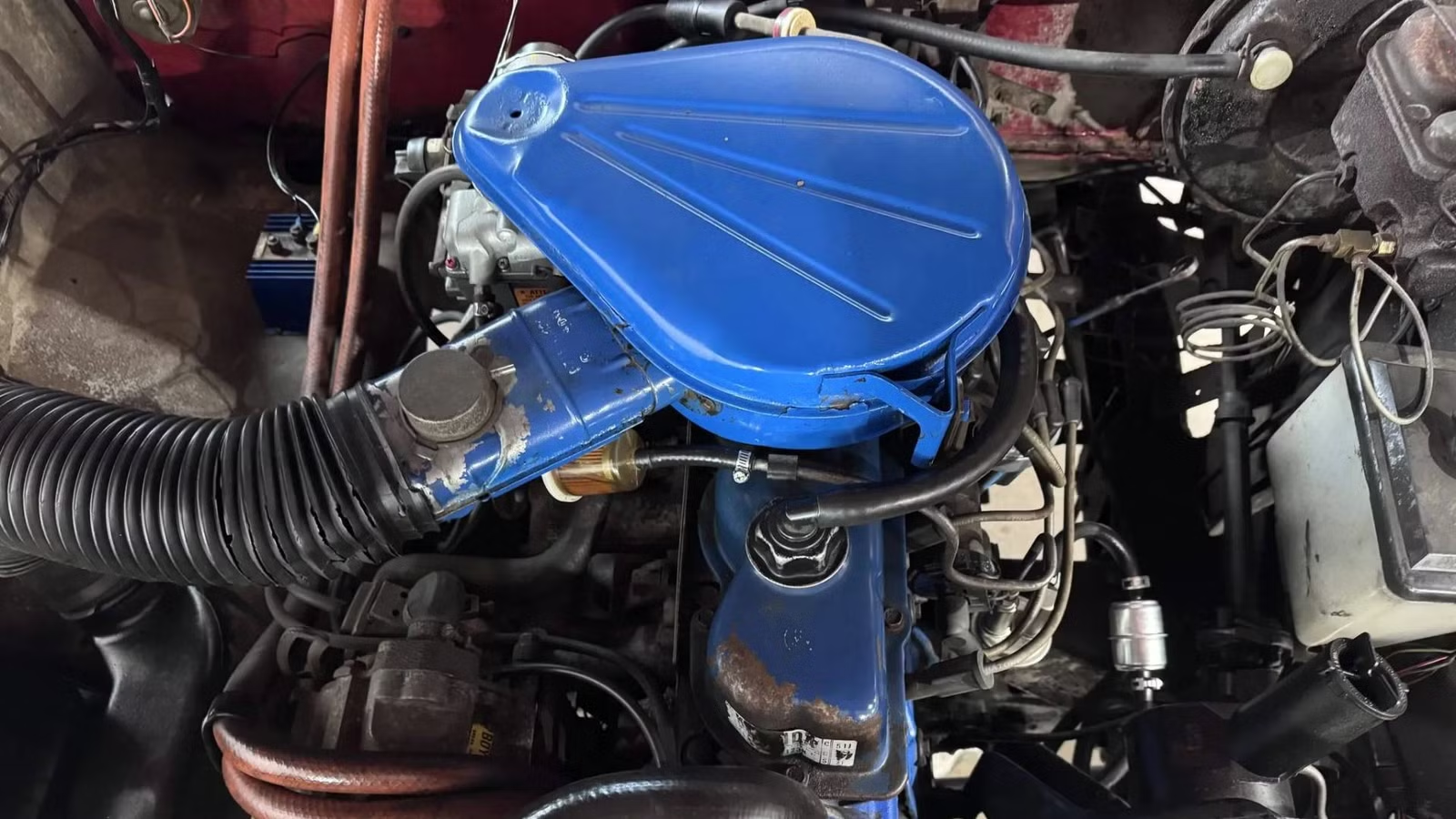
We measure an engine’s performance by the number of horses. Horsepower! When it comes to actual horses, there are breeds born to run and those bred to work. Engines are no different. You have power plants designed to put speed over everything, and mills built for torque and endurance. Much like a mule, an animal bred to be a beast of burden, Ford developed a seemingly unstoppable inline-six engine for its F-Series work trucks. It was engineered to put in long hours and endure the punishment of labor without losing power. So it’s no surprise that hot rodders eventually figured out that they could squeeze serious horsepower out of the engine block without breaking it.
Why Inline Six Engines Are So Good

Ford’s mighty inline-six engine isn’t a one-off. The entire concept of the inline-six engine is known for its timeless reputation for durable performance and longevity. This engine configuration can trace its roots back to the turn of the last century. Many will say BMW invented the first inline-six engine back in 1917, a massive 19-liter engine built for aviation. However, if you dig a little deeper in history books, you’ll notice this engine is even older.
Technically, the first naturally aspirated inline-six engine was developed by the Dutch company Spyker in 1903 as a purpose-built racing engine. In 1904, British automaker Napier developed the first mass-produced inline-six engine. But what makes the inline six so renowned?
Part of the reason is its simplicity. An inline-six engine only needs one cylinder head, one valve train, and one exhaust manifold. The simpler the machine, the more reliable it can be and the easier it is to maintain. Moreover, inline-six engines rely on a long stroke to generate powerful combustion. Because all the cylinders are aligned, it can produce its power more smoothly than a V6 or V8. As a result, while an inline six may take up more space in an engine bay, it makes up for it with smooth, strong and simple performance.

Ford’s “Big Six” Inline Six Engine

Ford introduced this legendary 300 cubic-inch inline-six engine for the F-Series pickup trucks in 1965. Ford dubbed this new inline six the “Big Six” because it was developed from a 240 inline six stroked to 300 cubic inches. At the time, this engine developed 170 horsepower and 283 lb-ft of torque. Apart from being marketed as a stout engine for work, it provided truck buyers with an alternative to the most expensive V8 option.
Ford kept the Big Six 300ci in production from 1965 until 1996. It became the base engine for F-Series trucks in 1975. But apart from being used in pickup trucks, the inline six found its way to power everything from wood chippers and irrigation pumps to farm tractors, snowplows, and even UPS delivery trucks. Basically, if a machine was needed to get a job done during the late 20th century, there was a good chance the Big Six powered it, ready to put in the miles and idle hours.
Common issues with this engine include the rear main seal leaking over time. The bolts on the exhaust manifold tend to back out and cause leaks. But these are minimal and easy fixes compared to the mechanical headaches and recalls plaguing many modern engines. It hasn’t stopped this engine from developing a “bulletproof” status among enthusiasts. When production of the 4.9-liter 300 eventually stopped in 1996, it was the last gas-powered inline six offered by Ford in a light-duty truck.
Producing 601HP From a 300ci Inline Six Engine Block

In 2025, PowerNation TV debuted a new series on its YouTube channel, called Engine Power. The show follows engine builders Frankie Forman and Pat Topolinski as they take on different projects. One of their first projects was seeing how much power they could turn from a stock Ford 300 inline six.
What they created was the ultimate Ford Big Six: a turbocharged 300 inline six that developed 601 hp on a stock engine block. Of course, this achievement wasn’t without a challenging amount of tuning and mechanical tinkering. The top of the 300 inline-six engine block had to be reinforced and fitted with hydraulic roller lifters, followed by a forged crankshaft, forged rods, custom racing pistons, and a custom billet camshaft.
The engine also received a stainless steel header exhaust manifold along with a set of Hypergate 45mm wastegates and a Turbonetics Sylvia 7268 turbocharger. On the dyno, the engine produced 555 hp and 623 lb-ft of torque on 12 psi of boost. But once they increased the boost to 16.5 psi, the 300ci inline six produced 601 hp and a whopping 702 lb-ft of torque. Not bad for a mule.
Straight Six Sleeper Potential

What this 601 hp inline six engine proves is what many engineers and hot rod engine builders have known for decades. These engines can do more than be put to work. Ford never marketed the Big Six 300 as a performance engine. Ford had a series of V8s intended for high-speed performance. In America, Ford’s inline-six variants were often marketed as fuel savers or workhorses.
As a result, this engine has earned a reputation for being “bulletproof” and for having sleeper potential. Of course, not everyone knows the hidden, untapped potential these engines are capable of producing. With the right set of parts, this engine can do anything, including winning. Scott Donohue proved this by winning the Baja 1000 not once but three times in a custom-built Ford racing truck powered by a 4.9L 300ci inline six.
Then there was the rare and impressive “Boss 300” engine built by drag racer Sherman Sligh, who modified a 300ci inline six to develop a claimed 625 hp. The build process involved boring out the 300 to 310, increasing the engine’s displacement to 5.1L. Along with a long list of modifications that involved titanium valves, a custom head, aluminum rockers, and a custom camshaft, among many others, as every nut and bolt required extensive work.
Don’t Judge an Engine by Its Cylinders

Ford’s 300ci inline-six engine may not have the speed or intimidating rumble of a V8, but it can kick like a mule. Those who judge this engine merely by its factory horsepower rating haven’t been educated on its legendary status. Meanwhile, those who have owned, tuned, and raced these engines will defend them as if they were speaking up for a dear friend. Nothing inspires loyalty like dependability, and that’s what makes Ford’s 300ci Big Six so highly regarded. It’s hard not to love something that never lets you down, especially if it makes 600 hp.
Source: PowerNation TV, Ford

Related posts



Latest Post


No Comments