
The JDM Toyota That Scared Mercedes Still Costs Less Than A Used Camry
JDM cars have become a big part of the global automotive culture and have become especially desirable in North America since many of them were never sold new here. We have spent countless hours and astronomical sums of money hunting down the poster cars of Japan’s golden era. But we’ve completely overlooked one of the most significant, disruptive, and uncompromising engineering achievements in automotive history. It is a machine that was made to beat the very best from Europe. It is an absolute masterclass in luxury, which shares its near-indestructible DNA with the legendary Lexus LS 400, but costs less than a used Toyota Camry.
Everyone Is Chasing JDM Performance Legends

The modern fixation on Japanese classic cars is nothing short of a cultural phenomenon. Go to any current car meet, scroll through social media or even auction sites, and you will most definitely see these cars being fully represented. The global automotive community has undergone a massive shift in how it views vintage Japanese cars as a whole and not just the poster cars. What were once affordable sports cars have now become highly valued collector-grade vehicles. However, not every Japanese sports car has the spotlight on them. The collective obsession is almost entirely on track-focused performance, leaving an entire segment of brilliant Japanese engineering in the shadows.
The JDM Market Has Become Obsessed With Horsepower

This explosion in values isn’t accidental; it is driven by an obsession with raw horsepower and tunability. Cars that fetch massive premiums today, like the R32 and R34 GT-Rs or the Mk4 Toyota Supras, earned their legendary status because their over-engineered powertrains could handle double or triple their factory power with just a handful of bolt-on modifications. The tuner culture of the early 2000s, amplified by movies and video games, turned these vehicles into status symbols.
When these cars started coming in, they were affordable, and there was something exciting about a ’90s JDM car beating a supercar with ease. Today, buyers willingly pay six figures to own a piece of that history, even on modified examples. The entire market has placed such a massive premium on performance that it has completely ignored cars engineered purely for luxury.

Toyota Built Something Even More Interesting For Japan Alongside Lexus

Back in August 1983, Toyota’s chairman, Eiji Toyoda, issued a secretive and incredibly bold challenge to his best minds: build a luxury sedan that would dethrone the undisputed kings of the premium market, targeting specifically the Mercedes-Benz S-Class and the BMW 7 Series. This directive kicked off the legendary F1 Project (Flagship One). Toyota spared absolutely no expense on this project.
The company deployed 1,400 engineers, 60 designers, and 2,300 technicians across 24 separate teams. They spent over a billion dollars developing roughly 450 flagship prototypes and nearly 1,000 experimental engines, logging millions of test kilometers in the grueling heat of Arizona and conducting speed tests on the German Autobahn. The result of this obsession was the export-market Lexus LS 400 that put the world on notice. A car so profoundly refined that it sent shockwaves through Stuttgart, forcing Mercedes-Benz to delay the launch of their own W140 S-Class to re-engineer it from the ground up.
Toyota Made A Superior Version For Japan Only

But while Western automotive journalists were busy losing their minds over the birth of the Lexus brand in 1989, Toyota was quietly building a parallel car back home. In the late 1980s, the Lexus brand did not exist in Japan; the luxury marque wasn’t formally introduced to the Japanese domestic market until 2005.
Toyota still needed a flagship to sell to its wealthiest domestic clients through its exclusive Toyopet Store dealer networks. The solution was to take the exact same billion-dollar F1 platform, apply the strict and uncompromising philosophy of the Lexus LS 400, and elevate it even further. They created a vehicle that wasn’t just a right-hand-drive clone of the export model; it was an even better, more advanced cousin meant solely for the streets of Tokyo and Osaka.
The Toyota Celsior Quietly Humiliated Mercedes

This brings us to the true hero of our story: the Toyota Celsior (XF10), which looked identical to the Lexus. Launched in October 1989 alongside its export twin (LS 400), the Celsior took its name from the Latin word meaning “lofty” or “elevated.” It was a true luxury car in every measurable sense, improving upon every aspect of the already phenomenal Lexus. When the Celsior debuted, it completely redefined what the industry thought was possible regarding NVH (Noise, Vibration, and Harshness) control.
While contemporary Mercedes-Benz models relied on brute force, heavy insulation, and massive doors to create a sense of isolation, Toyota used aerodynamic precision and mathematical engineering. The Celsior boasted a whisper-quiet cabin where you could hold a conversation in soft undertones while cruising at triple-digit speeds. At 60 mph, cabin noise was at 58 dB and would only go up to 74 dB at speeds above 124 mph. Its ride was so beautifully isolated that the car felt like it was floating above the asphalt, while offering build quality that put Europe’s finest to shame.
The Same Legendary 1UZ-FE V8 That Made The LS400 Famous

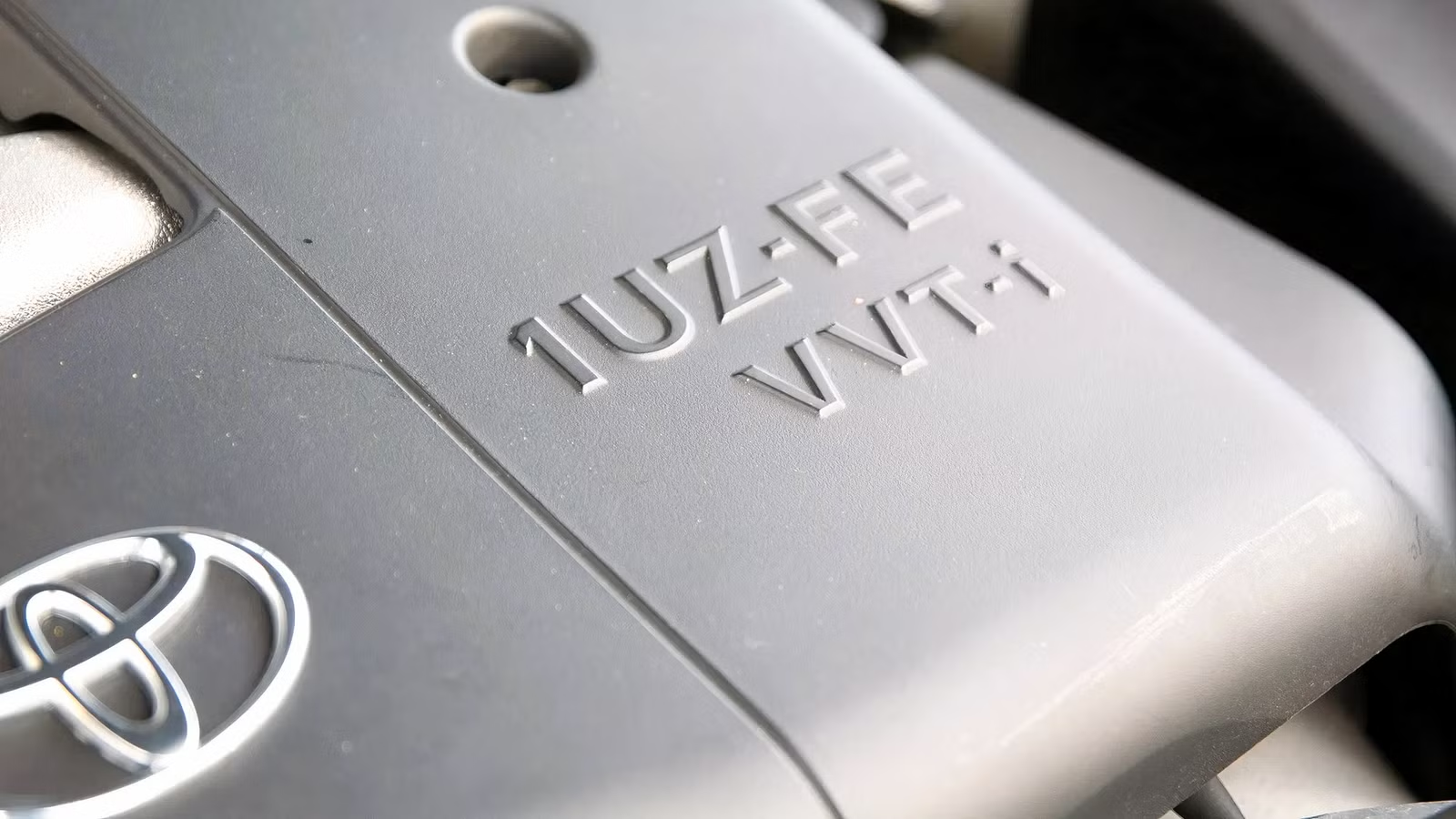
At the heart of the Celsior’s refinement was its powerplant: the legendary 1UZ-FE engine. This 4.0-liter, 32-valve, dual-overhead-cam V8 was a masterpiece of all-aluminum construction. Lexus did the famous champagne test with the LS400—a demonstration where a pyramid of full glasses rested perfectly still on the hood while the car accelerated up to 145 mph on a dyno. That stunt proved how smooth this engine could be.
Producing a smooth 250 horsepower and 260 lb-ft of torque, the 1UZ wasn’t built for performance; it was built for endless, uninterrupted longevity. It is an engine that could easily surpass 300,000 to 500,000 miles with nothing more than basic fluid changes and occasional timing belt replacements. Its inherent balance and over-engineered block meant that it delivered its power so smoothly it made traditional German V8s feel unrefined by comparison.
The Celsior Was Engineered For More Than Quiet Luxury

Where the JDM Toyota Celsior truly leaves its Western Lexus counterpart behind is in its staggering array of advanced technology. Because Japanese executives and buyers were highly tech-literate and willing to pay a premium for cutting-edge features, Toyota used the domestic Celsior as a testbed for options that the rest of the world wouldn’t get for another decade.
The top-tier Celsior “Type C” trim package came equipped from the factory with a revolutionary Piezo TEMS (Toyota Electronic Modulated Suspension) air suspension system. Unlike standard air bags, this semi-active setup used advanced piezoelectric ceramic sensors that read road irregularities in milliseconds, instantly stiffening or softening individual dampers to eliminate body roll during cornering or nose-dive during heavy braking. This is a feature Rolls-Royce is so proud of in its cars; this Toyota had an early version of it.
Furthermore, the Celsior introduced a primitive but highly functional laser-based radar cruise control system, hands-free cellular integration, and an optional GPS navigation system displayed on a color CRT screen. While export Lexus models almost exclusively used traditional leather or cloth, Japanese buyers could opt for ultra-premium Sakura (cherry blossom)-dyed wool or exceptionally soft, high-grade leather upholstery, transforming the interior into a private, rolling sanctuary. These extra features were never available on the LS400.
All The Luxury But None Of The Reliability Woes

Owning a luxury vehicle from the late 1980s or early 1990s is typically a recipe for financial ruin. If you purchase a classic BMW 7 Series or a Mercedes S-Class of this era, you are constantly fighting a losing battle against fragile vacuum lines, crumbling wiring harnesses, and catastrophic oil leaks. The Celsior completely flips this narrative. This platform consistently ranks as one of the least expensive classic luxury cars to keep on the road, simply because the underlying mechanical components were engineered to outlast their owners.
That said, you have to be realistic about keeping this classic JDM flagship running perfectly. You must look out for specific age-related quirks like the air suspension, which can leak or fail — no surprise given its age, and repairs are not cheap. Many owners convert them to standard Lexus LS 400 coil springs and struts for permanent peace of mind. Next, features like the power-tilting steering column, the LCD climate control displays, and the motorized instrument cluster needles can stick or fade over time. Otherwise, these are bulletproof cars.
The Toyota Celsior Might Be One Of The Smartest JDM Buys

The Toyota Celsior was a highly successful model with a production run spanning from 1989 all the way to 2006 across three distinct generations (XF10, XF20, and XF30) matching the evolutionary steps of the global Lexus LS lineup. Yet, despite its pedigree, many people outside Japan have no idea this car exists. Because it lacks the loud, aggressive sports-car styling that drives the typical JDM import market, the Celsior remains shockingly affordable. A clean, well-sorted, first-generation JDM Toyota Celsior has an average price right around $10,500.
To put that into perspective, an A80 Supra has an average price of $100,000 with some cars already crossing $200,000. R32 GT-Rs from the same time have an average price of $52,000, but clean cars regularly trade above that. Toyota pumped out roughly one million LS-series sedans for the global market over the years. The early JDM-exclusive Celsiors are rarer, with total Japanese domestic production accounting for only about 200,000 total units over its lifespan. The first-gen LS400s have an average price of $11,360, so with the Celsior, you are effectively acquiring a rare, low-volume JDM luxury car for the price of a commuter hatchback.
Collectors Are Finally Beginning To Notice JDM Luxury Cars

This car may not be so affordable for much longer; we are seeing a massive appreciation for high-end Japanese VIP cars. We have already seen the ultra-exclusive, V12-powered Toyota Century step out of the shadows, with pristine examples almost reaching $40,000.
Collectors, young enthusiasts, and smart investors are finally beginning to realize that the true peak of Japan’s bubble-economy engineering wasn’t just found in turbocharged sports cars, but executed perfectly in their executive flagships. The Toyota Celsior deserves to stand at the peak of that golden era. It is a vehicle that quietly humbled the proudest automotive engineers in Germany, offers uncompromised everyday reliability, and gives you a chance to own one of the greatest automotive engineering feats ever conceived, all for less than the cost of a mundane, modern used sedan.
Sources: Toyota, Lexus, JDMbuysell, Classic.com, Bring A Trailer,

Related posts





Latest Post


No Comments