
Wondering About CVT Reliability? These 10 Used Cars Tell The Story
CVT reliability has been a hot-button topic in automotive circles for years — and for good reason. The Continuously Variable Transmission promises smoother acceleration and better fuel economy than a traditional automatic, but a wave of high-profile failures left a lasting stain on its reputation. With used-car prices still elevated and buyers scrutinizing every purchase, knowing which CVT-equipped vehicles to trust has never mattered more.

Much of the distrust traces back to Nissan vehicles from 2003 to 2017, when transmission failures were widespread and costly. But many other automakers have also adopted the CVT — some with far better results. Is the hate warranted across the board, or is it largely a Nissan-specific problem? To find out, we examined a wide range of used vehicles equipped with CVTs, cross-referencing reliability scores with real owner feedback to determine just how bad the transmission can be — and whether some older cars actually got it right.
2018 Subaru Impreza
Reliability Score: 73/100
The Impreza is a nameplate historically associated with muddy roads and rally racing. Fitting it with a mild-mannered CVT was one of the clearest signals that its identity had shifted toward urban commuter duty. That’s not necessarily a bad thing — set nostalgia aside and you’ll find a genuinely capable family car. On the used market, examples typically list in the mid-teens.
Reliability

Very happy with the reliability. Extremely smooth ride. The CVT transmission is a bit “catchy” sometimes, but I think that’s just the nature of the kind of transmission it is… Overall, the Impreza is great.
Despite its modest reliability score of 73/100 on J.D. Power, owners tell a more encouraging story. Combing through owner reviews, we were hard-pressed to find anything genuinely negative about this model year. Reliability was rarely, if ever, cited as a concern.
- Average Yearly Maintenance Cost: $488 (RepairPal)
- Est. Maintenance Cost During The First 10 Years: $6,129 (CarEdge)
- Recalls: 5
- Worst Impreza Year To Buy Used: 2013
2016 Honda Civic
Reliability Score: 74/100

The Honda Civic has long been the go-to choice for budget-conscious buyers. When Honda made the switch to a continuously variable transmission, it was a natural fit for a small sedan built around efficiency and value. The Civic was fully redesigned for the 2016 model year, bringing a fresh look, updated technology, and a super-efficient 1.5-liter turbocharged engine into the mix.
Reliability
It took a month or so to get used to the CVT transmission, but eventually found the sweet spots and really never need to use sport mode because it’s unnecessary… No mechanical problems, runs like a champ. I love this car so much.
The Civic has always been considered one of the most reliable Japanese cars. When looking through owner reviews, not one mentioned that the CVT was a source of reliability issues. The main concern that people had with this model year was that some units shipped with faulty air conditioning systems — a problem that likely drags down the 2016 Civic’s J.D. Power quality and reliability score.
- Average Yearly Maintenance Cost: $339 (RepairPal)
- Est. Maintenance Cost During The First 10 Years: $5,620 (CarEdge)
- Recalls: 4
- Worst Civic Year To Buy Used: 2006
2013 Nissan Altima
Reliability Score: 76/100

Nissan is arguably the source of most people’s anxiety around CVTs. There were several years when transmission failures were rampant and owners were constantly dealing with expensive repairs. The Altima was redesigned for the 2013 model year and received meaningful upgrades that made it more enjoyable to drive — outside of its notoriously noisy CVT. Used examples can be found at relatively low prices, though buyers should factor in the transmission risk.
Reliability
…the “CVT” transmission on the Altima totally failed a month ago, the repair cost estimate for which exceeded $5,000. With just 110,000 miles on the odometer after ten years, this car should have been worth anywhere from $8,000 to $12,000. Instead, the CVT transmission failure essentially turned the car into scrap metal.
Nissan’s problematic CVT is the root cause of the Altima’s poor reputation from this era. Multiple owners reported transmission failures costing thousands of dollars out of pocket. These widespread issues prompted Nissan to extend warranties on vehicles built from 2003 to 2017, though most of those extended warranties have since lapsed. Newer Altimas have addressed the underlying problems and are now considerably more reliable.
- Average Yearly Maintenance Cost: $587 (RepairPal)
- Est. Maintenance Cost During The First 10 Years: $5,880 (CarEdge)
- Recalls: 10
- Worst Altima Year To Buy Used: 2013
2017 Nissan Versa
Reliability Score: 79/100

According to Nissan, 2017 marked the point at which the brand had turned the corner on its CVT troubles. The transmissions had been reworked, and the cars coming off the line were more dependable. The Versa is a prime example of a vehicle from this transitional period — a no-frills economy car built to keep running costs low, a reputation it upholds today. On the used market, the average price of one of these sedans sits at around $9,313.
Reliability
While some owners still complained about the CVT, the volume of issues was far lower than on earlier Nissan products. Most reliability complaints surrounding the 2017 Versa centered on the A/C compressor failing and general maintenance costs running higher than expected for an economy car.
- Average Yearly Maintenance Cost: $321 (RepairPal)
- Est. Maintenance Cost During The First 10 Years: $5,550 (CarEdge)
- Recalls: 3
- Worst Versa Year To Buy Used: 2009
2013 Lexus ES
Reliability Score: 84/100

While Nissan was struggling with CVT failures, other automakers were quietly proving the technology could work. The Lexus ES has long inspired confidence, pairing genuine luxury with above-average dependability. You can pick up the 2013 model year at an average price of around $14,936.
Reliability
I will suggest do an oil change every 3-4K miles for city/highway and do transmission fluid change every 3rd motor oil change after 70-80K miles on odo. In time change air filters and it should last a very long time.
Around 2013, CVTs still carried a stigma, and there are a handful of owners who expressed reservations about the transmission. With the Lexus ES, however, those voices are clearly in the minority. The overwhelming majority of owners praise the sedan as a dependable daily driver. We have a comprehensive guide to this Lexus ES generation and its reliability.
- Average Yearly Maintenance Cost: $492 (RepairPal)
- Est. Maintenance Cost During The First 10 Years: $5,571 (CarEdge)
- Recalls: 2
- Worst ES Year To Buy Used: 2007
2014 Toyota Corolla
Reliability Score: 84/100

If you ask most people which brand builds the most reliable cars, Toyota is almost always in the conversation. The Corolla is especially celebrated for its longevity and low running costs. The model was fully redesigned for the 2014 model year, and a CVT was offered as an option on certain trims. Used examples are widely available and generally affordable.
Reliability
My 2014 Corolla has 300,000km on it. Still has the original belt, rear brakes, and exhaust. I average about 47mpg on a road that allows me to drive 80km/h with the engine at 1,200 rpm. I drive a combination city/highway miles. I tow a trailer quite often. I plan on keeping this car for another 9 years / 300,000 kms.
The consensus is clear: the Corolla is an exceptionally reliable used buy. Owners regularly report high mileage with little to complain about beyond the interior’s budget feel. Corollas from this era are considered even more reliable than their newer counterparts.
- Average Yearly Maintenance Cost: $364 (RepairPal)
- Est. Maintenance Cost During The First 10 Years: $4,229 (CarEdge)
- Recalls: 2
- Worst Corolla Year To Buy Used: 2009
2020 Kia Soul
Reliability Score: 86/100

Jumping forward to a more recent example of the CVT done right, the quirky Kia Soul makes a compelling case. This compact SUV turned heads with a polarizing exterior design, but its value proposition is hard to argue with — Kia packed it with features at a price that undercuts most rivals. Many consider it one of the best first cars you can buy for a new driver. Used 2020 examples are available at competitive prices.
Reliability
The 2020 Soul is regarded as a solid, dependable compact SUV, and there are almost no complaints about its CVT — most owners say it feels indistinguishable from a conventional automatic. One significant caveat: a serious recall involving piston oil rings caused concern among owners. If you’re shopping for a used example, confirm that this recall was completed before purchase.
- Average Yearly Maintenance Cost: $437 (RepairPal)
- Est. Maintenance Cost During The First 10 Years: $7,182 (CarEdge)
- Recalls: 1
- Worst Soul Year To Buy Used: 2014
2018 Toyota Prius
Reliability Score: 86/100

When it comes to keeping running costs to an absolute minimum, the Prius is one of the strongest arguments on the market. Its efficient hybrid powertrain and legendary dependability make it a natural fit for high-mileage commuters. It may not quicken the pulse, but it’s comfortable, well-equipped, and remarkably easy on fuel.
Reliability
With over 65K miles on my 2018 Prius, I’m getting 52 mpg over the life of the car. No major mechanical problems.
It’s easy to poke fun at the Prius for being uninspiring, but finding an owner with a genuine complaint is nearly impossible. That speaks volumes about how dependable the hybrid is. The CVT is a non-issue in this application. Treat the Prius right and it’s capable of racking up some serious mileage.
- Average Yearly Maintenance Cost: $408 (RepairPal)
- Est. Maintenance Cost During The First 10 Years: $4,157 (CarEdge)
- Recalls: 1
- Worst Prius Year To Buy Used: 2010
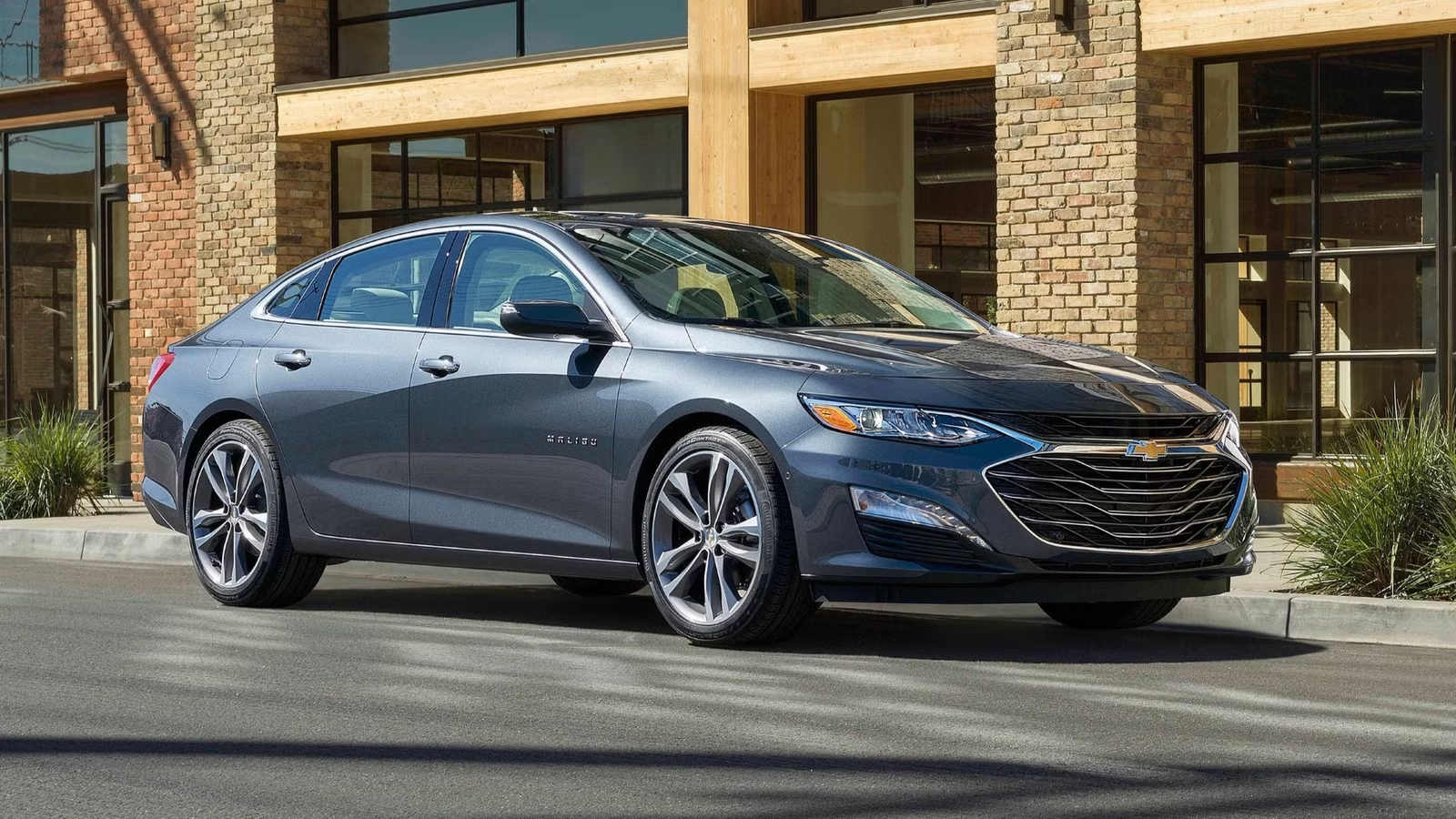
2019 Chevrolet Malibu
Reliability Score: 87/100

The Malibu is one of the few domestic entries on this list, and it represents Chevrolet’s attempt at an affordable family sedan with a long and storied nameplate. Unfortunately, the model has since been discontinued. The 2019 model year is essentially the same as the final version of the car, with only minor changes made in its closing years. Used examples can be found at competitive prices.
Reliability
I purchased the car with 22k miles on it, and the transmission went out at 40k. I got the transmission warranty replaced, which took 2 months, just for it to fail again at 81k miles. Warranty replaced again, and it’s slipping again at 90k.
Despite J.D. Power awarding the Malibu a high quality and reliability score, a meaningful number of owners report serious CVT trouble. Many buyers do manage to avoid major problems, but when the transmission does fail, it tends to do so catastrophically and at significant expense.
- Average Yearly Maintenance Cost: $532 (RepairPal)
- Est. Maintenance Cost During The First 10 Years: $6,642 (CarEdge)
- Recalls: 1
- Worst Malibu Year To Buy Used: 2004
2013 Nissan Murano
Reliability Score: 90/100

Topping our list is another Nissan from the brand’s troubled era. The Murano remains one of the most underrated used SUVs for value — a mid-size crossover that delivers a lot of vehicle for the money. The 2013 model year earns strong marks from J.D. Power and is considered one of the most reliable used mid-size SUVs in its price range.
Reliability
I bought a 2013 Murano 4 years ago. The car has 96,000 miles on it and the transmission is gone. Going to cost me $4,573 to have a rebuilt transmission in it and there is only a 1 year/12,000 mile warranty.
Owner reviews paint a mixed picture. Some Murano owners have reached relatively high mileage without any major transmission drama, while others have faced costly failures well before the 100,000-mile mark. It’s a familiar pattern for any Nissan or Jatco CVT from the 2003–2017 window — a roll of the dice that prospective buyers should weigh carefully.
- Average Yearly Maintenance Cost: $594 (RepairPal)
- Est. Maintenance Cost During The First 10 Years: $7,810 (CarEdge)
- Recalls: 1
- Worst Murano Year To Buy Used: 2005
Sources: OEMs, Cars.com, J.D. Power, Kelley Blue Book, Edmunds, RepairPal, CarEdge

Related posts





Latest Post


No Comments