
The Motorcycle That Gives Panigale-Level Attitude Without The Ducati Price

Ducati has consistently created drool-worthy motorcycles fit for bedroom posters. Often called the Lamborghini of the motorcycling world, Ducati inspires many aspiring riders. The Panigale lineup of sportbikes sits at the forefront of dreams; the streak began in 2011 with the Ducati 1199 Panigale. It’s the desirable fusion of grin-worthy performance, drop-dead-gorgeous looks, and exotic appeal that makes one forget its premium price tag, too.

However, what if a similar package is offered for a much cheaper price tag and without the Ducati badge and attitude? Sounds questionable, right? Well, it would have been a decade ago. But in 2026, we have an underdog European sportbike that hits all the right “exotic” spots: it’s a head-turner while remaining aggressively priced.
The Panigale V4 Is The Sportbike Everyone Wants — And Most Can’t Afford
What $27,795 Buys You: A Race-Derived V4 With MotoGP DNA
Few motorcycles make you crave riding them. The Ducati Panigale V4 tops this list with flying colors. It is a true showcase of peak Italian engineering and style. The Panigale V4 is a racebike for the road that diligently tames its monstrous side until one hits the racetrack. At its heart sits a menacing Desmosedici Stradale 90-degree V4 engine with Ducati’s legendary valve-train design.


This 1,103 cc mill is an extremely short-stroke design with a very high compression ratio of 14.0:1, which contributes to its exhilarating, aggressive character. This wheelie-popping monster produces 209 horsepower at 12,750 RPM and 89.5 pound-feet of torque at 11,250 RPM. This is one of the most powerful Ducatis ever made.

The chassis is also designed to be as rigid as possible while shedding as much weight as it can, thanks to its aluminum alloy construction. The hardware suite is top-spec, with fully adjustable Showa suspension and some of the largest brake rotors ever on a motorcycle, plus Brembo Hypure monobloc calipers lighter than the Stylema. All of this helps the Ducati Panigale V4 be featherlight with a curb weight of just 449 pounds.

Furthermore, even the base models pack commendable electronic features. Notable ones include a large 6.2-inch TFT, by-wire throttle, ride modes, power modes, traction control, wheelie control, slide control, engine brake control, and an electronically linked braking system. Its six-axis IMU lets all its assistive and performance-enhancing electronics work together seamlessly.
The ‘Ducati Premium’ Is A Double-Edged Sword

The Ducati Panigale V4 surely leaves very little to be desired. But that all-around appeal comes at a steep premium: $27,795 for the base Panigale V4. The price tag is well justified, and the riding experience will leave riders satisfied. But this expensive affair also limits its accessibility. Furthermore, high upkeep costs (especially with the notorious Desmo valve train) make owning this red-hot Ducati expensive as well.
So while the Ducati premium can offer an exotic riding experience like no other and make you feel special, the downsides are plentiful and, frankly, a burden for many riders without deep pockets. But what if a lesser-known Italian rival hit nearly every one of those Panigale highlights — at $8,000 less and with more horsepower? That bike exists, and it may already be the better buy.
Alternatives Are Plentiful But Not As Desirable And Exotic

Matching the Ducati Panigale’s exotic appeal is no small feat. This is also why many of its arch-rivals are still playing catch-up in putting the widest grin on the rider’s face. The BMW M1000RR is arguably one of its closest European rivals in terms of desirability and exotic appeal. Almost every body panel is made of carbon fiber to save weight, and BMW has packed the $35,395 M1000RR with top-spec, race-derived technology and a fierce inline-four producing over 200 horsepower. But despite all this, the base Panigale V4 scores higher with a much more affordable price tag, more power, and overall appeal.

Among Japanese rivals, the $28,999 Honda CBR1000RR-R Fireblade SP and the $27,899 Yamaha YZF-R1M match the Panigale’s aura. Both are the most powerful sportbikes each brand has ever made, but they still don’t break the 200-horsepower mark. Also, in terms of technology and exotic appeal, they fall short when compared to the mighty Ducati.

But an underdog rival from Aprilia hits all the right spots, just like the Ducati Panigale V4. It’s dramatic, powerful, and a head-turner. The RSV4’s tech suite is remarkable for its price tag of under $20,000. It is the Panigale V4’s kryptonite that deserves more attention.
The Aprilia RSV4 Undercuts Ducati By More Than $8,000 Without Cutting Corners
Aggressively Priced For A Flagship Sportbike At Under $20,000

With its recent 2025 updates, the Aprilia RSV4 has become much more desirable. Furthermore, its Panigale-level attitude doesn’t come with practical trade-offs such as extra-hot engines and clunky, slow riding experiences. A sharp, drool-worthy design, a technologically marvelous V4, and plenty of top-spec tech complete the RSV4’s Ducati-grade appeal.
The best part is its $19,699 price tag; that’s $8,000+ less than the base Ducati Panigale V4. Even loaded with most optional accessories, it will still be cheaper than the Panigale. That’s how value-packed this underrated Italian exotic is.
A Fierce V4 Offers Unmatched Performance

The Aprilia RSV4 is powered by a 1,099 cc 65-degree V4 engine that produces 217 horsepower at 13,000 RPM and 93.7 pound-feet of torque at 10,800 RPM. These grin-worthy numbers come from its short-stroke design and high-compression ratio. Power goes to the rear wheel via a six-speed manual paired with a slipper clutch. This engine also delivers aural drama with a MotoGP-spec exhaust note thanks to its cross-firing V4 layout. It’s also the most powerful production sportbike on sale, outperforming all its arch-rivals from Europe and Japan.
Underpinnings Designed For Precision Handling And Feedback

The RSV4 engine sits in a twin-spar aluminum frame that utilizes the mill as a stressed member. It is suspended on Sachs 43 mm fully-adjustable inverted front forks with 5.0 inches of travel. The rear gets a fully-adjustable Sachs monoshock with 5.1 inches of travel.
Braking duties are taken care of by dual 330 mm floating discs coupled to Brembo Hypure radial calipers. The rear gets a 220 mm disc coupled to a Brembo caliper. Grip comes from super-grippy tires wrapped around lightweight 17-inch cast wheels. Its focus on weight savings helps Aprilia trim things down and keeps the RSV4’s aggressive curb weight just under 450 pounds.
Panigale-Level Tech Standard — Not A $5,000 Upgrade

The 2025 update has also refined the RSV4 sportbike’s already stacked technology suite. Aprilia has loaded its flagship machine with assistive and ride-enhancing features. Notable standard ones include eight levels of traction control with integrated slide control, three ride modes, three levels of adaptive wheelie control, three engine maps, three levels of engine brake control, a two-way quickshifter, and cornering ABS.
Racebike-Inspired Design That Hits The Right Exotic Spots

The RSV4 has always had a distinctive design that sets it apart. It’s not loud, but not subtle either. And it still stands tall against the Ducati Panigale’s exotic appeal. Furthermore, with the 2025 updates, Aprilia also added more visual drama with MotoGP-derived aerodynamic winglets, a sleek, revised tail section, and refreshed fairings.

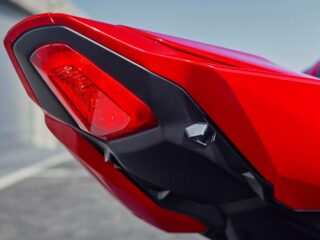
The rear section also gets MotoGP-like stegosaurus wings and a new fender-integrated tail lamp assembly. These offer modularity to declutter the RSV4 and transform it into a racebike without major tools. Beyond the new look, the visual elements also claim a six percent reduction in drag coefficient and an eight percent reduction in wheelie tendency. Rounding things out are two cool and contrasting shades (blue and yellow) with a more likable livery than the Ducatis.
Sources: Aprilia and Ducati

Related posts


Latest Post


No Comments