Why This Sports Car Refuses To Depreciate Like Everything Else
8 minutes reading
Saturday, 29 Aug 2026 19:00 0 32 autotech
Sports cars have a reputation problem when it comes to money. Buyers accept the tradeoff: blistering performance in exchange for a car that hemorrhages value the moment it leaves the dealership. But the Chevrolet Corvette has quietly rewritten that script. Kelley Blue Book projects the C8 Corvette will retain 61 percent of its original sticker price after five years, a number that puts it in the same conversation as certain pickup trucks and SUVs, not exotic coupes. Here’s why that figure matters and how the mid-engine Corvette pulled it off.
Depreciation is the quiet killer of sports car ownership. It rarely shows up in a brochure or a test drive, but it’s often the single largest cost of owning a car. It’s larger than fuel, larger than insurance, sometimes larger than the loan interest itself. Performance cars are usually the worst offenders.
Low production runs sound exclusive, but they also mean thin resale demand once the initial hype fades. Rapid model-year updates, shifting enthusiast tastes, and the simple fact that sports cars are driven hard and often modified, all conspire to accelerate value loss. A flashy coupe that stickers for $70,000 can easily be worth half that within three years.
A rear-end shot of a red 2026 Chevrolet Corvette Stingray at a golf courseChevrolet
Kelley Blue Book has noted that an average vehicle historically retains only around 37 percent of its original value after a five-year ownership period, and more recent data pegs the industry-wide figure closer to 45 percent. Sports and exotic cars frequently land below even that baseline, dragged down by high running costs, specialized maintenance, and buyers who trade in for the next new thing before the paint has a chance to dull. Against that backdrop, a sports car that holds onto anywhere close to 60 percent of its value is an outlier.
That’s exactly the category the Corvette has carved out for itself. Rather than following the sports-car script of steep early depreciation, the C8 generation has become something closer to a Toyota Tacoma in a Ferrari-esque body: a vehicle people actually want to buy used, which is the entire engine behind strong resale value. A vehicle people actually want to buy used, which is the entire engine behind strong resale value.
Exotic Looks Without The Exotic Depreciation
2025 Chevrolet Corvette C8 Stingray in Artic White front 3/4 shotChevrolet
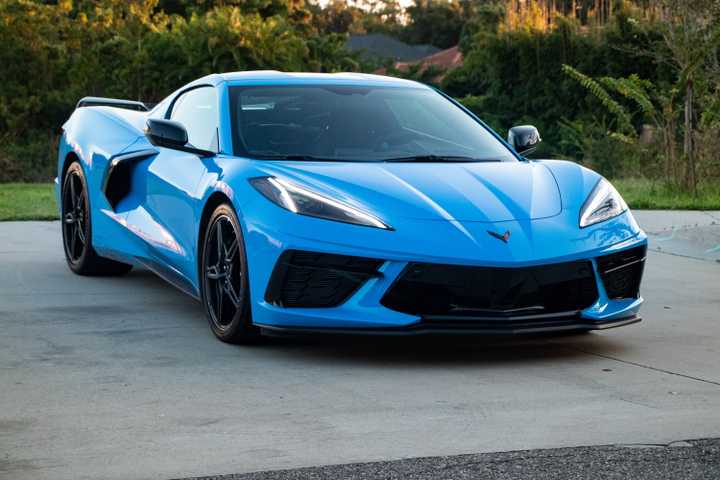
Park a C8 Corvette next to a used Porsche 911, an Audi R8, or a low-volume Italian coupe, and the styling conversation isn’t as lopsided as it once was. The C8’s mid-engine proportions, dramatic haunches, and low-slung stance read as genuinely exotic — the kind of car that draws phone cameras at a gas station. Yet its depreciation curve behaves nothing like the cars it visually competes with.
Exotic and near-exotic sports cars typically depreciate fast because their ownership costs scale just as dramatically as their looks. Specialized parts, dealer-only service networks, and finicky electronics all discourage buyers from taking on a car once the factory warranty expires, which craters used values. The Corvette avoids most of that trap.
Why The C8 Corvette Retains More Than 70 Percent Of Its Original Value After Three Years
A Driver’s Side And Rear 3/4 View Of A 2025 Chevrolet Corvette C8 Z06 In Sebring Orange Tintcoat Parked In Front Of A SunsetChevrolet
It’s serviced at any Chevrolet dealer, built on a platform GM can support at scale, and priced low enough at launch that even its five-year-old used values remain within reach of a broad buyer pool. Kelley Blue Book data has shown the 2021 Corvette losing only 27 percent of its value over three years — a figure that would be considered exceptional even for a mainstream sedan, let alone a 490-horsepower sports car with a starting price in the $60,000s. The result is a car that photographs like a European supercar but resells like a Toyota — But exotic looks alone don’t explain a six-year winning streak. The real story is what Chevrolet changed under the skin — and why that single engineering decision rewrote the Corvette’s entire value proposition.
How The Mid-Engine Formula Changed The Corvette
2026 Chevrolet C8 Corvette ZR1 Coupe Competition Yellow front 3/4 shotChevrolet
None of this happened by accident. When Chevrolet moved the Corvette’s V8 from the front to the middle of the chassis for the 2020 model year, it repositioned the entire nameplate. For 67 years and seven generations, the Corvette had been a front-engine American sports car competing largely on straight-line speed and value against cars like the Mustang and Camaro. The C8 changed the comparison set entirely, putting the Corvette in the same visual and dynamic conversation as the Porsche 911, Audi R8, and McLaren’s entry-level models, cars that often cost two to three times as much.
That Repositioning Did Wonders For Demand
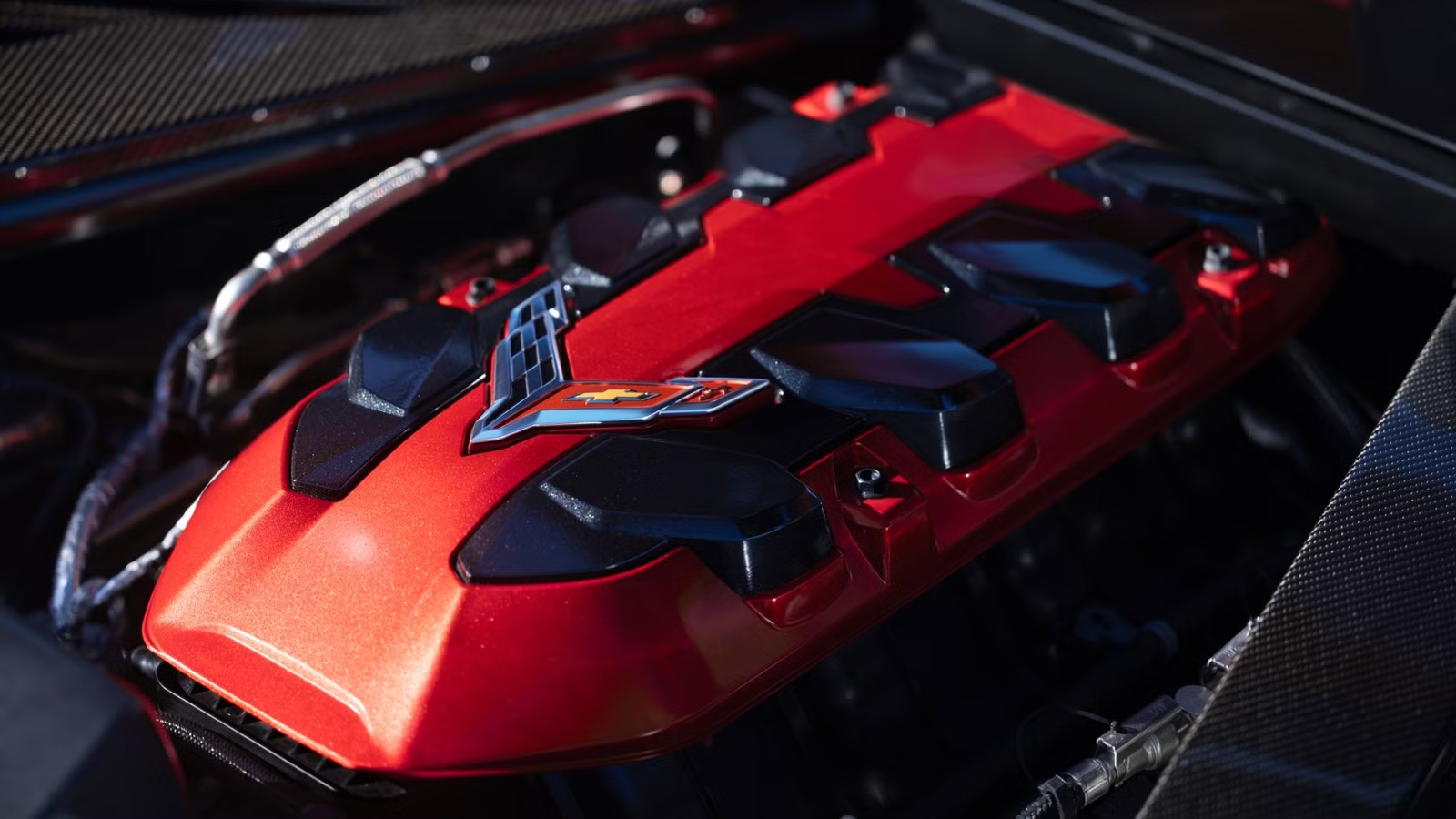
2026 Chevrolet C8 Corvette ZR1 engineChevrolet
The C8’s mid-engine layout, its first in 67 years of Corvette production up until 2020, is frequently cited as a major reason enthusiasts have gravitated toward these early models — and strong demand is the single biggest driver of strong resale value. Since launch, the C8 has posted a near perfect track record. The Corvette has earned a Kelley Blue Book Best Resale Value Award every year since its 2020 debut, an unusually consistent run in a segment where rapid technological change and shifting tastes typically punish long-term value.
The C7’s final year, by contrast, didn’t crack KBB’s top resale spot; it took the mid-engine switch to push the Corvette from a “great value performance car” into genuine best-in-class resale territory. The engineering decision made sense on paper — but the real proof is in the numbers. What does a 61 percent retention figure actually mean in dollars for the buyer sitting across from a finance manager?
Why 61 Percent Value Retention Matters To Buyers
Shot of 2027 Chevrolet Corvette ZR1X interior showing cockpitChevrolet
The specific number is worth sitting with. KBB’s analysis puts the 2025 Corvette’s projected five-year resale value at 61 percent of its original sticker price, based on 75,000 miles of typical ownership. That placed it second overall among every 2025 model-year vehicle sold in the U.S., trailing only the Toyota Tacoma’s 64.1 percent and putting the Corvette ahead of the average retention of 58 percent among the top ten vehicles on KBB’s entire list.
Translated into real dollars, the gap is significant. The average 2025 vehicle is projected to retain just 44.6 percent of its value after five years, meaning the Corvette holds onto nearly 37 percent more of its original value than the typical new car. On a Corvette Stingray stickering around $68,000, that difference is worth tens of thousands of dollars by the time a five-year ownership cycle ends, money that would otherwise simply evaporate the way it does with most performance cars.
That Matters For Three Distinct Groups Of Buyers
Rear 3/4 shot of 2027 Chevrolet Corvette ZR1X parkedChevrolet
For cash buyers, it means a lower true cost of ownership, even though the sticker price looks like a genuine sports car investment. For financed buyers, strong residuals reduce the risk of being underwater on a loan, which matters if life circumstances force an early sale. And for lease customers, high projected residual values directly translate into lower monthly payments, since a lease payment is essentially the gap between MSRP and projected resale value, spread over the loan term. In every scenario, higher retention means money staying in the buyer’s pocket.
The Performance Car That Makes Financial Sense
Put it all together, and the Corvette occupies a rare space in the automotive market: a genuine 490-plus-horsepower performance car that doesn’t ask buyers to accept crushing depreciation as the cost of admission. That’s historically been the trade sports car buyers had to make: thrilling to drive, painful to sell. The C8 generation has broken that pattern for six consecutive award cycles, backed by a value retention figure that beats most SUVs, sedans, and virtually every other performance car on sale.
The mid-engine redesign gets much of the credit, elevating the Corvette’s desirability into supercar territory while keeping its ownership costs and dealer network firmly mainstream. But the deeper lesson for buyers is about how resale value actually gets built: not through scarcity or hype, but through sustained demand meeting manageable ownership costs. The Corvette delivers both.
2025 Chevrolet Corvette E-Ray interior shot showing Digital DisplayWilliam Clavey | TopSpeed
For anyone weighing a performance car purchase today, the Corvette makes an increasingly rare argument: that you don’t have to choose between driving something genuinely exciting and making a financially sound decision. Few sports cars can say that with real data behind them.












No Comments