
Wilhelm Maybach’s Forgotten Role in Building the First Gas-Powered Motorcycle
You probably know the Maybach name as Mercedes-Benz’ subdivision that makes some of the most ultra-luxury cars out there. Think the GLS 600 SUV, S 680 4MATIC, or the SL 680 Monogram Series. But did you know that the very person Mercedes-Maybach is named after had a big hand in inventing (yes, inventing) motorcycles and internal combustion engines? That credit usually goes to Gottlieb Daimler, often regarded as the father of the automobile, but in our books, as in many historians’ books, Wilhelm Maybach is equally deserving of that title. Here’s the story of how Maybach helped develop the world’s first gas-powered motorcycle.

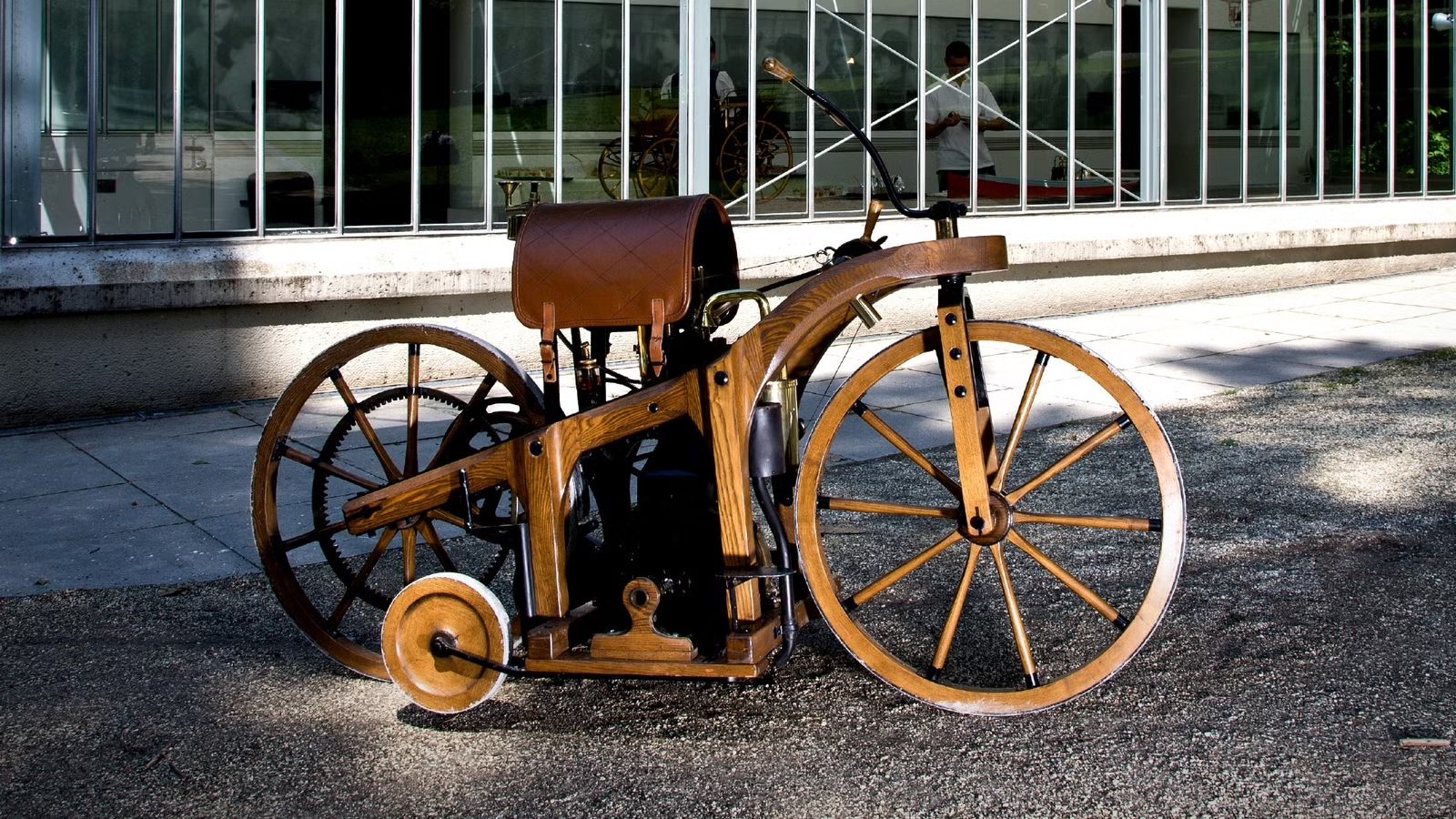
Since the original Daimler Reitwagen was completely destroyed in a catastrophic fire in 1903 at the Daimler-Motoren-Gesellschaft factory in Cannstatt, Germany, the images used here are of high-fidelity replicas.
The World’s First Gas-Powered Motorcycle: 1985 Daimler Reitwagen
Every motorcycle you’ve ever ridden, looked at, sneered at, or dreamt about traces its roots back to one particular motorcycle: the 1985 Daimler Reitwagen. Built by Gottlieb Daimler and Wilhelm Maybach, it is widely regarded as the world’s first motorcycle powered by an internal combustion engine. And yes, there were two-wheeled vehicles before this one, but the Reitwagen is generally considered the first motorcycle because of its ICE engine, which separates it from earlier steam-powered vehicles. Even the Oxford English Dictionary uses this criterion to describe the Reitwagen as the first motorcycle.
Half A Horsepower That Started It All


Also called the Einspur (German for single track), the Reitwagen was powered by a humble 264cc air-cooled single-cylinder 4-stroke engine that produced around half a horsepower at 600 rpm. That was enough to push the wood-framed motorcycle to roughly 7.5 miles per hour. Initially, the bike featured a single-speed transmission with a belt final drive, which was upgraded in 1986 to a two-speed belt primary and a pinion-gear final drive.
Its construction was pretty rudimentary by modern standards, with a wooden frame, wooden spoked wheels, iron rims, and a basic rear brake shoe. There was no suspension, either, and Daimler and Maybach fitted the bike with two jockey wheels to keep it upright at low speeds as it had no rake or trail. While it barely looks like a motorcycle today, it proved that a compact ICE could power a light, two-wheeled vehicle.
Why Earlier Vehicles Aren’t Technically Motorcycles

The Reitwagen wasn’t the first two-wheeled vehicle with an engine. Before it came machines like the Michaux-Perreaux or Sylvester Roper’s steam-powered velocipedes, both of which date to the late 1860s. There was also Lucius Copeland’s steam-powered vehicle of the 1880s. However, these featured steam engines proved to be a dead end for automobiles. And as Kevin Cameron of Cycle World points out, “History follows things that succeed, not things that fail.”
There was also Enrico Bernardi’s 1882 Motrice Pia, a gas-powered vehicle that predates the Reitwagen. However, it had three wheels, so it is as much a motorcycle as the Polaris Slingshot is. And yes, the Reitwagen also had jockey wheels, but historians argue that their use is justified, as it was due to the bike’s unemployed principles of rake and trail. So, with that logic, the Reitwagen is recognized as the first-ever motorcycle.
The Story Behind The World’s First Motorcycle

The Daimler Reitwagen earned Gottlieb Daimler a place in history as the father of the automobile. But if you dig a little deeper into the story, another name pops up: Wilhelm Maybach, for many historians. Maybach was the engineering mind behind some of Daimler’s greatest achievements, including the engine that eventually powered the Reitwagen. And here’s the story.
The Initial Years

Maybach was born in Heilbronn, Germany, in 1846. By the time he turned 10, both his parents had passed away, and he eventually ended up in an orphanage. By his late teens, he was working as a qualified designer at a local machine shop, specializing in stationary engines. There, his workshop manager, Daimler, then 29, noticed his efforts and took him as his main assistant. Maybach would hold that post and friendship until Daimler died in 1990.
In 1869, Maybach followed Daimler to Maschinenbau-Gesellschaft Karlsruhe AG, a manufacturer of heavy machinery and locomotives. Daimler had joined the company’s executive committee, and the two men spent hours discussing new ideas for engines and industrial machinery. This, however, was only the start of their partnership that eventually led to the Reitwagen.
Enter Nicolaus Otto

In 1872, Daimler moved to Deutz-AG-Gasmotorenfabrik in Cologne, then one of the world’s largest manufacturers of stationary gas engines. Maybach followed, becoming the company’s chief designer. There, the two worked with Nicolaus Otto, one of the era’s most important engine pioneers. In 1876, Otto patented the 4-stroke internal combustion engine that would become known as the Otto cycle. It established the basic 4-stroke operating principle still used by countless ICEs today.
But Daimler and Otto eventually disagreed on the direction the engine should take. Otto’s engines were designed primarily as large, slow-running stationary engines, but Daimler believed such engines could be sized down and used on vehicles. He wanted an engine that was smaller, lighter, and capable of running at much higher speeds. Due to the dispute, Daimler left Deutz in 1880, and Maybach soon followed him.
Building The Grandfather Clock

Together, they moved to Cannstatt and began working on developing a compact, high-speed internal combustion engine. Their first major breakthrough came in 1883 with a horizontal-cylinder engine that ran on petroleum naphtha. This was a fundamentally different approach from large stationary engines of the day, which typically operated at low speeds and were not designed to be compact. Daimler and Maybach wanted something that could run at around 600 RPM and be small enough to fit into a vehicle.
So, by 1884, Maybach had developed a new compact single-cylinder engine that would become the Standuhr, or Grandfather Clock, so named for its distinctive upright shape. The engine used several advanced features for its time, including a vertical cylinder, air cooling, hot-tube ignition, a large flywheel, and a camshaft-operated exhaust valve. And it ran at approximately 600 RPM when many contemporary engines operated at much lower speeds.
The Idea Was To Build An Automobile, Not Exactly A Motorcycle

The next step was simple: the pair had to put the engine into application and needed a testbed for it. Their goal wasn’t to develop a motorcycle at all, but the engine simply wasn’t yet powerful enough to move a full-size carriage. So, Maybach convinced Daimler to build a two-wheeled frame around the engine. In 1885, a smaller version of the engine was installed on the frame, which was patented as the Petroleum Reitwagen, or petroleum riding car. It became known simply as the Reitwagen, the world’s first motorcycle. This bike would earn Daimler the title of the father of the automobile.
The Forgotten Part Of The Story

Exactly who did what in the Daimler-Maybach partnership isn’t entirely clear. Daimler was undoubtedly the visionary. He understood the potential of compact, high-speed ICEs, but historical records also suggest that Maybach was often the one responsible for turning those ideas into reality. Put simply, Maybach handled all the practical engineering while Daimler came up with the ideas. Yet, we remember the world’s first motorcycle by Daimler’s name, not Maybach’s.
The Same Uncertainty Follows The Development Of Other Platforms

Some sources suggest that Daimler often took credit by only putting his name on the patents, which is also what would’ve happened with the Reitwagen. Another good example is that of the V-twin engine. Daimler is widely credited for developing the V-twin engine in 1889, one that would eventually become synonymous with Harley-Davidson. But the exact engineering contribution is less clear-cut. Some historical accounts credit Daimler, while others attribute much of the engine’s actual design work to Maybach.
The same uncertainty applies to the Stahlradwagen, or steel-wheeled car. Daimler and Maybach had already experimented with putting their engines into existing carriage-based vehicles, but the Stahlradwagen represented another step forward. It used a dedicated chassis designed specifically around the internal combustion engine rather than simply adapting an existing horse-drawn carriage. Some sources, again, credit Maybach with the chassis design, while others attribute the work to both Daimler and Maybach.
The Story Doesn’t End There

Both Daimler and Maybach would go on to adapt their engines for increasingly diverse vehicles, including carriages, boats, and experimental aircraft. But as Daimler’s ideas got more ambitious, Maybach continued to establish himself as one of the era’s most influential automotive designers. He would eventually earn the nickname King of Designers.
Maybach Also Developed The World’s First Modern Car

During that time, while working at Daimler-Motoren-Gesellschaft, Maybach also developed the honeycomb radiator, a design that dramatically improved cooling efficiency. Then, in 1990, Emil Jellinek, an influential customer and representative on the French Riviera, wanted a faster, more capable automobile. He believed there was a good opportunity there. And so, Maybach designed the automobile and Jellinek named it after his daughter: Mercedes 35 PS, a machine widely regarded as one of the world’s first modern automobiles.
The designer who helped develop the world’s first motorcycle with an internal combustion engine also helped create Mercedes, later known as Mercedes-Benz. And perhaps we owe him an apology. Without his engineering, you probably wouldn’t be riding motorcycles today, and we certainly wouldn’t be here writing about them. Our lives would’ve looked very, very different, although admittedly, we’d probably have a bit more money in our bank accounts.
Source: Mercedes-Benz, Cycle World, Maybach Foundation, etc.

Related posts


Latest Post


No Comments