
The Suzuki Dual-Sport That Refused To Die For More Than A Quarter-Century
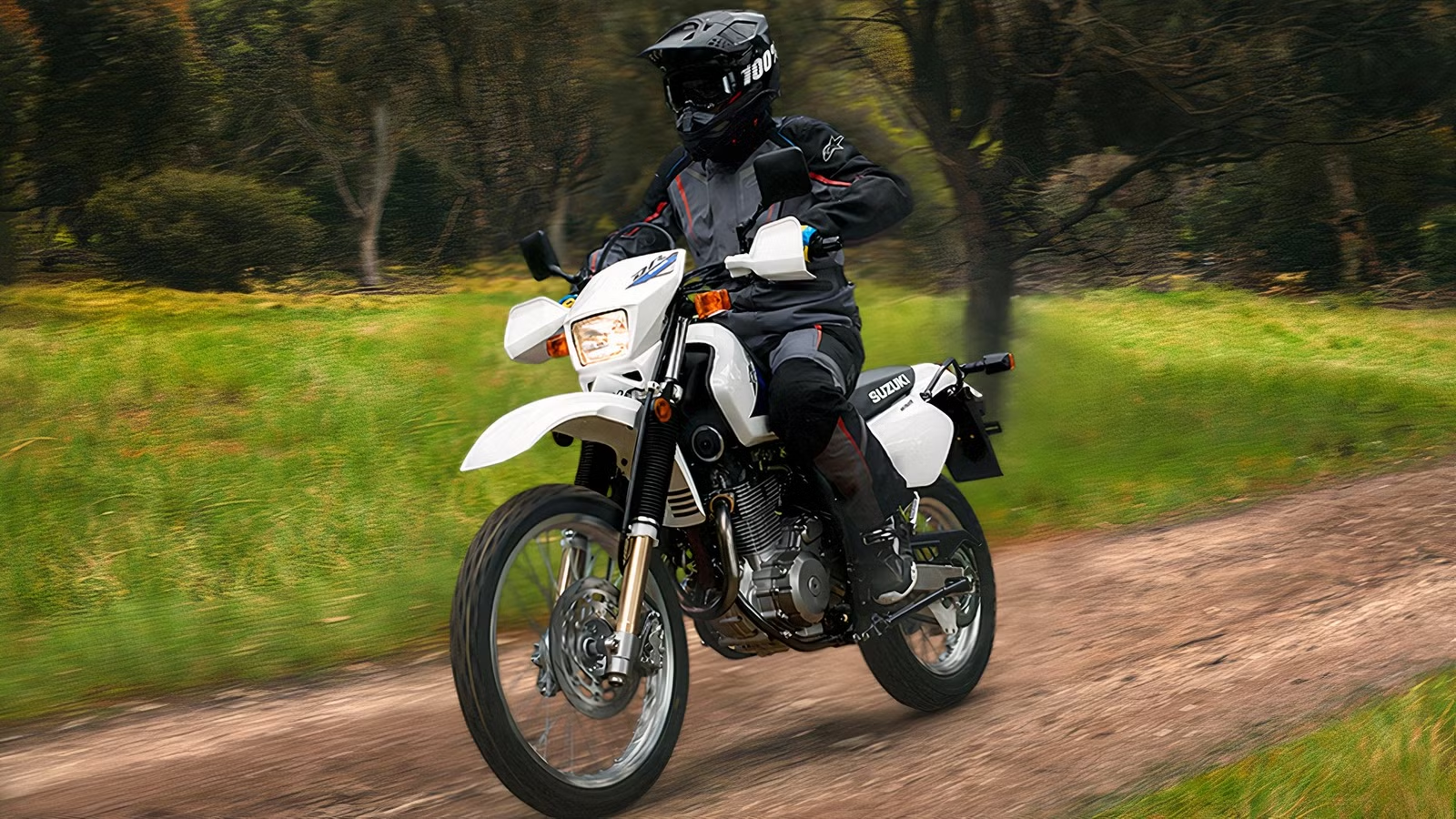
Motorcycles have changed enormously over the last few decades. Sure, they still have two wheels, an engine, and a seat, but they’ve evolved far beyond just the base parts. But progress for progress’ sake isn’t always good, and sometimes the best bikes are the ones that get the basics right. They don’t always have to be the fastest, newest, or most advanced. And this bike proves that once you’ve found the right formula, you don’t need to change.
When Motorcycles Were Built To Be Used, Not Just Sold

Motorcycles haven’t always had the myriad systems they come with today, nor did they always have technology that could rival a car. Time was, all a rider needed was a couple of dials and a throttle and they were good to go. And this was especially true of dual-sport bikes. Practical enough that they could be used on the daily commute to work through the week, yet durable enough that you could blast down a dirt road on the weekend, and enjoy both just as comfortably.
It was a simple formula: take a single-cylinder engine, some long-travel suspension, a 21-inch front wheel, sensible gearing, and the parts it needed to make it street-legal. It didn’t make for an especially sophisticated bike, but it didn’t need to be. All it needed to be was strong and versatile.
The late 1980s and early 1990s were also a time when manufacturers weren’t necessarily concerned about living on the bleeding edge of technology. Some bikes obviously did forge forwards – bikes like the Honda NR750 and its oval-shaped pistons, the Yamaha FZR1000 EXUP with its innovative exhaust-valve system, or the Bimota Tesi 1D and its swingarm suspension – but, for the most part, it was reliability, serviceability, and simplicity that mattered most.

The Motorcycle Industry Moved On, But One Formula Didn’t

The new millennium saw dual-sport motorcycles start to change. Carburetors were replaced by fuel injection, emissions regulations were more restrictive, and electronics were becoming far more commonplace. Bikes were faster and smoother, but they were also vastly more complicated.
Technological improvements are usually largely welcomed. The Honda CB750 was a game-changer that ushered in a new era of superbikes and devastated the British industry. The Suzuki Hayabusa destroyed production-bike speeds and effectively ended top-speed competition between manufacturers, and the Ducati Monster proved that minimalist styling could still have mass-market success. But in the dual-sport market, some still wanted simple machines that could do multiple jobs and not complain. Modern adventure bikes, arguably started by the BMW R80 G/S in 1980, were filling the gap, but were also going the way of the industry at large in becoming more complicated. Older designs were also getting revamped, and the previously no-frills dual-sport section became increasingly complicated.
But while the rest of the industry worked on keeping up with a changing formula, there was one bike that stood out for its refusal to do so. This bike didn’t chase anything more than it had, stubbornly staying rooted in the past. And it became a legend because of it.
Meet The Suzuki DR650: The Dual-Sport That Refused To Die

Some bikes go through so many changes in their life cycle that they’re almost unrecognizable by their last iteration. The Honda Goldwing, for example, started as a 999 cc flat-four with minimal bodywork and morphed into a 1,833 cc behemoth, while Harley-Davidson’s 2021 Sportster was a far cry from what the bike first looked like in 1957. It’s normal to see change, as long production runs and competition force manufacturers to rethink their offerings. But Suzuki didn’t do this with the DR650.
The DR650 was first introduced in 1990 with a 644 cc single-cylinder engine, and was a more road-focused take on the preceding DR600. But after six years it received an overhaul, becoming the DR650SE.
The bike was already somewhat old-school: it retained the 644 cc single-cylinder, air-cooled engine, which was mounted to a five-speed gearbox and placed inside a straightforward chassis that prized simplicity, reliability, and durability. There was no big fairing up front, no additional riding modes, nothing unnecessary at all. There was just long-travel suspension, a 21-inch front wheel, a 366-lb wet weight, and 43.5 horsepower to play with. And while play was something the bike could handle, sensible commutes were also within its wheelhouse.

A dedicated dirt bike is brilliant off-road but, if it’s even road-legal, you wouldn’t want to ride one 30 miles to work. Likewise, adventure bikes are perfect for mile munching, but their considerably larger size can hold them back as soon as the trails get tighter. The DR650SE was just 34.1 inches wide, while adventure bikes like the Honda NX650 Dominator and Kawasaki KLR650 were 35 inches and 37 inches wide respectively.
But the key to the DR650SE was in its simplicity. A single-cylinder engine isn’t exactly the most sophisticated way to power an engine, especially compared to some of the other bikes of the time. However, it does vastly reduce the number of moving parts. The weight was another factor, with the bike being lighter than both the aforementioned Honda and Kawasaki and having nothing extra that it didn’t need. The bike didn’t pretend to be something it wasn’t; it, and Suzuki, knew exactly what it was. It was a simple, hard-working bike that could tackle any mission a rider had in mind for it, and do so with aplomb.
But while the usual life cycle of a machine is an initial run before necessary changes are made, this isn’t the case for the DR650. Following that initial 1996 redesign, there’ve been resoundingly few changes, and that 1996 formula is still recognizable in today’s bikes. And why shouldn’t it be? Suzuki hit the nail on the head when it made the DR650SE, and it’s exceedingly hard to improve on something great. There’s no sequel to Citizen Kane, no The Great Gatsby 2: The Greater Gatsby. And there’s no successor to the DR650SE.
Why The DR650 Became The Motorcycle You Could Take Anywhere

By its very nature, a dual-sport bike isn’t solely focused on one task — and therein lies its strength. The DR650 wasn’t the absolute best at anything it did, but it was good enough at multiple things to justify itself. It was also a good base, giving riders a starting point to make it more catered to what they’re after. Parts can be added or swapped, sure, but requiring little to actually keep the bike going makes it a perfect companion when concrete becomes dirt and supplies become limited.
Take Suzie and Kelvin Prevett, for example. They used two DR650s on a two-and-a-half-year adventure across South America. Jamming Global did a two-year, 100-000-mile Continental Divide trip atop one. Forums are full of riders sharing stories about how their bike took them where they needed to go regardless of the terrain, and the bike still wanted more.
Of course, doing multiple jobs well means it’s not going to be perfect. The 644 cc engine means it’s not necessarily great at highway speeds, while adventure bikes (by design) offer far more technological aids for the modern rider. But that’s not why someone buys a DR650. They buy one because both their bike and the bike in general just keep going.
The DR650’s Greatest Achievement Is Simply Still Being Here

In a world that requires constant stimulation and thrives on “new”, the DR650 lives on its ability to survive already in its final form. Suzuki doesn’t need to keep bringing out new versions, and riders don’t need to keep upgrading every year. The people who buy them aren’t impressed by an extra two horsepower, or a new system, or having another 6 oz shaved off the last model. It’s the complete opposite.
The DR650 doesn’t live on a spec sheet; it lives on allowing riders to experience what they want without issue. It helped the bike to enter its 30th year largely the same as it entered its first, marking incredible longevity for, at its core, a very basic bike.
The DR650 isn’t here today because it kept changing. It’s here because it knew what it needed to be, and it’s stuck with that all these years later.
Sources: Trail, Jamming Global

Related posts




Latest Post


No Comments