
What A Million-Mile EV Battery Would Mean For Used-Car Buyers
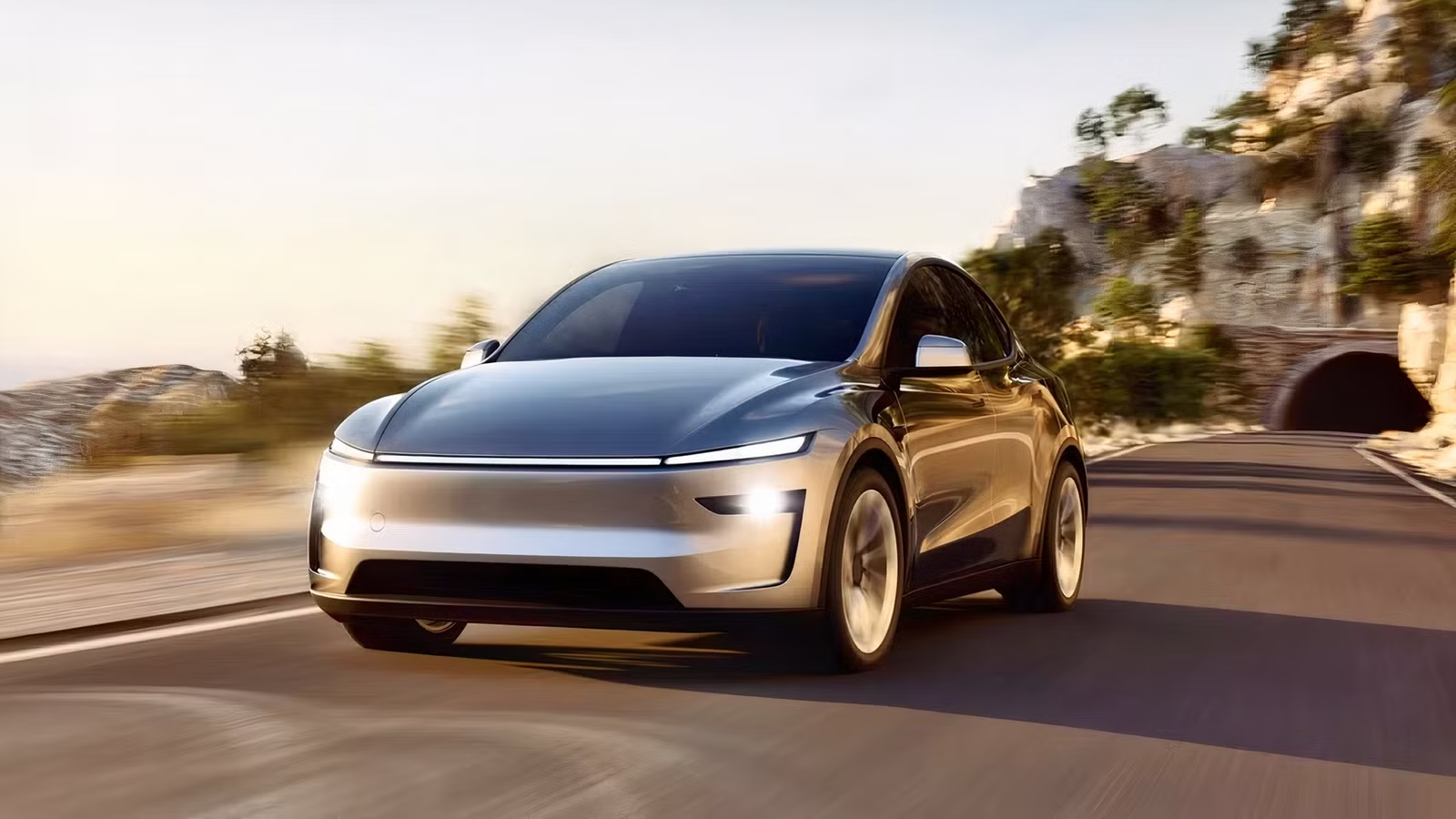
The electric car industry faces significant secondary-market friction due to the financial and practical uncertainties of battery degradation. Unlike internal combustion engines, which experience incremental wear across numerous replaceable components, high-voltage battery packs represent a singular, highly concentrated point of financial exposure.

Standard lithium-ion chemistries suffer capacity loss from thermal stress, fast-charging cycles, and simple calendar aging. When remaining battery health drops to 70 percent, usable driving range drops drastically while charging frequency increases. Because complete pack replacements often exceed the residual value of older vehicles, consumer fear of out-of-warranty failures accelerates initial depreciation and restricts access to affordable pre-owned electric transport.
The Million-Mile Battery Makes EVs More Trustworthy
The concept of a million-mile electric vehicle battery introduces a total restructuring of ownership economics, depreciation curves, and consumer behavior. For decades, the pre-owned vehicle market has functioned under the assumption that mechanical components degrade predictably over time and distance.

Internal combustion engine vehicles lose market value as they cover more miles because internal components, transmission assemblies, and auxiliary friction surfaces face cumulative wear, typically resulting in costly repair requirements. Electric vehicles introduce a different layer of depreciation uncertainty centered entirely on high-voltage battery degradation.
This has resulted in buyers approaching pre-owned EVs with more caution. Out-of-warranty battery pack failures often exceed the total residual value of the car, further impacting depreciation rates. A battery with a million-mile lifespan removes this fundamental financial risk, shifting consumer priority away from high-voltage chemistry health and back toward traditional automotive condition markers.
Why Modern Batteries Start To Fade After 100,000 Miles

Standard lithium-ion chemistries, such as nickel-manganese-cobalt formulations, experience capacity loss through chemical side reactions, lithium plating, and solid electrolyte interphase layer growth over repeated charge-discharge cycles. Fast-charging events, extreme thermal conditions, and high states of charge accelerate this process.
A pack operating at 80 percent of the original capacity alters usable driving range, forces more frequent charging stops, and introduces thermal management burdens during peak demand. The threat of total module failure hangs over the transaction, creating steep initial depreciation curves for first owners, while restricting access to affordable, reliable transport for all owners that come after.
Improving Consumer Trust In EVs

A million-mile energy storage architecture alters this financial dynamic by extending chemical cycle life far beyond the structural lifespan of standard automotive platforms. Advanced lithium iron phosphate chemistries, solid-state electrolyte integration, and refined single-crystal cathode designs enable thousands of full discharge cycles with minimal capacity loss.
If a battery retains 90 percent of its original storage potential after 1,000,000 miles, the battery should no longer be considered a consumable component. For used-car buyers, the primary advantage shifts directly to financial predictability and long-term asset security. Historically, buying a high-mileage internal combustion vehicle involves calculating upcoming mechanical maintenance schedules, including timing belt replacements, head gasket repairs, transmission rebuilds, and catalytic converter replacements.
Electric powertrains already eliminate the majority of these reciprocating components, leaving the high-voltage battery as the single highest financial vulnerability. Eliminating battery degradation anxiety simplifies the pre-owned inspection process. Buyers no longer need specialized diagnostic software to measure individual cell voltage differentials or estimate remaining chemical life. The vehicle’s high-voltage energy storage system becomes as reliable as the structural frame members supporting the suspension.
Better Batteries Change How EVs Are Viewed In The Used Market

This longevity dynamic completely restructures traditional vehicle valuation models, particularly high-mileage pricing floors. In conventional automotive markets, passenger vehicles with 200,000 or 300,000 miles approach scrap value regardless of overall cosmetic condition, primarily due to cumulative powertrain wear. A million-mile battery creates a solid residual value floor for pre-owned electric vehicles. Even if an electric car covers 250,000 miles over a decade of continuous operation, its energy storage system maintains near-original performance specifications.
Consequently, second-hand buyers secure reliable transportation at lower price points without sacrificing practical driving range or facing catastrophic repair liabilities. The shift in component longevity forces a major reallocation of pre-owned vehicle inspection priorities. When the high-voltage pack retains its integrity to this extent, secondary wear components take center stage during pre-purchase evaluations. Mechanical friction points, including control arm bushings, ball joints, shock absorbers, wheel bearings, and steering rack assemblies, evolve into the new indicators of vehicle health.
Similarly, body structure integrity, rust prevention, paint condition, thermal management fluid circulation, and interior cabin wear determine residual pricing. Buyers focus their attention on traditional chassis maintenance rather than evaluating complex chemical degradation curves or thermal stress histories within the battery management system.
Improving Accessibility To The Mass Market

The presence of ultra-durable battery packs also expands access to affordable personal mobility across lower-income demographic segments. Under current market conditions, budget-conscious consumers often buy older internal combustion vehicles with elevated mileages, exposing themselves to unpredictable maintenance costs and volatile fuel prices. A pre-owned electric vehicle featuring a million-mile battery provides a low-operational-cost alternative. Charging costs remain lower per mile than internal combustion fuel consumption, and electric drive units require minimal routine servicing. Combining low operational expenses with an indestructible energy storage system provides economically vulnerable households with highly stable, low-maintenance transportation solutions.
Extended battery lifespans also disrupt traditional financing, leasing, and insurance structures within the pre-owned market. Financial institutions construct loan terms around projected vehicle depreciation and asset security. Because conventional electric vehicles face uncertain long-term battery health, lenders often assign higher interest rates or shorter loan terms to high-mileage pre-owned units to offset financial risk. A certified million-mile battery allows lenders to extend loan terms across high-mileage electric vehicles with confidence, knowing the underlying powertrain retains its core value. Lower monthly loan payments make second-hand electric vehicles accessible to a broader range of buyers, stimulating overall secondary market liquidity.
Fleet Vehicles Become More Viable Used Options

Beyond personal ownership dynamics, ultra-durable batteries create new opportunities within the commercial fleet and ride-hailing sectors. High-mileage fleet operators, including taxi services, delivery companies, and mobile rideshare platforms, depreciate assets rapidly based on accumulated distance. Fleet vehicles entering the secondary market often carry 150,000 to 300,000 miles accrued within just a few years of operational service. Under current conditions, the used market steers clear of ex-fleet electric vehicles due to extreme battery cycle counts and fast-charging stress. A million-mile pack allows former commercial vehicles to enter the retail used market as reliable personal vehicles. Despite high odometer readings, these vehicles retain full utility, offering buyers heavy discounts on chassis pricing without compromising daily range capabilities.
The environmental impact of this technology extends deep into secondary asset utilization and circular economy models. Traditional vehicle manufacturing carries a significant carbon footprint, with battery production accounting for a large portion of an electric car’s initial embodied emissions. Extending the operational life of a battery to one million miles spreads these production emissions across hundreds of thousands of additional driving miles, dramatically lowering the vehicle’s net lifetime environmental impact. Furthermore, when the surrounding vehicle chassis eventually succumbs to structural fatigue, road salt corrosion, or body damage after several hundred thousand miles, the million-mile battery remains fully functional. This enables straightforward pack repurposing into secondary applications, such as stationary energy storage grid support or residential solar storage systems, without requiring immediate recycling or chemical reprocessing.
Noteworthy Concerns Regarding Long-Life Batteries

Technological stagnation risk represents one of the few counter-arguments confronting used-car buyers considering a high-mileage vehicle with an ultra-durable battery. While a million-mile battery ensures chemical durability, it locks the vehicle into the specific energy density, charging speed, and software architecture of its manufacturing era.
A 10-year-old electric car with 300,000 miles might possess a healthy battery, but it still relies on legacy charging systems or lower peak charging rates compared to newly manufactured models. Second-hand buyers must balance the durability of the energy storage system against rapid advancements in charging infrastructure speed, vehicle connectivity, active safety systems, and overall vehicle efficiency.
Battery Faults Will Be Easier To Diagnose And Resolve

Vehicle repairability and modular component replacement also adapt in response to ultra-long-life batteries. In early-generation electric vehicles, isolated module failures often trigger complete battery pack replacements due to sealed construction and high labor costs. As manufacturers design packs intended for million-mile lifespans, structural repairability becomes a core engineering objective. High-voltage enclosures feature accessible bus bars, modular cell arrays, and replaceable contactors. Used-car buyers benefit from this design approach because minor electrical faults can be serviced independently at reasonable costs without having to replace the entire energy storage unit.
The introduction of a million-mile battery also reshapes aftermarket support networks and independent repair capabilities. Independent mechanics and automotive technicians shift their focus from complex engine rebuilds to high-voltage system diagnostics, thermal fluid maintenance, and chassis reconditioning. Training standards adapt to prioritize electrical safety, control module flashing, and mechanical suspension overhauls. As high-mileage electric vehicles become commonplace on secondary markets, the widespread availability of independent repair options further drives down total ownership costs for subsequent buyers.
It Changes The Way Consumers View EV Ownership

The psychological impact on consumer purchasing behavior represents one of the most significant changes stemming from million-mile battery adoption. Car buyers traditionally hold deep-seated anxieties regarding high odometer readings, viewing 100,000 miles as a major psychological threshold that signals impending mechanical breakdown. High mileage no longer automatically signals an expiring vehicle. Instead, buyers evaluate vehicles based on physical wear, component care, and documented maintenance histories, normalizing the purchase of 200,000-mile or 300,000-mile vehicles for daily commute duties.
Ultimately, the deployment of million-mile electric vehicle batteries redefines the economics of the pre-owned automotive market. By eliminating battery degradation as a primary financial risk factor, this technology stabilizes vehicle depreciation, lowers entry barriers for budget-conscious consumers, and extends the operational lifespan of personal mobility assets. Used-car buyers transition from a position of financial vulnerability to one of long-term asset security, backed by powertrains built to outlast the very chassis they propel. As these ultra-durable energy storage systems filter into the secondary market, the traditional relationship between vehicle mileage, financial value, and operational reliability is permanently transformed.
Sources: Wheels, The Electric Car Scheme, and eCarsTrade.

Related posts




Latest Post


No Comments