
The Bike That Delivers Sport Bike Performance Without Sport Bike Ergonomics
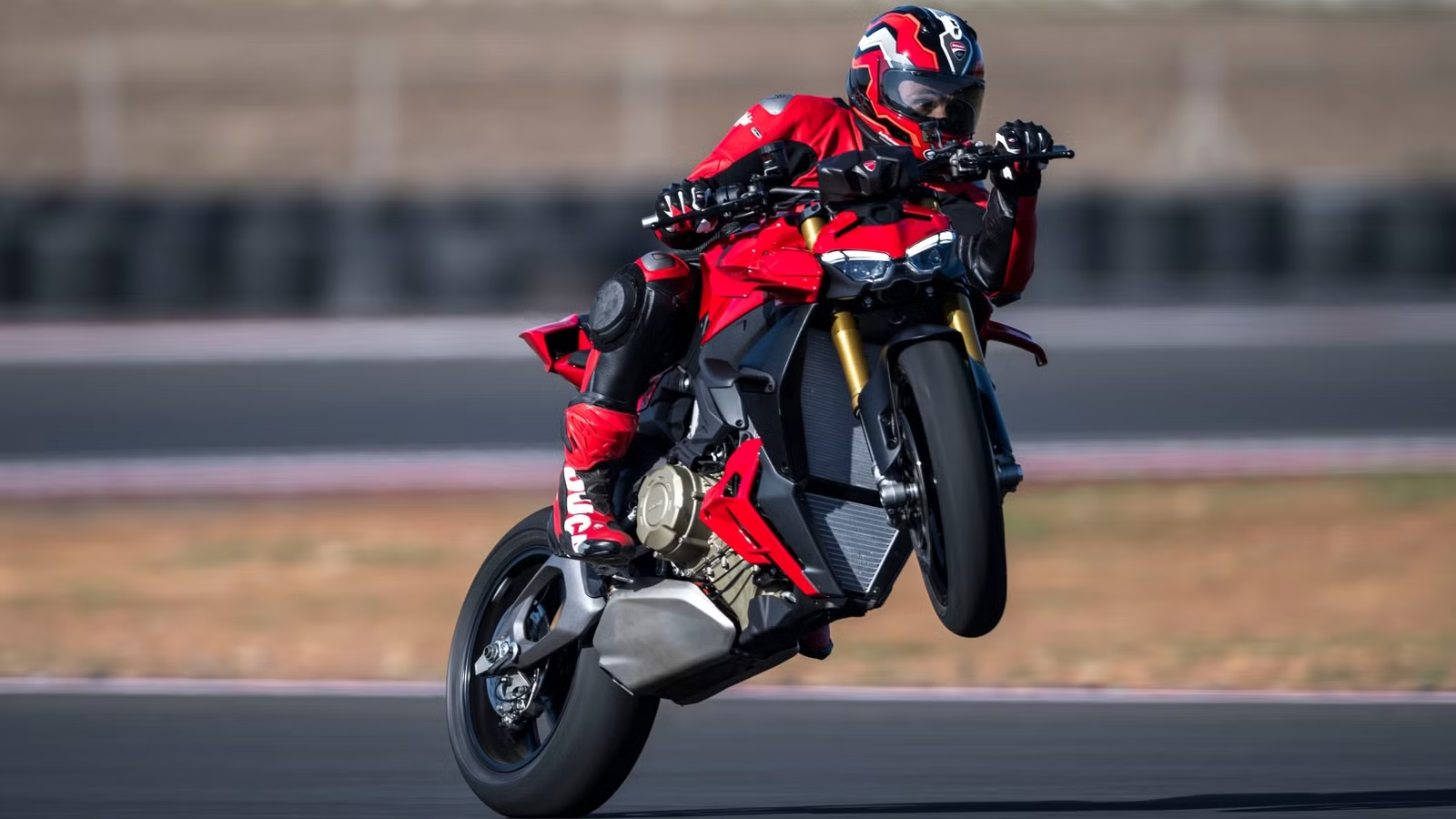
Modern flagship sport bikes are engineering marvels, but extracting their performance comes with a fairly literal physical price. Low clip-ons, high rearsets, compact cockpits, and a constant forward lean make perfect sense when you’re braking from triple-digit speeds or hanging off through a fast corner. They’re less convincing when you’re crawling through traffic or spending a Sunday afternoon on imperfect roads. Naked bikes promise much of the excitement without the contortion, and one flagship Ducati now has superbike performance, too.
The Price You Pay For Superbike Performance Can Be Painful

That aggressive riding position isn’t there simply because manufacturers want superbikes to look serious. Putting the rider low and forward improves aerodynamic efficiency, loads the front tire under acceleration, and provides the leverage and feedback needed when braking hard and changing direction at speed. High rearsets also create the cornering clearance required on track. The problem is that roads aren’t racetracks, and the same ergonomics can leave your wrists, knees, neck, and lower back doing plenty of work before the engine has even started breaking a sweat.
Naked Bikes Reduce The Pain But Usually With A Compromise

The traditional naked-bike recipe is simple enough. Lose the bodywork, replace the clip-ons with a wide handlebar, relax the rider triangle, and suddenly the same basic motorcycle becomes much easier to manage at ordinary speeds. Better leverage helps in tight corners and traffic, while the upright posture takes weight off the wrists. For street riding, the benefits are difficult to ignore.
There’s usually a catch, though. Naked versions of sport bikes often arrived with detuned engines, softer suspension, cheaper brakes, or less sophisticated electronics. That left an obvious question for riders who wanted both: what if you removed the uncomfortable parts of a superbike but left almost everything responsible for making it outrageously fast?

The Best Hyper Nakeds No Longer Feel Like Compromises

The modern hyper-naked class has largely answered that question. Machines such as the BMW M 1000 R, KTM 1390 Super Duke R Evo, and Aprilia Tuono V4 Factory aren’t watered-down alternatives for riders who’ve grown tired of sport bikes. They’re serious performance motorcycles in their own right, equipped with premium suspension, advanced electronics, powerful brakes, and engines capable of producing acceleration that would’ve belonged exclusively to superbikes not that long ago.
The Ducati Streetfighter V4 Is Essentially A Panigale Freed From Its Riding Position

That bike is none other than the Ducati Streetfighter V4. Ducati calls the philosophy behind it the “Fight Formula,” and the basic idea remains wonderfully uncomplicated: take Panigale V4-derived hardware, remove the fairings, fit a high and wide handlebar, then preserve as much of the superbike’s performance as possible. So you get a 1,103cc Desmosedici Stradale 90-degree V4 producing 205 horsepower at 12,650rpm and 88.3 pound-feet of torque at 11,500rpm.
That output puts it firmly in superbike territory, yet the rider doesn’t have to accept a traditional superbike cockpit to access it. The upright bar provides more steering leverage and places considerably less weight on the wrists, while the absence of full bodywork makes the bike feel visually and physically less enclosed. Ducati hasn’t tried to turn the Streetfighter into a soft roadster, either. Its 59-inch wheelbase, 24.5-degree rake, and 3.9 inches of trail underline how seriously the chassis still takes going fast.
There’s Still Serious Panigale DNA Underneath

The V4 itself leaves little doubt about the bike’s lineage, tracing back to the fire-breathing Panigale V4. It uses a counter-rotating crankshaft, desmodromic valve actuation with four valves per cylinder, liquid cooling, and a 14.0:1 compression ratio. Twin injectors feed each cylinder through ride-by-wire elliptical throttle bodies, while a variable-length intake system helps manage breathing across the rev range. Power reaches the rear wheel through a six-speed transmission with Ducati Quick Shift 2.0 for clutchless upshifts and downshifts.
The standard V4 uses Ducati’s aluminum monocoque chassis, a fully adjustable 43mm Showa BPF fork, a fully adjustable Sachs shock, and Sachs steering damper. The S swaps those components for a 43mm Öhlins NIX30 fork, TTX36 rear shock, and Öhlins steering damper managed through Smart EC 3.0 semi-active electronics. Both versions get 4.9 inches of front and 5.1 inches of rear travel, while the S also adds forged aluminum wheels and a lithium battery.

Stopping hardware is equally serious. Up front are twin 330mm semi-floating discs grabbed by radially mounted Brembo Hypure four-piston monobloc calipers, while a 245mm disc and two-piston caliper handle the rear. Both work with Ducati’s Race eCBS system. Pirelli Diablo Rosso IV Corsa rubber comes standard in 120/70 ZR17 front and 200/60 ZR17 rear sizes, so Ducati clearly hasn’t chosen street comfort as an excuse to fit less aggressive hardware.
Electronics Do A Lot Of Heavy Lifting, So You Can Enjoy The Power

Ergonomics can make the Streetfighter more approachable, but they can’t change the fact that 205 horsepower in a fairly lightweight naked bike is an enormous amount of performance. That’s where Ducati’s electronics become essential rather than decorative. Riding Modes and Power Modes work alongside Race eCBS, Ducati Traction Control DVO, Ducati Wheelie Control DVO, Ducati Slide Control, and Engine Brake Control to continually manage how much of the motorcycle’s capability reaches the pavement.
The current generation also uses Ducati Vehicle Observer technology, which estimates a wider range of dynamic parameters to give the electronic systems a more detailed picture of what the motorcycle is doing. The quickshifter reduces interruptions during hard acceleration and braking, while the Streetfighter’s aerodynamic winglets generate downforce to help keep the front end settled as speeds rise. Information is presented through a wide 6.9-inch TFT display with a wide 8:3 aspect ratio.
The V4 S Pushes The Formula Even Further
The standard Streetfighter V4 already weighs just 421 pounds wet without fuel, but the even more absurd V4 S lowers that figure to 417 pounds despite keeping exactly the same engine output. Its forged wheels reduce rotating mass, while the electronically controlled Öhlins setup can alter damping behavior without forcing the rider to reach for tools every time conditions change. Both models carry a 4.2-gallon fuel tank and share a 33.3-inch seat height.
Ducati currently asks $24,995 for the Streetfighter V4, while the V4 S starts at $30,995 in Ducati Red. There’s also a Corse-liveried V4 S priced at $32,995. Ducati lists an additional $1,295 destination charge before taxes, registration, dealer fees, or options, so none of these are inexpensive ways to escape superbike ergonomics. Then again, very little about this motorcycle suggests affordability was ever part of the brief.
It Makes More Sense On The Road, But It Hasn’t Suddenly Become Sterile

Calling the Streetfighter more usable than a Panigale shouldn’t be confused with calling it tame. The 33.3-inch seat is still relatively tall, there’s essentially no wind protection, the V4 produces plenty of heat; and 205 horsepower remains excessive for almost any normal street situation. It’s also a focused machine with a firm chassis, aggressive tires, and expensive hardware. Removing the fairings and clip-ons hasn’t magically turned Ducati’s flagship naked into a commuter.
What it has done is separate superbike performance from the riding position traditionally associated with it. The Streetfighter V4 gives you a 205-horsepower V4, sophisticated chassis electronics, serious Brembo brakes, premium suspension, and clear Panigale DNA without requiring you to spend every ride draped across the fuel tank. It’s still demanding, still outrageous, and still unmistakably a Ducati. It just proves that going superbike-fast doesn’t necessarily mean sitting like you’re qualifying for one.
Source: Ducati

Related posts
Latest Post


No Comments