
This Subaru Boxer Still Beats Its Modern Turbo Successor
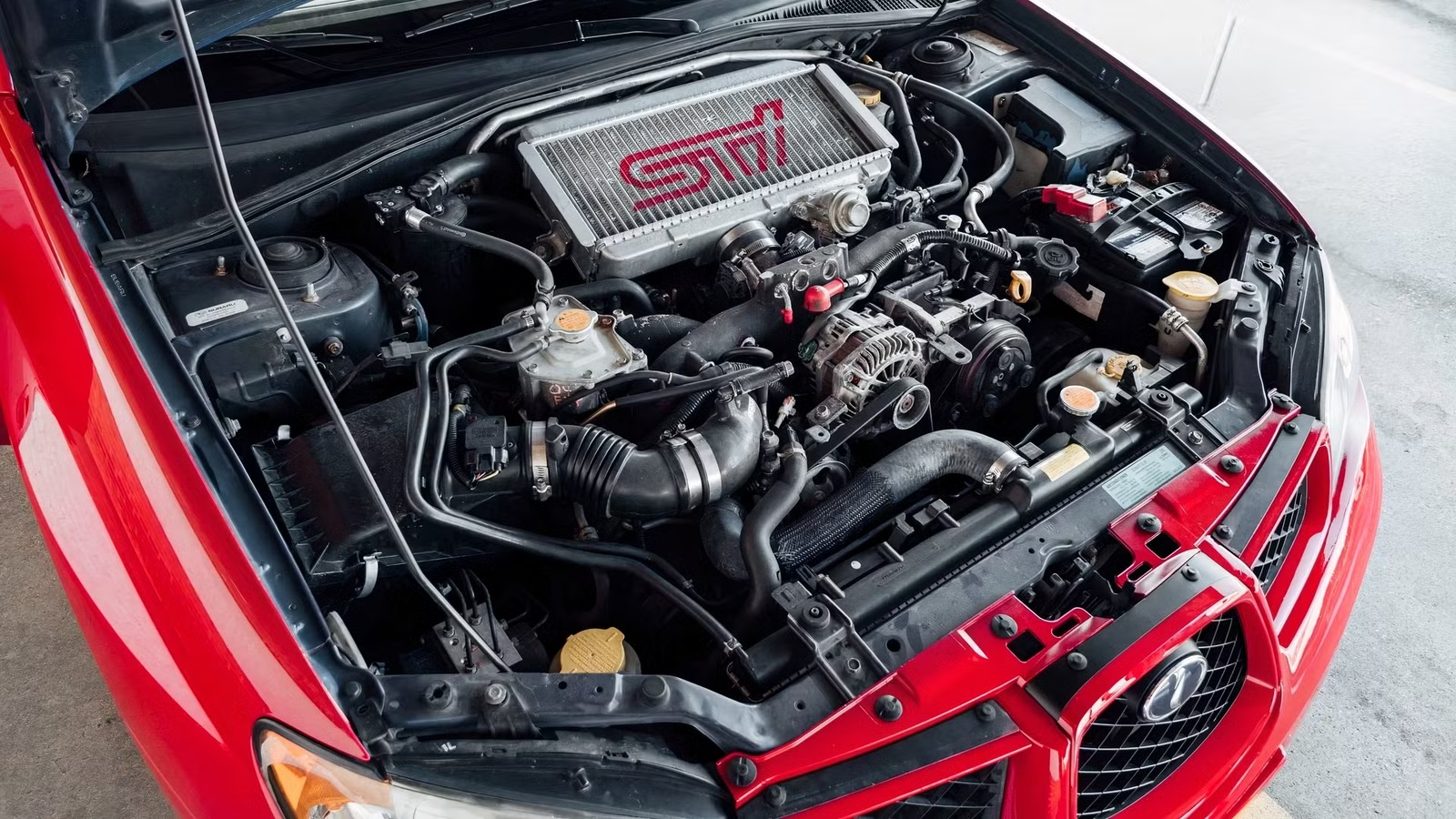
Subaru retired its most famous engine in 2021, and the tuning world never really let go. Walk into any shop that builds Subarus for a living, and you’ll still hear its name spoken with more reverence than its factory-fresh replacement gets. That’s an odd thing to say about an engine with a well-documented rod-bearing problem and a piston design that dates back to the Clinton administration. But ask why builders keep specifying it over Subaru’s modern turbo four, and the answer has less to do with nostalgia than with two decades of engineering data the newer engine simply hasn’t earned yet.
The EJ257’s 2004-2021 STI Era Built A Tuning Foundation Subaru Has Yet To Replace

The EJ257 arrived in the 2004 Subaru Impreza WRX STI and stayed in production, largely unchanged in its fundamentals, through the final WRX STI in 2021. Over that run it powered every U.S.-market WRX STI, with output climbing from the low 300s up to the 2019 to 2020 WRX STI S209, which made 341 horsepower and 330 pound-feet of torque. That’s a 17-year production window with essentially one architecture, and it’s the reason the EJ257 became the default engine code in the Subaru tuning vocabulary.

Seventeen years is an eternity in aftermarket terms. Every failure mode got documented. Every weak point got a fix, a part number, and a forum thread explaining exactly when to worry about it. Shops like Crawford Performance built entire product catalogs around the EJ257’s role as the strongest of Subaru’s 2.5-liter boxer variants for high-power builds, and that kind of institutional knowledge doesn’t transfer overnight to a new platform, no matter how good the new platform is on paper. When a tuner recommends an EJ257 over something newer, they’re not being sentimental. They’re pricing in 17 years of other people’s mistakes already being solved.
Why Forged Internals And A Semi-Closed Deck Keep The Old Boxer Relevant


The EJ257’s durability reputation starts with its block. Where the lesser EJ255 used an open-deck design, the EJ257 received a semi-closed deck block and deeper-dish pistons from the factory. In plain terms, a semi-closed deck adds extra material connecting the cylinder walls to the outer casing near the top of the block. That bridge work stiffens the cylinders against the flexing and heat cycling that high boost pressure creates, which is exactly what starts to distort an open-deck design once power climbs past stock levels.
The factory internals help too, though it’s worth being precise about what’s actually forged and what isn’t. The EJ257’s connecting rods were made from forged high-carbon steel, giving the bottom end real strength out of the box. The factory pistons, however, were cast aluminum with an Alumite coating, not forged, and that’s precisely the component that lets the EJ257 down at serious power.

This is the nuance that gets lost in EJ folklore. The block and rods can take a beating, but stock pistons and their ringlands are the platform’s known failure point once boost and heat climb past what they were designed for. Push a stock EJ257 much beyond 350 whp and ringland failure becomes a real risk. The fix is well understood and inexpensive relative to the engine’s overall value.
Swap in forged pistons, and the semi-closed deck can support serious power reliably. Aftermarket short blocks built around the EJ25 case are rated to support up to 700 horsepower, but only with the right internals and a tune built to match. The platform’s real strength was never that it survived abuse stock. It’s that the ceiling with proper prep is enormous, and every step to get there has already been mapped by someone else.

The question isn’t whether the EJ257 can handle power — it clearly can. The question is whether Subaru’s newer engine has solved those same problems and then some, which is a harder comparison than it looks.
The FA24DIT Fixes The EJ’s Biggest Flaws With Better Efficiency And Cleaner Combustion

None of that is an argument that Subaru’s newer engine is worse. The FA24DIT, the 2.4-liter turbocharged flat-four that succeeded the EJ family in the 2022 WRX, fixes real problems the EJ never solved. It uses direct injection and a twin-scroll turbocharger, sharing its 2,387cc displacement and 94mm bore with 86mm stroke across its Ascent, Outback, Legacy, and WRX applications. Direct injection alone addresses one of the EJ’s persistent weaknesses. The older engine’s port injection ran richer under load and produced dirtier combustion, especially in colder starts, than a modern direct-injection setup does.
Subaru also strengthened the rotating assembly with tougher connecting rods and pistons compared to the outgoing FA20DIT, and reworked the torque curve, so peak torque arrives earlier and holds flatter across the rev range. That’s a genuinely better daily-driving engine with more low-end torque, quicker turbo response, and none of the EJ’s reputation for burning oil between services.

On efficiency and emissions, there’s no real contest. The FA24DIT was built in an era when Subaru had to answer to stricter fuel economy and emissions rules than existed when the EJ257 was designed, and it shows in how the engine behaves at idle, at cold start, and at the pump. If you’re cross-shopping the two purely as engines to live with, the FA24DIT wins that argument comfortably.
Two Very Different Paths To Power: The EJ’s Mature Aftermarket Versus The FA24’s Growing Ecosystem

Where the comparison flips is aftermarket support, and it’s worth being precise about which FA24 we’re actually talking about. The 2015-2021 WRX, notably not the STI, ran the smaller FA20DIT, a 2.0-liter unit that never got the deck strength or displacement of what came after. The FA24DIT is the newer, larger engine, and it now underpins Subaru’s most recent STI-badged performance cars, including the limited-run WRX STI S210, which pushes the 2.4-liter’s output past what the standard WRX makes.
Subimods frames the current buyer’s guide for the FA24DIT around builders who are just now establishing what long-term reliability and power mods look like on the 2022-and-newer platform, and that framing is accurate. The FA24 platform is only about four model years old as this is written, which means the aftermarket is still in its early-adopter phase. Builders report solid results with bolt-on turbo upgrades and supporting mods, and early data shows the stock internals can handle meaningful gains over factory output, but nobody has a fifteen-year dataset on ringland behavior, rod stretch, or long-term block integrity under sustained high boost—because that data doesn’t exist yet.

Compare that to the EJ257, where 8020 Automotive and Crawford Performance can point to two decades of documented builds at every power level from mild bolt-ons to 600-plus-whp full builds. The EJ’s aftermarket isn’t just bigger. It’s been stress-tested by thousands of owners across nearly every climate and driving style Subaru sells cars in, and the failure data has been public for years.
Stock Versus Built: Which Subaru Boxer Makes More Sense For Long-Term Performance?


So which engine actually makes sense, and for whom? If you’re buying a Subaru to drive stock, with no plans to touch the tune, the FA24DIT is the better engine without much debate. It’s more efficient, cleaner running, easier to live with day to day, and it comes in a newer chassis with modern safety and infotainment to match. There’s no nostalgia argument strong enough to offset that for a daily driver.
The calculation changes the moment you’re planning to build. If the goal is a known quantity, a tuning path where every failure point has already been identified and solved by someone else, the EJ257 still makes the stronger case. A used WRX STI with a tired EJ257 is, in effect, a blank canvas with a 20-year instruction manual attached.

Forged pistons for reliability past 350 whp, proven ECU platforms, and a parts catalog that treats powerful builds as a solved problem rather than an open question. Buyers going that route should budget for the pistons from the outset rather than treating stock internals as safe past mild power gains.
For someone building an FA24DIT today, the way forward is less certain, not because the platform is weak but because it’s young. The engineering fundamentals—direct injection, a stronger rotating assembly than its predecessor, and a torque curve built for daily usability—are genuinely superior to what the EJ offered from the factory.

But claims about its ultimate tuning ceiling remain early data rather than settled facts, and buyers chasing serious power today are, in effect, beta-testing the platform’s limits alongside the shops that build for it. The EJ257 earned its reputation the hard way, one failure and one fix at a time, over 17 years. The FA24DIT is still writing that same story, and it’s simply too early to say how it ends.
Sources: Subaru, The Drive, Motor1 & Crawford Performance

Related posts




Latest Post


No Comments