
How this 95-litre diesel monster keeps industry going
Whether I successfully dodge the coach’s call for a volunteer linesman or not, on a Saturday morning you will usually find me standing beside a soggy football pitch.
A lot of the time, though, I’m only pretending to watch the nine-a-side juniors match that’s unfolding in front of me. Quite often I’m being happily distracted by Mark, whose lad happens to play for the same team as mine and who happens to work for Cummins Power Solutions. And, bless him, he likes to talk unadulterated filth to me, at a pretty scandalous hour, about his employer’s particular stock-in-trade: diesel-powered engines and generators.

I’m a receptive audience, because my appetite for engine chat isn’t quite as well sated by my day job as it used to be. My word, the engines we used to have: quirky V5s, screaming V10s, pedigree V12s, crossplane-crank V8s and VTEC Honda fours; ‘cheeky triple’ three-cylinder thrummers and little ‘sewing machine’ V6s. Petrol and diesel, puffed and blown, large and small. How we loved them all.
Then ‘downsizing’ and ‘Euro 4’ took the first ones away and creeping hybridisation and tighter and tighter emissions regs reaped more and more. Now electrification is all the automotive industry really cares to invest in, while some of the greatest examples of 20th-century mechanical engineering that I can think of are cast aside and left to wither.
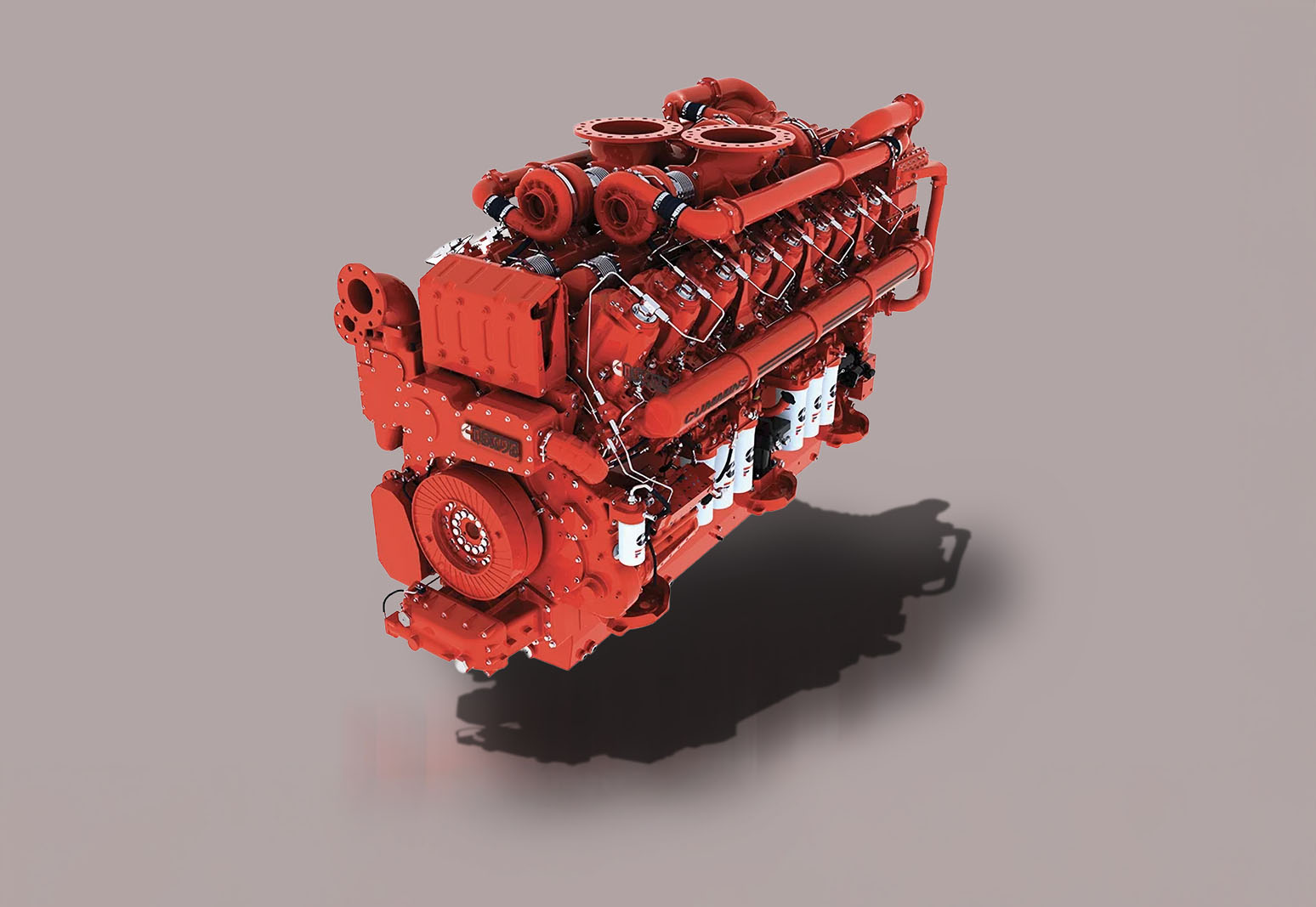
We all liked the big ones, didn’t we? Well, Cummins’ current biggest is the 95-litre QSK95. A 4400hp, near-18,000lb ft, quad-turbocharged, 16-cylinder diesel unit, it makes peak power at 1800rpm-although it can only sustain that for 10 seconds, being designed for long-hour, heavy-load applications. It’s eight feet tall, 14 feet long, weighs a little over 13 tonnes and apparently has an alternator large enough to cover a small dining table (and presumably turn it into kindling). Typically it powers superyachts, locomotives and mining trucks.

Cummins is, of course, developing something even larger, set to breach the 100-litre barrier, but it’s not quite ready yet (when it is, you can be sure I’ll hear all about it, and you’ll be next).
There are, according to Cummins’ most excellent website, more than 1200 QSK95s operating in 36 countries as you read this. And that’s just one engine model. Cummins ‘generators and power systems’ webpage lists 400-odd others and more than 600 generators besides. Its biggest ‘gennie’ is a 78-litre, 3.5kVA unit. Looking a bit like the star of 1980s BBC stop-motion TV show Bertha, it could just about power a small-to medium-sized commercial building during a blackout.
The prevalence of these generators, and our reliance on them, is easy to overlook as we congratulate ourselves on our ‘path to net zero’ efforts. Most hospitals have at least one, either on the roof or in the basement, otherwise power cuts would cost lives. Factories and offices too, in many cases.
The data centres now being built around the globe by tech giants like Amazon, Meta and Google are the extreme end of the spectrum. They’re desperately power-hungry and their impact on emissions has been well covered by the press. Apparently it’s common for them to have 20 diesel generators to ensure continuity of power supply, in some cases quite a lot more. All because we want all of our music in the cloud and to ask Gemini to make a daft video of the family cat dancing like Bruno Mars.

Related posts





Latest Post


No Comments