
Oldsmobile Quad 4: The Four-Cylinder Sold as V8 Power
At 257.123 mph, A.J. Foyt’s General Motors project Oldsmobile Aerotech made a four-cylinder look like the future. A few years later, a driver in an ordinary Cutlass Calais could hear that engine shaking through the cabin at idle. Oldsmobile’s Quad 4 promised V8 power with four-cylinder economy. Its output impressed for the time, but rough manners and early mechanical problems made the promise harder to enjoy. The gap between the record car and the commuter car became its defining story.
Oldsmobile Built A Four-Cylinder To Challenge The World’s Best

Oldsmobile began work on the Quad 4 in the early 1980s. Some accounts date the program to 1982, while others use 1984, so a precise starting year is difficult to pin down. It was a division-level “Skunk Works” effort: an ambitious project to give Oldsmobile a modern domestic answer to the sophisticated dual-overhead-cam engines coming from Japan and Europe. It was also the last engine engineered entirely in-house by Oldsmobile. The goal was not simply to replace an aging four-cylinder. The new design had to make a convincing case for four cylinders in a market still impressed by displacement.
The Quad 4 Had Technology Detroit Couldn’t Ignore
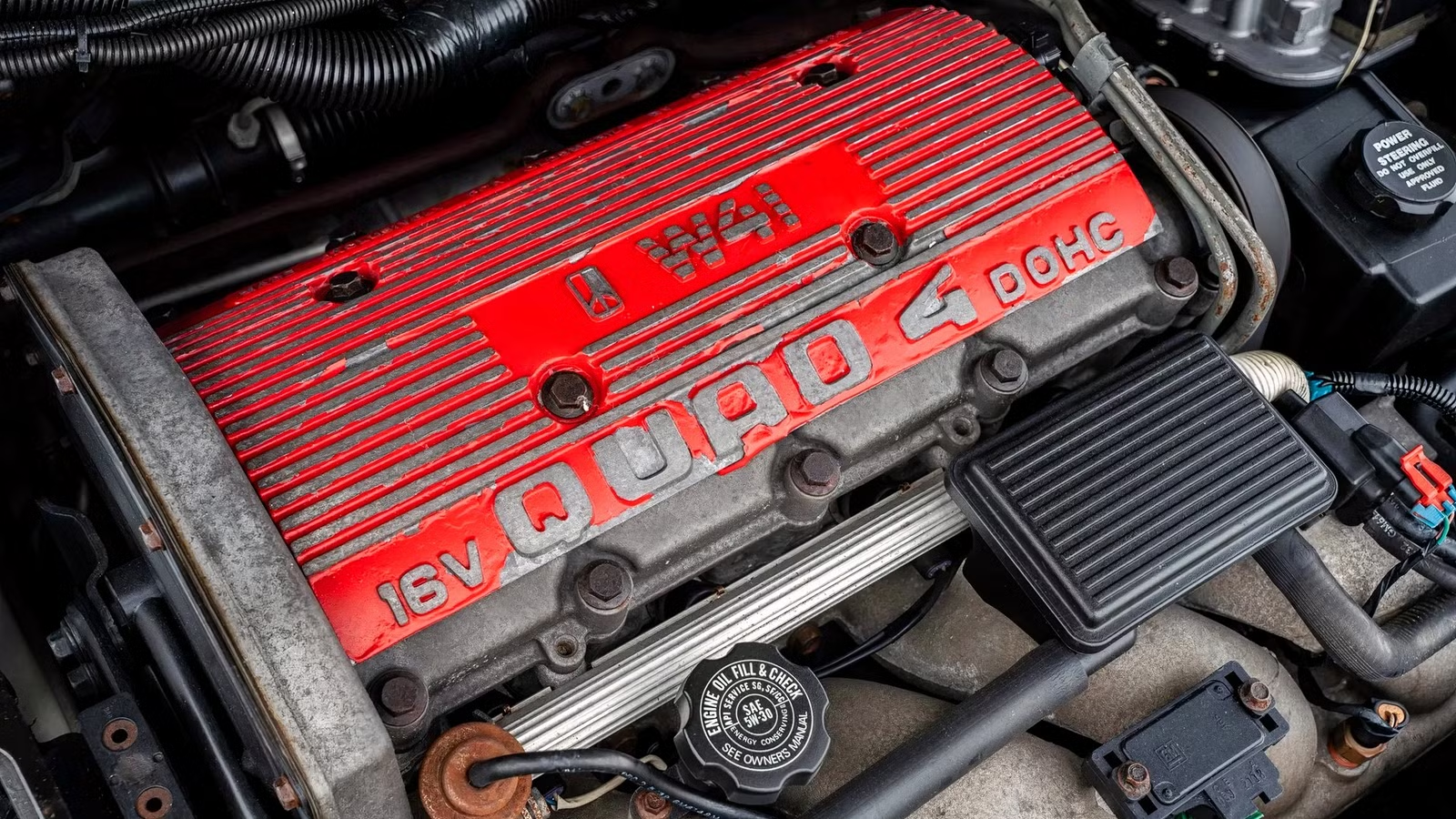
The 2.3-liter engine used an iron block, aluminum cylinder head, dual overhead camshafts, and four valves per cylinder. Chain-driven cams and hydraulic followers helped it breathe at high rpm, while a direct-fire ignition system eliminated the distributor and conventional plug wires. Those were serious features for a domestic compact-car engine in the late 1980s. Oldsmobile then gave the design a much bigger stage. The turbocharged Quad 4 in the Aerotech was part of the division’s research and publicity program, and its 1987 run produced a 257.123-mph closed-course record. That was the halo. Buyers, however, got a very different car.
GM Promised V8 Power From An Engine With Half The Cylinders


The production Quad 4 arrived for the 1988 model year in the Oldsmobile Cutlass Calais and Pontiac Grand Am. Its 2.3 liters produced 150 horsepower and 160 lb-ft of torque in standard LD2 form. That was a striking number compared with GM’s familiar 2.5-liter Iron Duke, rated at 98 hp, and its 3.0-liter V6, rated at 125 hp. The Quad 4 even matched the 3.8-liter V6’s horsepower, despite having two fewer cylinders and substantially less displacement. It gave Oldsmobile a credible answer to buyers who wanted stronger performance without stepping up to a larger engine.
High Output And W41 Versions Pushed The Four-Cylinder Further

The basic engine was only the beginning. Oldsmobile’s High Output LG0 version reached 180 hp, using more aggressive camshafts, higher compression, and revised breathing. The W41 went further, reaching 190 hp in its 1991–92 form and finding its way into performance models such as the Cutlass Calais Quad 442 and Achieva SCX. Later, W41’s ratings fell to 185 hp as the engine was revised. These were naturally aspirated production engines, not turbocharged Aerotech specials. The marketing pitch about V8 power was easy to understand when a compact four-cylinder could still deliver figures that challenged larger GM engines by contemporary standards.
The Quad 4’s Missing Balance Shafts Made It A Paint Mixer

The Quad 4’s power figures looked good in a brochure. The experience from behind the wheel could be less flattering. Its 2.3-liter displacement made it a relatively large inline-four, a layout that naturally produces secondary vibration. Oldsmobile chose not to fit balance shafts to the original engine, a cost and complexity decision that left more of that movement reaching the car. Drivers and reviewers described the result as noisy, thrashy, and agricultural. It made even routine driving feel like a mechanical demonstration at idle. The Aerotech showed what the design could do when speed mattered more than comfort.
Head Gaskets And Timing Problems Made The Reputation Worse

Vibration was not the only complaint. Early Quad 4s developed head-gasket problems that could let coolant enter a cylinder, and GM announced a recall in February 1993 covering about 500,000 vehicles from the 1987–91 model years. GM cited a revised gasket and assembly changes. Cracked heads and timing-chain trouble also appeared in repair accounts, although not every engine suffered them. The recall figure describes the vehicles included in the campaign, not half a million confirmed failures. It was a serious admission for an engine sold as a technical milestone, especially when its record-setting cousin had helped sell the promise.
GM Fixed The Quad 4’s Biggest Problem Just Before Replacing It

Oldsmobile addressed the roughness. For 1995, the 2.3-liter Quad 4 gained a pair of chain-driven balance shafts in the oil sump, reducing the vibration that had dogged earlier versions. The change came with other revisions, including a lower output rating for the standard engine. For 1996, the family moved to a larger new 2.4-liter design known as the Twin Cam, or LD9. It was an evolution of the Quad 4 rather than a clean-sheet departure, retaining the dual-cam, four-valve layout while changing its dimensions. By then, the engine had already spent years trying to outrun its reputation.
The Twin Cam Was Better Refined, But The Quad 4’s Reputation Stuck

The 2.4-liter Twin Cam used a 90-mm bore and 94-mm stroke, compared with the original Quad 4’s 92-mm bore and 85-mm stroke. The longer stroke shifted its character toward torque, while balance shafts improved refinement. The family continued through the 2002 model year before GM replaced it with the Ecotec for 2003. That ending is ironic. The Aerotech concept car had shown the Quad 4 could support extraordinary speed, but owners judged it by cold starts, idle quality, and repair bills. Oldsmobile had built an ambitious four-cylinder. It simply took too long to make the everyday version feel finished.
Source: General Motors, Mecum, Bring A Trailer

Related posts



Latest Post



No Comments