
This Overlooked ’90s Performer Just Sold for Six Figures at Auction
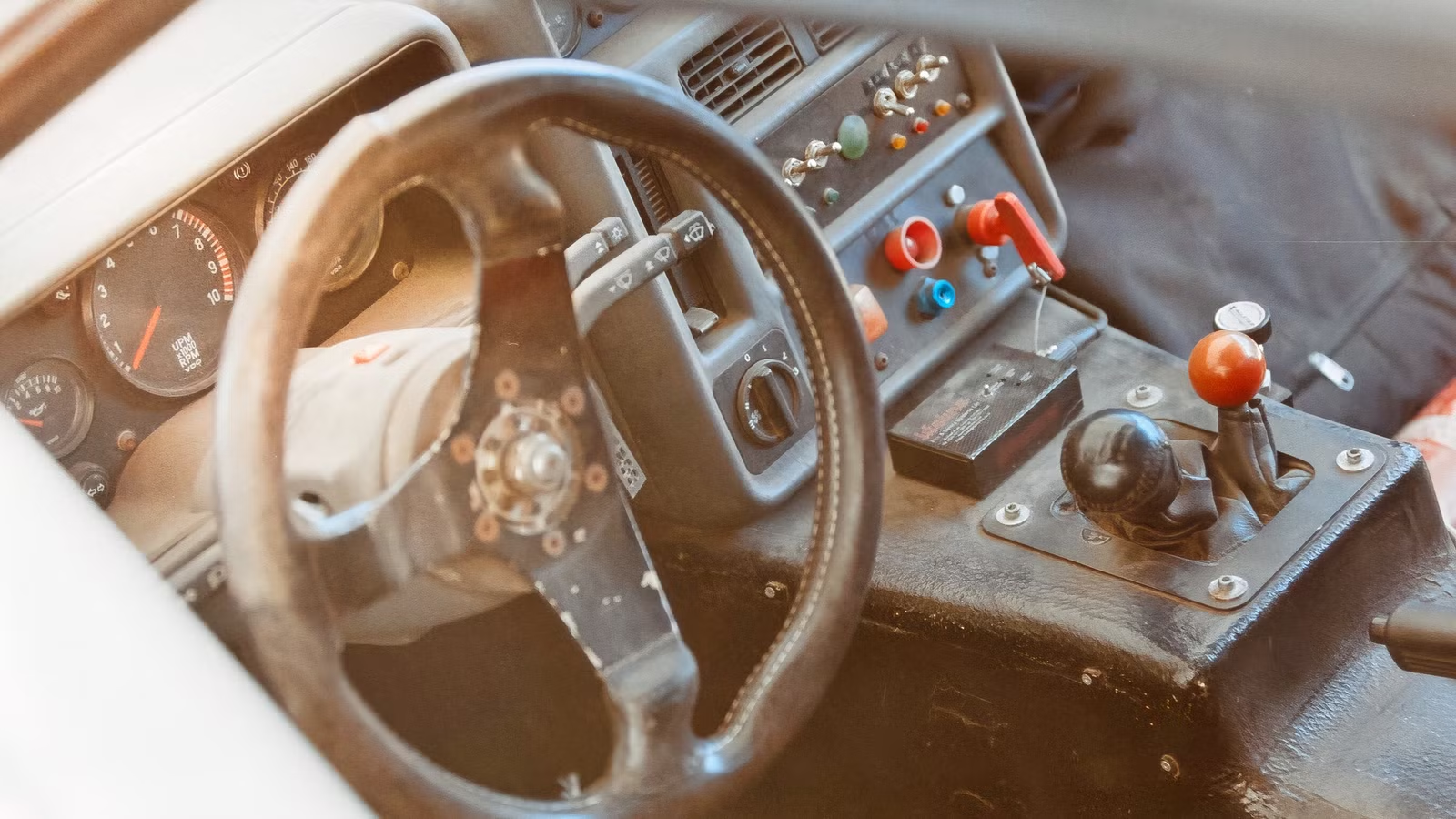
Some performance cars stay famous forever. Others burn brightly for a few years, fail to hold up against modern expectations, and lose their place in the automotive zeitgeist. But some cars all but disappear from the conversation, only to come roaring back once collectors realize how special they really were. The cars most likely to make that jump tend to combine rarity, pedigree, and enthusiast appeal in a way that makes you wonder how they ever fell off the radar in the first place. This one checks all three boxes. It came out of one of motorsport’s wildest eras, was built in tiny numbers, and spent years as something of an enthusiast footnote. Today, surviving examples can be worth around $400,000.
Group B Created Some Of The Wildest Road Cars Ever Built

For Group B rallying, manufacturers were given enormous freedom to build increasingly extreme competition cars, with very few stipulations. One of those stipulations, however, was that homologation rules still applied, so no matter how lofty their rally ambitions became, a road-going version also needed to exist. This meant some of the most outrageous rally machinery of the era had street-legal siblings that ordinary buyers could, at least theoretically, drive back and forth to work.
The requirement was 200 examples, which was just low enough that automakers were willing to deliver some serious automotive hardware to dealership showrooms and let people slap a license plate on there. The result was a short-lived crop of road cars that were expensive, specialized, and often wildly impractical, but also unlike almost anything else being sold at the time. Audi, Peugeot, Lancia, and others all produced memorable machines under Group B, while Ford eventually decided that adapting an existing model simply wasn’t going to be enough.
Ford’s RS200 Was Built Specifically To Win In Group B


Ford’s answer to Group B was not another road car adapted for rally duty. The company had tried that route with the rear-wheel-drive RS1700T, but by then Audi had already shown how important four-wheel drive was becoming. Ford scrapped the project and started over with something purpose-built for the new rules.
The result was the RS200, a mid-engine, four-wheel-drive two-seater designed around rallying from the beginning. Its name came from the 200 road-going examples Ford theoretically needed for homologation, while designer Tony Southgate and engineer John Wheeler, both from Formula One, helped shape the chassis and drivetrain layout. The production cars were assembled by Reliant, with a Ghia-designed composite body wrapped around a turbocharged Cosworth engine.
In other words, the RS200 was less a fast Ford with rallying in its heart and more a rally car that had been taught just enough manners to pass for a road car.
The RS200 Was Far More Exotic Than Its Ford Badge Suggested

The RS200 wore the same nondescript blue oval you would have seen on the Ford Tempos of the day or the anonymous Ford crossovers of today. Mechanically, though, it had very little in common with the ordinary Fords sitting in showrooms. Its turbocharged 1.8-liter Cosworth BDT four-cylinder sat in the middle of the car, while the gearbox was mounted up front as part of an unusually complicated four-wheel-drive system. The chassis used an aluminum honeycomb structure with separate front and rear subframes, and each corner got twin wishbones and twin dampers.
Even the body was unusual. Ghia designed the composite shell and Reliant assembled the production cars. The windshield and rear lights were borrowed from the Ford Sierra, though, because economics had to get a vote somewhere. Road-going RS200s made about 250 horsepower, while competition versions were already making more than 400 horsepower. For something wearing a Ford badge in the mid-1980s, it was borderline alien.
Group B Disappeared Before The RS200 Could Reach Its Potential
Ford finally got its purpose-built Group B car onto the world stage just as the category was beginning to implode. The car arrived late, but there were flashes of promise. Kalle Grundel finished third at the 1986 Swedish Rally, giving Ford a podium almost immediately, but that would ultimately become momentum without an outlet.
That same season, Joaquim Santos crashed an RS200 into spectators at the Rally de Portugal, killing three people and injuring dozens more. Weeks later, Henri Toivonen and co-driver Sergio Cresto were killed when their Lancia Delta S4 crashed at the Tour de Corse. Group B’s escalating speeds and safety problems had become impossible to ignore, and the category was abolished after the 1986 season.
For Ford, the timing could hardly have been worse. An even more extreme RS200 Evolution was coming, but the championship it had been designed for disappeared before Ford could really find out what the car was capable of. From that point on, the RS200’s future would be decided less by competition and more by collectors and enthusiasts.
A Car That Cost £49,995 New Can Now Bring Around $400,000

Ford priced the RS200 at £49,995 when new, and even that proved optimistic once Group B disappeared. With the car’s competition career effectively cut short, Ford struggled to move the road-going examples and some were reportedly discounted just to find buyers.
Today, the same qualities that made the RS200 such an odd proposition in period are exactly what collectors want: tiny production numbers, purpose-built engineering, and racing provenance, all wrapped up in one of the strangest performance cars a major manufacturer would ever sell. In May 2026, a 1987 RS200 brought £290,576 at auction, about $390,000, while an RS200 S sold for £382,500 in late 2025, or about $518,000. Even broader market data puts typical RS200 sales comfortably into six figures.
For a car that once struggled to justify its price, becoming a $400,000 collector piece is quite a second act.
Sources: Ford, FIA, Classic.com, Motor Sport

Related posts

Latest Post


No Comments