
How Oldsmobile Broke GM’s Own Rules To Build 515 Factory Muscle Cars
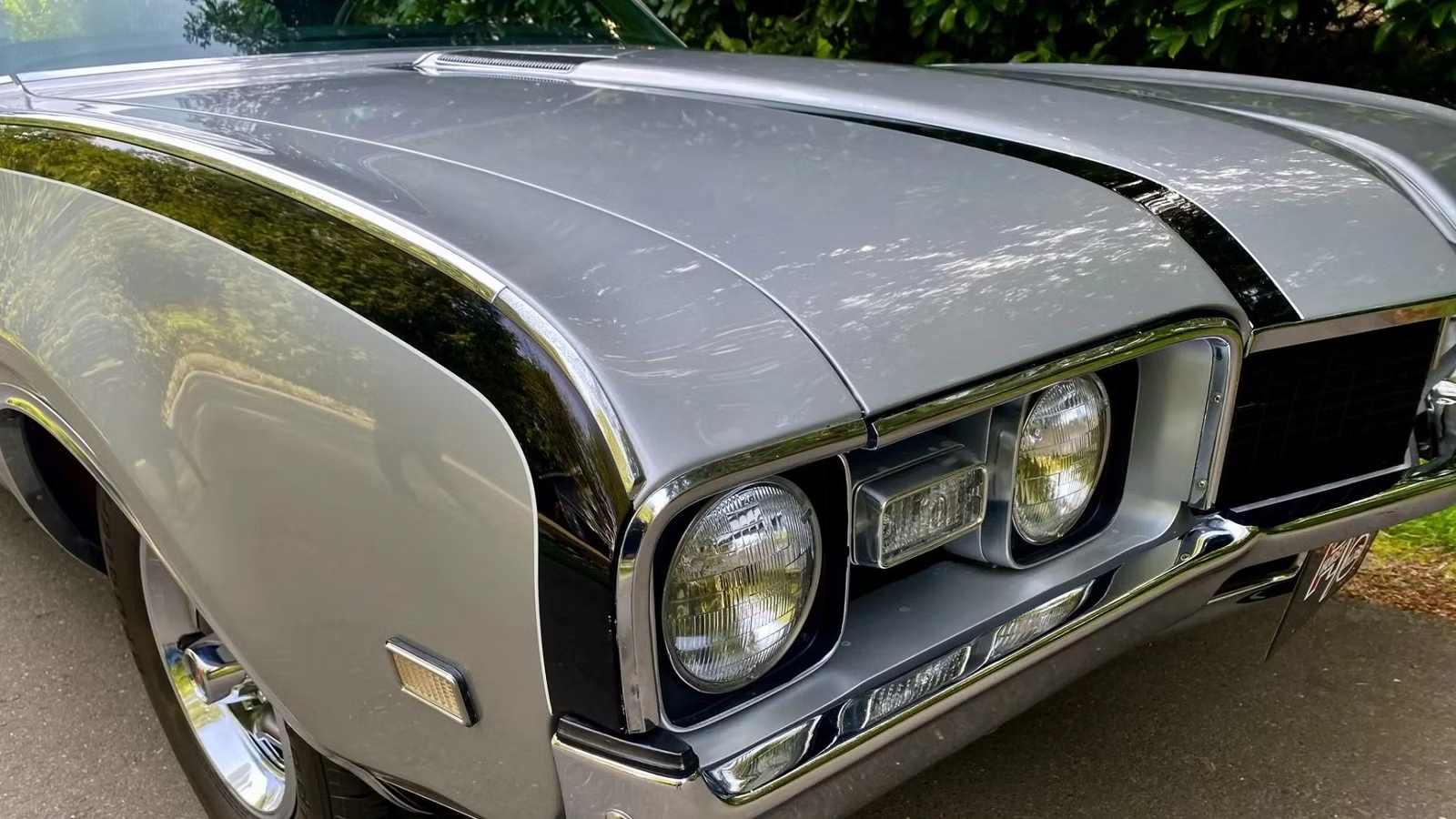
By the late 1960s, General Motors was fighting a horsepower war on two fronts. Its divisions fought Ford and Chrysler in showrooms while battling one another inside GM. Corporate leaders tried to control the chaos with one firm rule – intermediate cars could not use engines larger than 400 cubic inches. Then, in 1968, exactly 515 Oldsmobile intermediates left Lansing with 455-cubic-inch V8s, regular dealer access, and factory warranty coverage. But how did this happen?
GM’s 400-Cubic-Inch Rule Put Oldsmobile In A Horsepower Trap

Some history is useful here. GM’s divisions operated like rivals that happened to share one very large office building: Chevrolet, Pontiac, Buick, and Oldsmobile fought for buyers, budgets, and bragging rights. Corporate management still controlled the sharpest tools, though. From the mid-1960s through 1969, GM generally limited compact and intermediate models to 400 cubic inches. The Corvette received an exception, but regular A-body cars did not. GM also used a horsepower-to-weight guideline that discouraged divisions from advertising every horse their engines could produce.
Ford and Chrysler worked without an equivalent displacement ceiling. Ford could place its 428 Cobra Jet in smaller cars, while Chrysler offered 426 Hemi and 440 power in midsize models such as the Charger. Those companies still dealt with cost, warranty, and production limits, but corporate policy did not stop them at an even 400. That difference mattered because muscle-car buyers understood a very simple form of math: more cubes usually meant more torque.
The restriction trapped Oldsmobile at the worst possible moment. Its 442 had earned real performance credibility, but the 1968 model still relied on a 400-cubic-inch V8. Meanwhile, the brand had introduced a 455 Rocket V8 for its full-size cars and front-drive Toronado. The 455 shared the smaller engine’s basic exterior dimensions and could fit the A-body without an engineering miracle. It offered the low-speed force that enthusiasts felt before they ever read a road test. Oldsmobile also wanted younger buyers and a harder performance image. Chief Engineer John Beltz had pushed for an Oldsmobile version of the Camaro and Firebird F-body, but GM leaders rejected the idea because another pony car might steal sales from Chevrolet and Pontiac.

A Rejected Pontiac Idea Gave Oldsmobile Its Corporate Alibi

George Hurst and Jack “Doc” Watson had already tested a similar loophole at Pontiac. Their proposal called for Hurst to buy completed Firebird 400s, replace their engines with Pontiac 428s, and return the finished cars for dealer distribution. Pontiac liked the performance potential, but the plan created political and practical trouble. Pontiac could not ship engine-less Firebirds without breaking GM policy, and it lacked authority to buy back hundreds of removed 400s. Chevrolet also opposed giving the Firebird an advantage over the Camaro.
Hurst and Watson carried the basic concept to Oldsmobile, where Beltz saw more than an engine swap. He saw a corporate shield: Hurst could provide its famous name, enthusiast trust, and a story that separated the special cars from ordinary Oldsmobile production. Beltz understood fast cars, but he also understood how decisions moved through GM. Colleagues remembered him as an outspoken maverick who knew where the boundaries stood – and when to lean on them.
Oldsmobile’s sales organization disliked the proposal and doubted the division could move even 500 examples. But Beltz kept pushing. Hurst supplied a recognizable partner, while nearby company Demmer Engineering offered a place to complete specialty work outside the main plant. By early 1968, only one serious obstacle remained: the company that owned Oldsmobile.
The 1968 Hurst/Olds Was The Factory-Built 455 Rule Breaker

The resulting car was the 1968 Hurst/Olds. Oldsmobile based it on the 442 and placed its 455 Rocket V8 under the hood. The division advertised 390 gross horsepower and 500 lb-ft of torque, then paired the engine with a specially calibrated Turbo-Hydramatic 400 three-speed automatic. A Hurst Dual-Gate shifter sat in a small center console. Drivers could leave it in the normal automatic gate or move the lever into a separate track for manual gear selection. The setup offered a little theater without demanding a clutch pedal. Period tests pushed the car through the quarter-mile in the high-13-second range on factory-style equipment, impressive performance for an air-conditioned intermediate weighing about 3,800 pounds.
Oldsmobile developed two versions of the 455. Cars without air conditioning received the hotter W-45 specification. Engineers combined the 455 short block with freer-flowing “D” cylinder heads associated with the W-30 400 and a more aggressive camshaft. A richer carburetor calibration helped feed the larger engine. The W-45 cars also used 3.91:1 rear gears, which made the 455’s instant torque feel even more violent from a stop.

Air-conditioned cars carried the W-46 setup. It used milder “C” heads, a calmer cam, and 3.08:1 gearing that reduced engine speed and gave the air-conditioning system a better chance of surviving summer traffic. Oldsmobile advertised both engines at 390 hp and 500 lb-ft, although the W-45 clearly offered the stronger performance tune. Of the 515 production cars, 153 came with air conditioning, leaving 362 in the more aggressive non-A/C form.
The car looked special without dressing like a rolling fireworks stand. Oldsmobile used Peruvian Silver, a color borrowed from the Toronado range, then added black paint across the deck lid, around the rear glass, and over sections of the hood and body. Thin white pinstripes outlined the black areas, red plastic inner fender liners added a flash of color beneath the silver body, and unique Hurst/Olds badges identified the car on the front fenders and trunk. Inside, black bucket seats surrounded a real walnut dash insert, the compact console, and the curved Dual-Gate lever. Hurst had originally considered its familiar gold color, hideaway headlamps, and an adjustable rear spoiler, but time and cost reduced the plan.
Oldsmobile completed 515 production examples during a short run late in the model year. The often repeated breakdown lists 51 pillared coupes and 464 pillarless Holiday-style coupes. Records do not agree cleanly on that ratio, however.
The Real Innovation Was The Factory-Backed Loophole

By that time, dealers had already learned how to create machines that Detroit’s normal option sheets would not allow. Yenko Chevrolet, for example, converted roughly 54 Camaros during 1967 by replacing their original engines with Chevrolet’s 427 V8. Other performance dealers, including Nickey, Dana, Berger, and Baldwin-Motion, offered similar work. These businesses took the financial and mechanical risk, then sold complete cars to buyers who wanted more than Chevrolet would install at the factory. The formula worked, but it usually placed the dealer or converter between the customer and the manufacturer. The Hurst/Olds borrowed that idea and moved it much closer to the assembly line. The Hurst/Olds represented an evolution of the dealer-supercar model.
Oldsmobile’s arrangement joined five pieces that rarely appeared together. First, the division installed the prohibited powertrain during normal factory production. Second, Oldsmobile kept responsibility for the factory warranty. Third, Hurst placed its name on the car and supplied instant credibility with enthusiasts. Fourth, Demmer performed visible finishing work, which gave the project an honest outside-contractor role and a useful layer of political cover. Finally, Oldsmobile sent the completed cars through ordinary dealers. The customer simply bought an Oldsmobile from an Oldsmobile dealer, even though the car carried an engine that GM policy said should not be there.
Warranty Woes and Dealer Installs

The warranty issue explains why Oldsmobile could not simply let Demmer handle the engine installation for real. Oldsmobile did not want dealers selling new cars with major powertrain work that fell outside normal factory control. It also did not want to guarantee engines that another company had installed. Factory assembly solved both problems – workers could fit the engine with standard production tools, stamp the correct identification numbers, and connect the drivetrain through known procedures. The 455 also fit the chassis with little drama because Oldsmobile designed it around the same basic engine family as the 400. The rule concerned displacement, not physical size or chassis strength.
The same approach pointed toward Chevrolet’s later use of Central Office Production Order, or COPO, channels. Yenko had pulled factory engines from Camaros and installed 427s himself in 1967 and 1968. By 1969, Chevrolet could use COPO ordering to place the L72 427 in the Camaro during factory assembly, reducing the work that Yenko and other dealers needed to perform. The Hurst/Olds did not create COPO, but it demonstrated the strength of a more integrated system – factory hardware, specialty branding, limited production, and dealer distribution.
The limited run also protected the car’s character. Oldsmobile could focus on a narrow package with strong brakes, heavy-duty cooling, performance suspension, ram-air hardware, and a drivetrain selected for torque. The result felt complete rather than improvised. Many dealer conversions delivered brutal speed but depended on the skill and parts choices of the individual shop. The Hurst/Olds used an organized build path and a shared specification. Even the milder W-46 served a clear purpose by letting a buyer enjoy 455 torque with air conditioning.
Those 515 Cars Proved GM’s Rules Were Negotiable

Oldsmobile’s sales staff had worried about finding 500 buyers. Demand quickly made that fear look almost charming. Surviving accounts differ on the precise order count, but they place dealer requests between roughly 2,600 and more than 3,000 cars. Oldsmobile could not satisfy them – the program arrived late in the 1968 model year, and Demmer had only weeks to finish the planned run. Its workers had to paint the accents, apply pinstripes and badges, fit interior trim, and install the special shifter hardware. Production began near the end of spring and ended in July. The 515 total therefore says little about the size of the market. It reflects the limits of a rushed specialty operation squeezed between approval meetings and the model-year changeover.
The division returned with another Hurst/Olds for 1969 and built 906 regular-production hardtops, plus a small number of promotional cars outside that figure. The second version wore a much louder white-and-gold paint scheme, a large hood scoop, a rear spoiler, and more visible Hurst branding. Its production total climbed by more than 75 percent over the 1968 run. That increase confirmed that the original car had done more than entertain a few engineers. Dealers wanted it, buyers understood it, and Oldsmobile valued the attention. GM finally lifted the 400-cubic-inch restriction for the 1970 model year, allowing the regular 442 to carry a 455 without an outside name or carefully worded explanation. By then, the first Hurst/Olds had already shown that the restriction could bend when performance, marketing, and corporate theater aligned.

The 455 made those 515 cars fast, but displacement alone does not explain their importance. The Hurst name made the package easy to sell to enthusiasts, and Demmer’s real finishing work gave Oldsmobile a politically useful story. Factory installation kept the drivetrain consistent and allowed the division to stand behind it. Dealer distribution made the car feel like a genuine product rather than a backyard experiment with a window sticker. The Hurst/Olds simply proved that GM’s hardest rules could become negotiable when a division found the right partner, limited the risk, and gave management just enough cover to look the other way.
Source: Oldsmobile, General Motors

Related posts



Latest Post


No Comments