
This 2028 Mazda RX-9 Render Wants To Make Sports Cars Weird Again
Let’s face it, sports cars aren’t weird anymore. There was a time when exotics had optional wing mirrors, twin fuel tanks, and the kind of visibility that would make sitting in a post box seem like a panoramic view. But some time ago, around the 2000s, sports cars and supercars became all user friendly. Not only would computers stop cars flying into ditches, but exotic engines made way for reliable (often) turbocharged units that were as normal as the four-pot in your hot hatch. Supercars became daily drivers, and everything became…well, a bit samey. That’s why the new Mazda RX-9 is long overdue.
The Mazda RX9 Reminds Us Of Why Mazda Is A Fabulously Quirky Carmaker
Mazda started making weird cars around 1961 — and that’s because they started using an engine quite unlike any other. On 4 July 1961, the Japanese government officially approved Mazda’s licensing agreement with Germany’s NSU Wankel GmbH relating to the use of the revolutionary rotary engine. This quirky invention didn’t have pistons or cylinders, instead using rotating discs. The result was a lightweight and compact engine that had low vibration and noise.
While many licensees gave up on the tech, Mazda continued, producing everything from the Cosmo Sport 110 S of 1964, to the 1991 FD RX-7, which quickly became a JDM icon and one of the most gorgeous Sports Cars on the planet. Finally, there was the quirky but cool RX-8 (with a RENESIS two-disc rotary engine), with odd rear doors, that bowed out in 2012. Fun fact, Mazda still makes a rotary of sorts, but it’s a single rotor in the MX-30 R-EV that acts as a generator to recharge the battery and extend driving range.
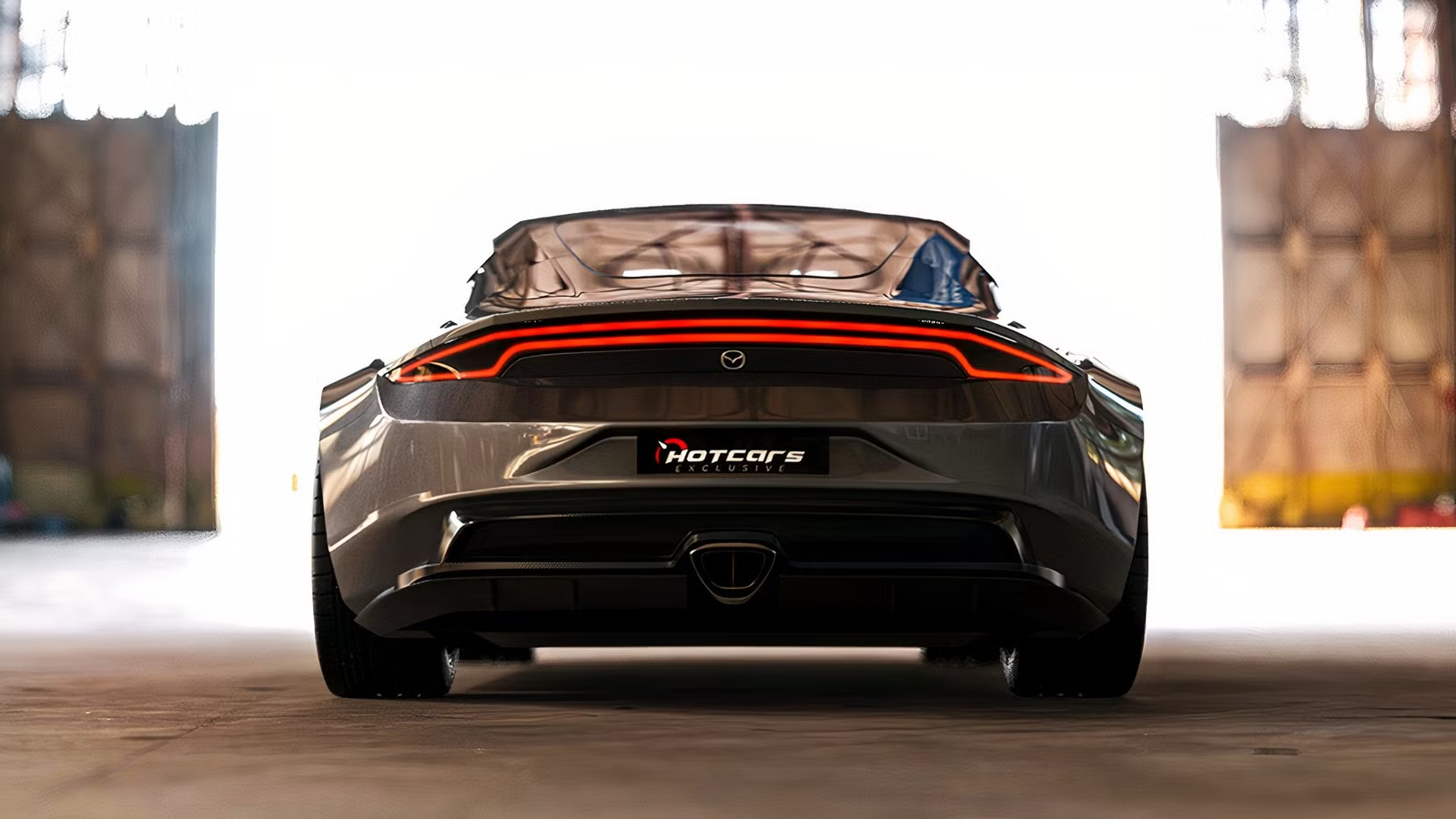
So back to the RX-9 concept and why it would bring back the weird for Mazda. Our render shows a car that could use a beefed-up version of the rotary range extender in the MX-30 R-EV, making it a PHEV sports ca. But forget that. This model has more in common with the Mazda RX-VISION sports car concept at the 2015 Tokyo Motor Show. This long forgotten concept, which still looks remarkably fresh today, was expected to use a turbocharged 1.6-liter two-rotor unit pumping out approximately 400 hp. It wasn’t to be, however, with the rakish coupe shelved.


Our RX-9 render sidesteps that concept’s overly futuristic styling for a more upright windshield and roomier cabin, albeit with a smaller and more conventional footprint. The more familiar front treatment is a nod to the likes of the Mazda 3, and the profile shares similar proportions to the lovable Mazda Miata RF.
As with the ’90s RX-7, the RX-9 is designed to be a lightweight rotary firecracker, but with enough creature comfort to make it useable every day. By combining the best of the Miata with swooping lines that hark back to the last RX-7, Mazda would surely have a winner on its hands. Mazda always made its name in sports cars by channeling the best of the ’60s, and the RX-9 render fits perfectly into that philosophy.

The most likely powertrain would come from another overlooked concept, the Mazda Vision X-Coupe, a crossover coupe that was unveiled at the Japan Mobility Show 2025. This car is powered by a plug-in hybrid system integrating a two-rotor rotary turbo engine with a motor and battery – perfect for the new RX-9. The maximum output is 503 horsepower, with a driving range of around 100 miles in motor-only mode, and almost 500 miles when operating in combination with the engine. Combine that with a curbweight that should undercut other hybrid sports cars, and the RX-9 will have true supercar performance.
Why The World Needs A Rotary Hybrid RX-9

What made the FD RX-7 so iconic was the weird way in which it did things. Remember, in the ’90s the world was full of fantastic JDM models that were packing turbocharged four- and six-cylinder engines, while covered in huge wings and spoilers. The RX-7 was a delicate car, both in its wonderfully restrained and organic looks and also in its drivetrain. The twin-rotor 13B-REW rotary engine had modest high-end torque (217 lb ft at 5,000 rpm was achieved from two turbos arranged in sequence), so the car weighed just 2,761 lbs. The result was a pretty, small sports car that stood out against the more brutish rally reps of the day.

Likewise, today’s performance cars are getting heavier and heavier, replacing lithe balance with thumping hybrid and EV powertrains that send power to all four wheels. This approach is about pummeling the asphalt rather than dancing across it. If Mazda could make an RX-9 with a manual gearbox, lightweight, rear-drive — and, of course, that quirky rotary powerplant — it would be just as welcome as a gutsy outsider as the FD RX-7 was. It would also go down in history as an icon.

Related posts




Latest Post


No Comments