
BMW M3 EV prototype driven: it’s the world’s best driver’s EV
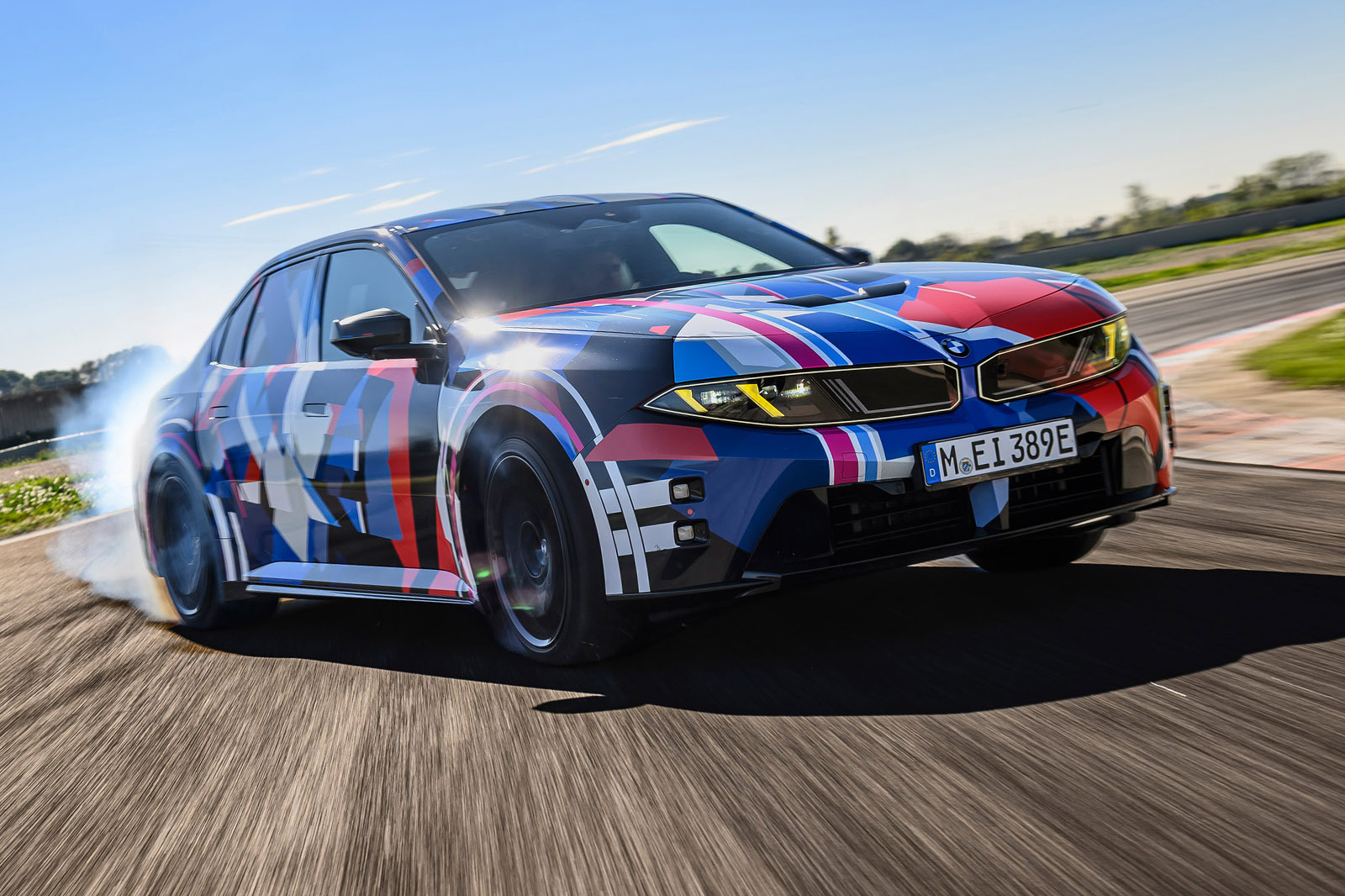
Does BMW’s first electric M car feel like an M car should? It has four motors to help it on its way

The first thing they do when we get to the Miramas proving ground, BMW’s testing facility near Marseille, is take me for a passenger ride in the new electric BMW M3. And it’s quite the experience. I haven’t been in an EV that feels so alert on corner entry or exit – or in the middle – and while I have driven some that are faster in a straight line, the new M3 is hardly shabby.
When I get out I write three simple words in my notebook: ‘911 Turbo-plus’. Okay, passengering isn’t driving, but this could be some car.
Then the briefings start. There are a lot of these, and even though they are interspersed with asterisks because some figures are ‘to be confirmed’, BMW of course knows all the numbers by now. The hardware is set, with only a few percent of dynamic tweaking still to be done. What I’ll drive today is essentially what the electric M3 will be like when it arrives in customers’ hands in June next year.

And that will be what, exactly? As usual with BMW M cars, the hardware is base 3 and then some. And this is a proper M car variant costing around £100,000, not just an M-badged extension of the conventional i3 on which it’s based. “We think a BMW can be electrified without compromise,” says Stefan Lupberger, who oversees vehicle dynamics and functional development of the car. “It is not a question about the powertrain. It’s a question of whether it is an M car.”
In body, the M3 is a touch wider in the arches, around 10mm each side, than the standard i3, and there are aerodynamic addenda, with a natural fibre composite roof as an option. Our test car wears Michelin Pilot Sport 6 tyres, 275/35 R20s on the front and 295/30 R20s on the rear – although 21in rears will be an option.
Modern car bodies are pretty stiff already, but there are underbody stiffening plates front and rear; the fronts attach the battery pack to the body more stiffly than on the regular i3. There are struts to link top-mounts to A-pillars, a strut brace beneath the bonnet and strengthened top mounts front and rear. Suspension subframes are new amd rigidly mounted at the back, and each one has strengthened axle carriers, extra stiffening and new bearings. It is, as M3 project lead Philipp Brunn says, “largely new suspension”, of MacPherson struts at the front and five-link at the rear, with coil springs and adaptive dampers.
The battery pack, of over 100kWh is in the same place beneath the floor and roughly the same size as on the regular i3, but it has M-specific cells (no more details yet) and, probably as importantly, new cooling, because of the levels of discharge/charge it can take via four motors, one for each wheel.
Maximum power output is about 838bhp, with up to 644bhp going through the front pair of motors or 751bhp through to the rears. It’ll never blow full power through all four, presumably because there’s only so much the hardware can take. It can also, though, and I think this is crucial to the way I felt the car behave earlier, take up to 540kW of regeneration under braking, which BMW says is up to the full dynamic limit of its tyres.
This level of power-delivering or power-absorbing capability is at the heart of the decision to fit four large motors: they are much quicker to respond and modulate than engines and gearboxes or hydraulic brakes. BMW says old-fashioned mechanicals can have latencies of up to 300ms – “anything more than 150-200ms you’ll feel,” says Lupberger – and companies strive to gain as much response as possible. Conversley, motor/generators respond so quickly that BMW has to turn the responses down.
I suspect the front motors are so powerful because of their capacity to brake rather than for their power. BMW wants the M to feel mainly rear-driven, and, as with its other four-wheel-drive M cars, the M3 has a rear-drive-only mode for efficiency, or slidey antics.
The tax for fitting four big motors comes on the scales. “We are adding a signifi cant amount of weight,” says Brunn, “which is always painful, but we need it for precision.” An EV with just one motor per axle, like a Hyundai Ioniq N or Porsche Taycan, doesn’t weigh as much as one with four motors, and EV weight is already an issue. But the work each wheel can do is still partly determined by mechanical diff erentials, open or otherwise, and hydraulic ABS, with the latency all those involve. The M3’s kerb weight is notably absent from BMW’s bumf – I would imagine it’s around 2400kg. But M division thinks the compromise is worth it for the rapidity of response.
So let’s see. The interior is covered over but the seats are low. There are new seats – optional, lighweighted, with carbonfi bre backs but a thin squab so you feel like you’re in an old-fashioned on-the-floor BMW. Still has the annoying composite tray between your legs, mind. the steering wheel is i3-adjacent but with big M-function buttons and there are a lot of drive mode options. There’s a faster steering ratio than the regular i3’s, but at over two turns between locks it’s still habitable – this is a daily driver, says BMW.
The ride, difficult as it is to gauge for sure on a circuit, has some compliance. Still, it feels really tightly controlled over crests. But it’s the handling that blows me away. It’s rare after nearly three decades of testing to find a car that does something one hasn’t experienced before. Ever faster and capable, sure. But most cars have a feeling that there’s a powertrain trying to push you forward, with a separate system holding you back; there’s a bit of slack here and there. But the M3 just feels sharper, tighter, defter and precise.
The handling balance is predictable enough. In its more chilled drive modes it pushes up to a steady-state understeer, as it ought to. But even so it’ll tweak and tighten its line on corner exit under power if the entry speed is modulated correctly. Putting the chassis into a sportier mode lets it move around more: it understeers less, you can back it in on the brakes more and it’ll push its tail wider on exit under power.
In its overall balance it’s a bit like, say, a Porsche 911 Turbo mixed with an Audi R8 mixed with a Mk3 Ford Focus RS – obviously four-wheel drive, but with a willingness to become mobile and act like it’s a bit rear-driven.
The rapidity and precision of the responses, though? I don’t think any of those other three would match the M3. Sure, you can feel the car’s weight, but in some cars you nudge up to, maybe over, the edge, and if you lift-off and reapply power or change gears or get on the brakes there’s a bit of delay between things happening. There’s none of that here; it’s so immediate and controllable. Remarkable.
The tremendous amount of regen the car can handle is at the heart of these responses, I think: instead of a pulsing ABS system the car can hover around the edge of adhesion. And it has a huge effect on brake temperature. Whereas you could reasonable expect that to reach 600deg C, instead after five fast laps the front discs (carbon ceramic as an option) were under 100deg C. Which is also, because there’s less heat soak through the rim, kinder on the tyres.
There are gears too, incidentally. Sort of. BMW says don’t call them that: they’re stages. Six of them. But they act a lot like gears – there’s a ‘rev’ limit, and throttle response and braking is sharper the higher up the range you are, and it makes a growly, then howly, noise doing it. You can turn that off , but it can all feel a bit ethereal if you do.
Either way, this is the most fun EV I’ve driven, by a distance – and before today I wouldn’t have known what that was (Hyundai Ioniq 6 N, original Tesla Roadster, the silliest Porsche Taycan, Renault Twizy?). There’s a new electric Porsche Boxster coming, and that might change things, but right now there’s no question: this is the world’s best driver’s EV. It’s a car that will compete at the very sharp end of our Best Driver’s Car feature next year. Extraordinary.
| bmw m3 electric prototype | |
|---|---|
| Feels like an M car, but drives like no other EV to date. For now, the best electric driver’s car out there. | |
| Price | £100,000 est |
| Motor | Four, types tbc |
| Power | 838bhp (approx) |
| Torque | 885lb ft (approx) |
| Transmission | single-speed reduction gearing; 4WD |
| Drive battery | 100kWh (approx) |
| Kerb weight | 2400kg (est) |
| 0–62mph | <3.0sec (est) |
| Top speed | >155mph (est) |
| Energy efficiency | 4.0mpkWh (est) |
| Electric range | 400 miles (est) |
| Max charging rate | 450kW |
| Rivals | Hyundai Ioniq 6N, Mercedes-AMG GT55 4dr coupe, Porsche Taycan Turbo |

Related posts

Latest Post


No Comments