
The Bike That Makes A Strong Case For Owning Just One Motorcycle
There probably isn’t a rider who has spent enough time on two wheels who hasn’t stayed up at night building the perfect multi-bike garage in their head. A Sportster S for Sunday blasts and a CRF300L for when the pavement runs out. A Ninja 1100SX for the fast stuff and an NC750X for the sensible stuff. The permutations are practically endless, and for a while, having the right bike for every job sounds like the ideal setup.

Then reality gets involved. Ride one bike more than the others and the neglected machines start looking rather pointless, while every additional motorcycle brings another round of upkeep. Fortunately, modern motorcycles have gotten remarkably good at doing several jobs at once. The trick is finding one that can cover enough ground that the second bike starts looking unnecessary.
Adventure Bikes Have Become The Ultimate One-Bike Solution
Adventure bikes have quietly become the motorcycle world’s answer to the awkward question of, “If I could only keep one, which one would it be?” They can tour, commute, carry a passenger, eat up broken roads and, when the pavement finally gives up, keep going without much drama. They aren’t particularly interested in being the absolute best at any one of those jobs, and that’s kind of the point. Some lean harder toward the dirt, others are clearly happier on asphalt, while different engine sizes and price tags make the category broad enough to cover everything from relatively approachable machines to premium flagships.
How BMW Helped Build The Modern Adventure Bike


BMW has been playing this particular game for a very long time. The R 80 G/S showed up in 1980 with a fairly simple idea: take the company’s boxer-powered road-going motorcycles and give them enough off-road ability to make the end of the pavement feel more like an invitation than a warning. Even the name gave the game away. G/S stood for Gelände/Straße, essentially off-road/road, and the bike went on to define what we now know as the adventure motorcycle. The formula stuck, and so did the GS name. All these ADVs kept stretching the idea in different directions, with each generation becoming more capable and more sophisticated. Then, in 2024, BMW went back to the drawing board for a complete ground-up redesign.
The R 1300 GS Might Be The Ultimate One-Bike Garage

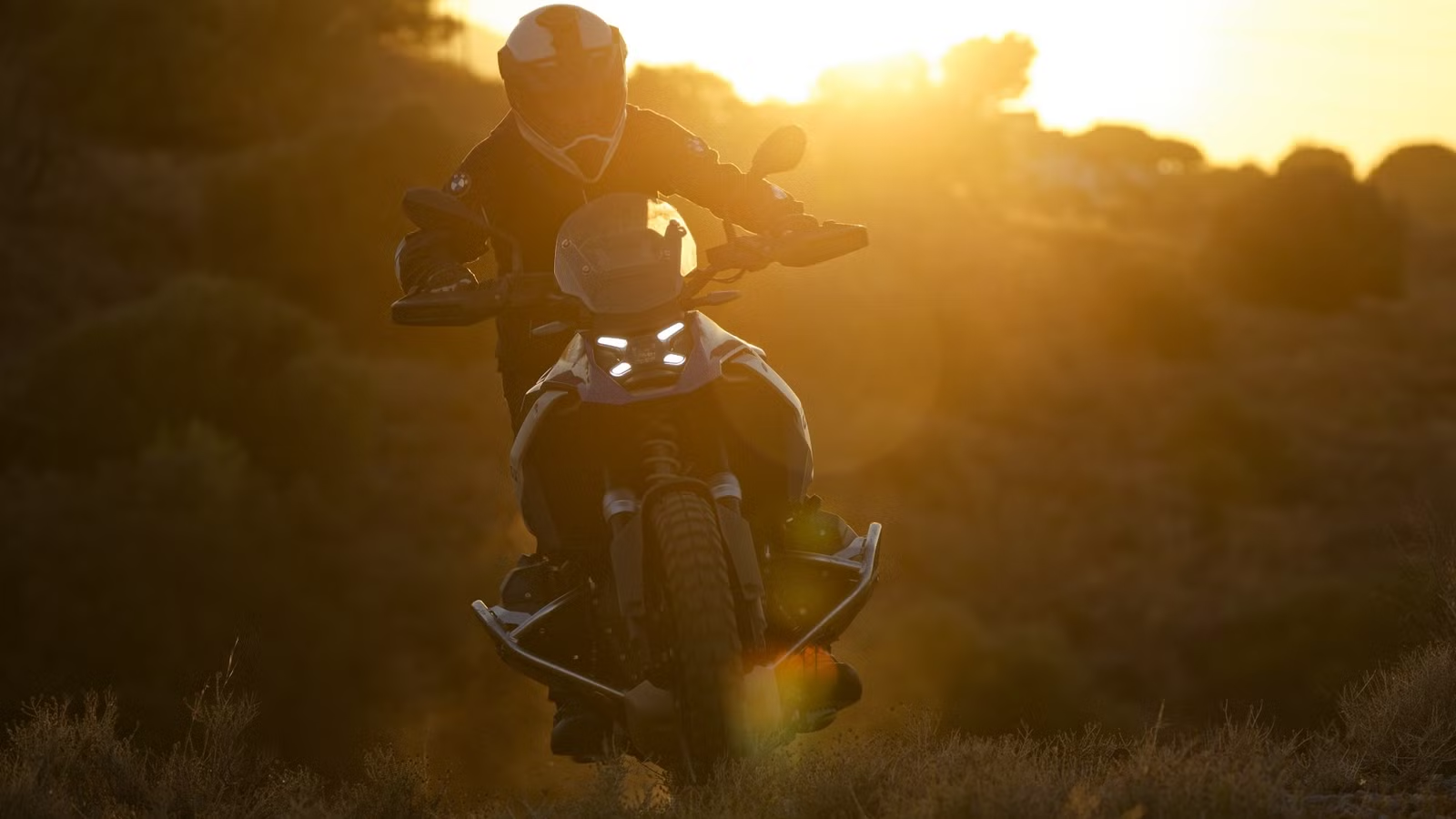
That brings us to the R 1300 GS, now practically synonymous with the quintessential big-bike all-rounder. Calling it a facelift or routine model update would undersell the changes. It’s almost a motorcycle version of the Ship of Theseus: the GS name and familiar boxer formula remain, but BMW replaced so much underneath that this is effectively a new machine. The boxer was redesigned, the six-speed gearbox moved underneath it for a more compact powertrain, and the old tubular-steel frame gave way to a new sheet-metal steel frame. The rear subframe became die-cast aluminum, the Telelever and Paralever were reworked, and the extensive redesign shaved 26 pounds from the previous model.
BMW’s Proven Boxer Brings The Firepower

Ah, the boxer. Fire one up and those cylinders sticking out either side give the engine its unmistakable character, with that familiar side-to-side rocking motion as the crank spins. BMW has been refining this layout for decades, and in the R 1300 GS it has grown to 1,300cc and produces 145 horsepower and 110 pound-feet of torque. BMW also moved the six-speed gearbox underneath the engine, rather than having it mounted behind the boxer as before, helping create a more compact powertrain and centralize mass in the chassis. The cylinders still hang out in the breeze, though, because some things are simply too GS to mess with.
The 145-horsepower peak arrives at 7,750 rpm, leaving plenty of additional engine speed above the torque-heavy portion of the rev range for stronger acceleration when the road opens up. At 110 pound-feet, it also out-torques the Ducati Multistrada V4 (92 pound-feet), Honda Africa Twin (77.4 pound-feet), and Harley-Davidson Pan America 1250 (94 pound-feet).
The R 1300 GS Has Ample Long-Distance Ability

If you’re buying a motorcycle like this, you’re definitely going to do some touring. This is where it’s important not to confuse the R 1300 GS with the R 1300 GS Adventure. The regular GS doesn’t get the Adventure’s huge 7.9-gallon tank or its 593-pound curb weight, instead using a five-gallon tank and weighing 523 pounds ready to ride.
What it does get is Dynamic Cruise Control, heated grips, an adjustable windscreen, a 33.4-inch standard seat height and a flat tank-seat line BMW designed around long-distance ergonomics. Add the optional Vario luggage (BMW’s expandable hard cases that can change their storage capacity depending on how much gear you’re carrying), comfort seat and other touring equipment, and there’s plenty here for putting serious miles between fuel stops.
Premium Suspension That Handles All Life’s Adventures With Ease

The suspension is where BMW’s unusual approach gets interesting. Up front, the EVO Telelever uses a wishbone-style linkage and a central shock absorber, separating the handlebar’s steering movement from the suspension’s compression and extension. At the rear, the EVO Paralever pairs a single-sided swingarm with BMW’s shaft-drive system. Both ends offer substantial travel, with 7.5 inches up front and 7.9 inches at the rear, while the optional Dynamic Suspension Adjustment adds electronic suspension adjustment, load compensation and spring-rate adjustment.
The R 1300 GS Is Loaded With Technology

The R 1300 GS gets the kind of electronic safety net you’d expect from a modern flagship, with traction control and lean-angle-sensitive ABS working with the bike’s sensors to account for things like lean angle and wheel speed. Hill Start Control helps when setting off on an incline, while Dynamic Cruise Control takes some of the work out of long highway runs.
Keyless Ride lets the rider start the bike without pulling out a key, while tire-pressure monitoring keeps tabs on both tires from the cockpit. There’s also a 6.5-inch TFT display with smartphone connectivity and a dedicated charging compartment with a USB socket, while buyers can add BMW’s optional radar-based Riding Assistant with Active Cruise Control and additional collision-warning functions.
Optional Automated Shifting Makes Life Easier

Automatic and semi-automatic transmission systems are becoming increasingly common across the motorcycle world, and BMW has its own take on the idea with the optional Automated Shift Assistant, or ASA. It removes the need for the rider to operate the clutch manually, while the gearbox can still be controlled through the conventional foot shifter.
Put it in automatic mode and the system handles the gear changes itself, using information such as engine and transmission speed, clutch position and the selected riding mode to determine when to shift. Manual mode is still available when the rider wants to choose the gear without having to operate a clutch lever. The R 1300 GS has rivals from across the globe, like the Multistrada V4 and Africa Twin, but its do-it-all recipe is hard to beat, especially if you’re aiming for a one-bike garage.
Sources: BMW Motorrad USA, BMW Group PressClub USA, Ducati USA, Honda Powersports, Harley-Davidson USA

Related posts
Latest Post


No Comments