
The Yamaha That Balances Excitement and Reliability Better Than Most
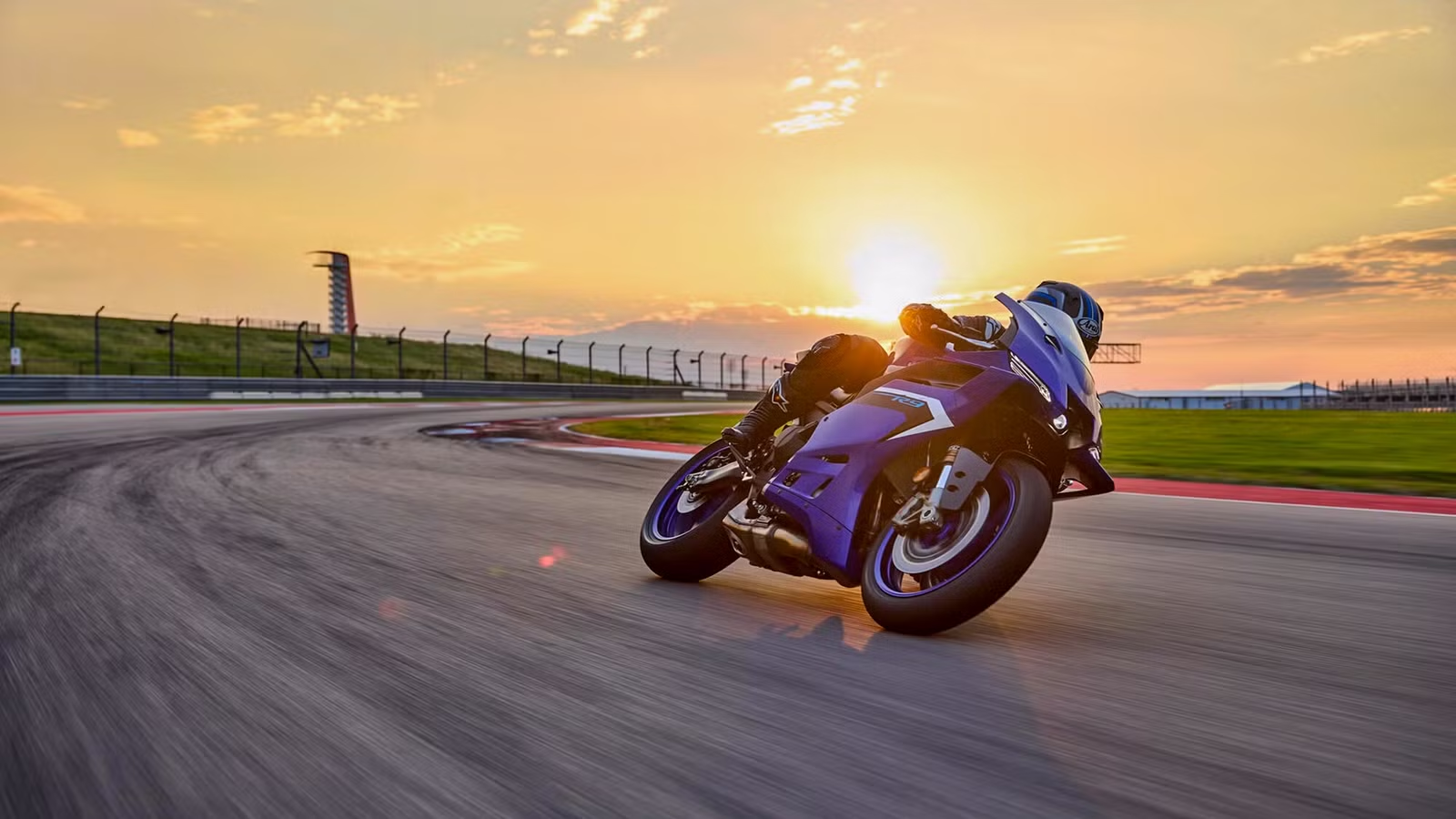
Every rider wants the same thrill: an engine that revs hard, a higher compression ratio, and a redline that climbs well past 10,000 RPM. All this will surely make the motorcycle exciting to ride, but it also makes reliability a much tougher target to hit. Currently, most machines chase this formula, and in return demand tight and costly service intervals from their owners. This trade-off isn’t universal, though. A handful of bikes manage to balance the fun and reliability factor by delivering a liter-class superbike-like rush, while remaining dependable enough to rack up six-figure mileage with only routine maintenance. And there’s one such Yamaha mid-weight motorcycle that nails this balance in particular, without asking the owner to compromise on either side.
The Most Exciting Motorcycles Can Be Sensitive

Superbikes are engineered first for outright performance, and everything else is secondary. That means the engine lives life on the edge where every component is working overtime, with barely any breathing room for the motor. These machines make riders go ‘woah’ every time they rev out, but by the time a rider has done a couple of laps on the track, that same engine is often ready to demand a hefty service bill.
High-revving machines use complex components, and those leave very little margin for error – miss a service or use the wrong oil, and that bill only gets bigger. Basically, these machines demand constant care from the owner. It’s not a flaw but rather a trade-off a manufacturer makes deliberately: chasing high-power figures and top-end power over long-term ease of ownership.
But Part Sharing Has Done Wonders In Recent Times

Every problem has a solution. And motorcycle manufacturers have found a smart workaround for this trade-off. Rather than developing a brand-new, high-revving engine for every sporty model in the lineup, manufacturers now seek to build a single great mill and use it across their entire lineup. Be it a naked bike, an adventure bike, or a sports bike, every model uses the same mill, but with a change in tune. This brings down the cost, and eventually also brings in the reliability factor. Using a mill that has already covered thousands of miles, with a change in tune to match the sporty dynamics of a sports bike, balances both fun and reliability.
Take Suzuki, for example: its 776cc parallel-twin debuted in the naked GSX-8S and the V-Strom 800DE adventure bike, and later made its way to the GSX-8R sports bike, remaining largely unchanged. Even Honda has done the same with its 649cc inline-four, sharing it between the naked CB650R and the faired CBR650R. As a result, at a lower cost, both motorcycles share engines with a reputation for surviving thousands of miles with routine servicing. Now this sharing isn’t limited to the engine only. Electronics, wiring, and sensors carry over too.

Yamaha has proved itself a master of this formula with the YZF-R7. By taking the widely trusted 689cc CP2 engine, which debuted with the MT-07 naked motorcycle, and placing it inside an aerodynamic sport chassis, the Japanese manufacturer created a low-maintenance, high-reward track bike. This realization set the stage for Yamaha’s broader approach to modern performance bikes.
Yamaha’s Formula For Stress-Free Riding

Yamaha nails this part-sharing approach, and as a result, it pays off as a well-balanced motorcycle that, while staying true to its sports bike nature, does not ask the owner to trade away reliability. Eventually, riders get to actually enjoy the performance, and the cherry on top is the accessible initial cost. Yamaha leans on this approach across most of its lineup, but it comes together most convincingly in one particular Yamaha mid-weight.
The Yamaha YZF-R9 Brings The Ultimate Balance Of Fun And Reliability

This philosophy reaches its sharpest expression in the Yamaha YZF-R9. Slotted into Yamaha’s R-series lineup as the successor to the YZF-R6—technically, the R7 was meant to fill that gap, but for many enthusiasts, it failed to live up to its predecessor’s raw character. Instead, the R9 steps in to properly fill those shoes, delivering the blistering performance buyers lost when the 599cc supersport began disappearing from showrooms.
There is a catch, though. Instead of being as aggressive as the YZF-R6 or YZF-R1, Yamaha built the R9 around a platform it knew intimately. As a result, the R9 is as exhilarating to ride as a supersport yet perfectly capable of handling city duty, while being painless to own. This gives it a balance of fun and mechanical reliability without asking buyers to compromise on either front.
At $12,499, It Offers Unbeatable Value

Carrying an MSRP of $12,499, the YZF-R9 offers a great value-for-money deal. At this price point, the Yamaha R9 still undercuts some of its direct middleweight sports bike rivals without asking for any compromises in equipment or performance, while also delivering the Japanese reliability factor. For riders who want the thrill of a proper supersport without a proper supersport’s price tag or upkeep demands, the R9 makes a compelling case. But a price tag only means something if the hardware backs it up. The engine under that fairing is where Yamaha either proves or breaks its promise — and it’s not what most buyers expect.
The 890cc Inline-Three Is The Real Deal

At the heart of the R9 sits Yamaha’s CP3 engine, a liquid-cooled, 890cc inline-three with a crossplane crankshaft lifted out of the MT-09 streetfighter and the Tracer 9 touring bike. In the R9, this mill pumps out 117.4 horsepower and 68.6 pound-feet of torque, similar to its engine-shared counterparts. However, to fit the sports bike’s character, Yamaha has made some tweaks to gearing, throttle response, and engine mapping. Transmission duty is handled by a six-speed manual gearbox with a slip-and-assist clutch.
Apart from its sports bike character, and the performance figures, there’s something more that makes this engine special. It’s the reliability it offers. The mill has already proved its high-mileage credentials in Yamaha’s streetfighter and touring motorcycle. Instead of chasing the redline like Yamaha’s 599cc mill used in the R6, this CP3 has a modest compression ratio and peak power tops out at 10,000 RPM. This results in a balanced character without compromising on reliability.
How The Engine Bridges The Gap Between Track Excitement And Street Dependability

Apart from the fun-to-ride factor and reliability, there’s also something that seasoned riders look out for in a particular bike. We’re talking about versatility. Since the CP3 mill is also used in a street naked and touring motorcycle, it is quite versatile. The low grunt makes it easy for riding around the city, while the triple-digit horsepower is more than enough for serious speeds. Instead of being an old-school superbike, the R9 delivers the R-series look with Yamaha’s engine character, along with a chassis and electronics package that can be enjoyed outside a closed circuit.
Brembo Stylemas And KYB Suspension: The Hardware Yamaha Didn’t Have To Include

Supporting its versatility further is a flexible chassis. The Yamaha R9 is built around an aluminum Deltabox frame, using the engine as a stressed member, which helps it to be lightweight. The chassis is suspended on fully adjustable 43mm KYB inverted forks at the front and a fully-adjustable KYB monoshock at the rear. Braking duties are handled by dual 320mm discs up front coupled to Brembo Stylema four-piston calipers, and a 220mm disc at the rear coupled to a single-piston caliper. The R9 rolls on 17-inch wheels at both ends.

The Yamaha R9 doesn’t compromise on features. It gets nine ride modes, Yamaha’s YCC-T by-wire throttle, three-level slide control, three-level lift control, lean-sensitive brake control with ABS, two-level engine brake management, launch control, wheelie control, and Yamaha Ride Control with preset and customizable modes. All of this is controlled via a five-inch TFT screen along with Bluetooth connectivity for smartphone pairing.
$4,500 Cheaper Than The Panigale V2 — And Better Equipped Than The GSX-R750

The Yamaha R9 directly competes with the Ducati Panigale V2, which is also a lighter, more livable sports bike. While the Panigale offers similar power figures, it is still around $4,500 more expensive than the Yamaha. The R9 also competes with the Suzuki GSX-R750, which offers a similarly torquey engine and balanced chassis for a fun ride, but falls well short on the modern electronics suite and safety nets offered by Yamaha.

All that said, the Yamaha R9 stands out as a proper sports bike built around a reliable engine that delivers fun on track days while making perfect sense on the street.
Source: Yamaha

Related posts

Latest Post


No Comments