
2027 Honda CBR1000RR-R Fireblade HRC Works Edition First Look: Earns Its Wings
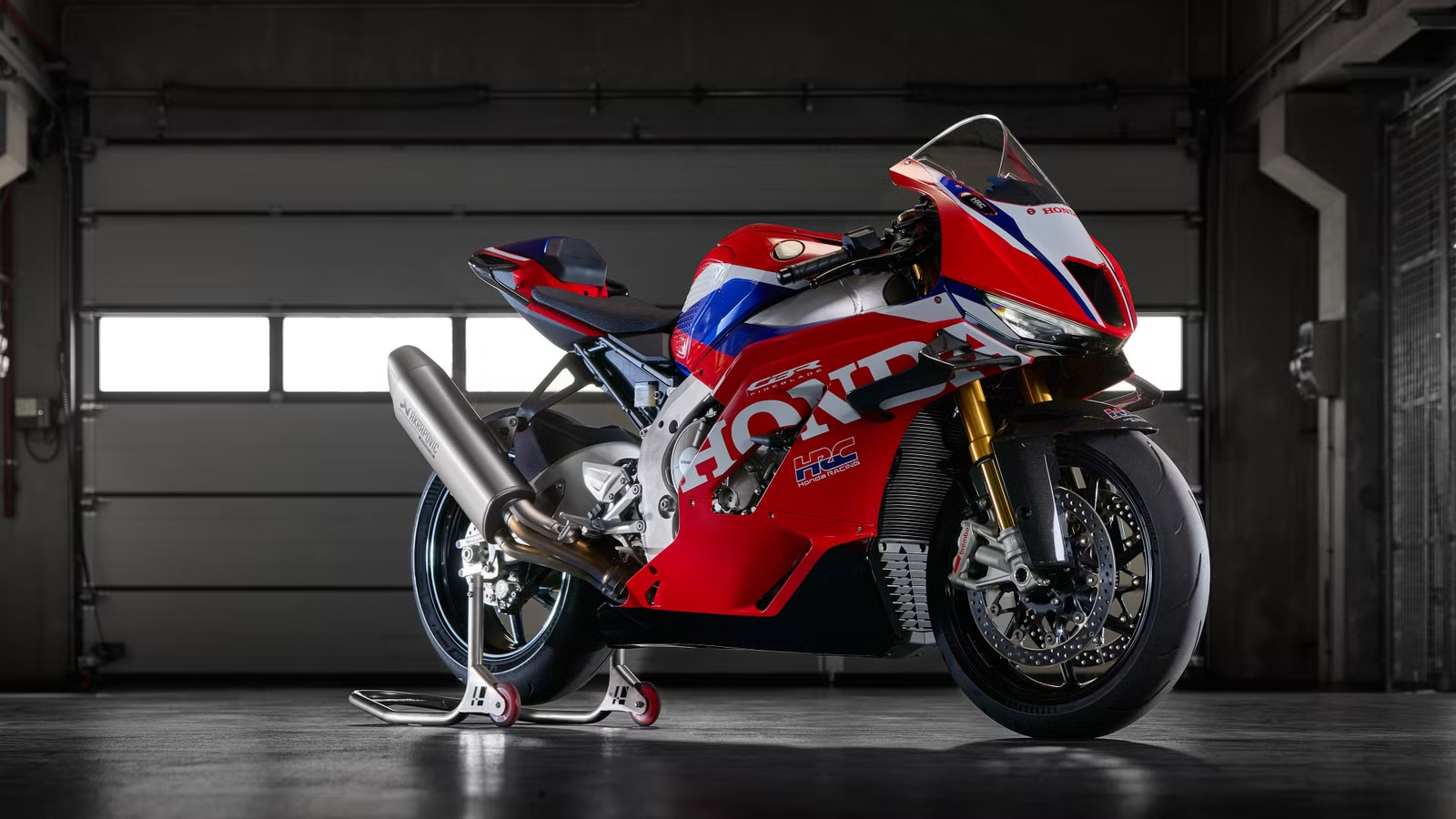
The 2027 Honda CBR1000RR-R Fireblade SP is already eyeing up racetracks far and wide with its bevy of updates for the coming model year. Honda announced a trio of updated Fireblade models, which include a base model, the Fireblade SP, and a new Honda CBR1000RR-R Fireblade HRC Works Edition, set to be the brand’s new homologation special that the brand says is the new foundation for its WorldSBK machine. American Honda has not confirmed what the 2027 Fireblade lineup will look like in the United States, but we’ll update this story as more information becomes available.

The Fireblade HRC Works Edition shares the SP’s new frame, swingarm, reworked 1,000cc engine, and redesigned bodywork, so we won’t rehash all of it here. For a deep dive into those changes, check out our 2027 Honda CBR1000RR-R Fireblade SP First Look. Instead, let’s focus on what separates the Works Edition from its SP sibling.
Engine: Same Heart, Race Intent
Under the bodywork, the HRC Works Edition uses the same updated 1,000cc inline-four as the SP, rated at a claimed 214.6 horsepower at 14,000 rpm and 84.1 lb-ft of torque at 10,500 rpm. As with the SP, a new two-stage Variable Air Funnel system to improve midrange performance, we also see bumped-up 13.8:1 compression, lighter magnesium engine covers, and a lightweight titanium Akrapovič muffler.

Since the HRC Works Edition will serve club-level and professional riders alike, the brand included several other race-focused updates, which are shared with the rest of the 2027 Fireblade lineup. A new cam sprocket widens the range of valve timing adjustments, and revised mainshaft and countershaft spacing opens more gear ratio options, giving teams more room to tailor the engine to a given circuit. Honda notes that altering valve timing or gear ratios isn’t permitted on public roads and affects the warranty. Unless you’re racing at a professional or near-professional level, it’s unlikely you’re going to dig into the transmission to update gearing, so the warning is somewhat of a moot point, but Honda’s race-focused intent is clear.
Chassis: Built To Be Adjusted

The HRC Works Edition is built around mechanical adjustability, setting aside the semi-active Öhlins suspension found on the SP model. The rake can be manually adjusted to let riders alter steering geometry to suit a given circuit, tire choice, or riding style, while an adjustable swingarm pivot allows tuning of anti-squat and anti-lift behavior under acceleration and braking. Honda, again, notes those adjustments aren’t permitted for road use. Out of the box, the Works Edition runs a steeper 23.8 degrees of rake and a slightly shorter 3.9 inches (99.8mm) of trail than the SP.
It also sits a touch taller, with a 33.3-inch (847mm) seat height and 5.3 inches (135mm) of ground clearance, compared to the SP’s 33.2 inches and 5.1 inches. Honda lists the European-spec curb weight at 441 pounds, about two pounds less than the SP.
Suspension and Brakes: Back to Basics

Semi-active suspension is out; conventional, mechanical Öhlins components are in: a 43mm NPX28-30 fork and a TTX36 shock. That makes sense for a bike born for racing, since semi-active suspension isn’t permitted in WorldSBK, and race teams want to tune everything with extreme precision.
Up front, Brembo Hypure Sports four-piston radial-mount calipers replace the SP’s Hypure units. Honda says they save 32 grams compared to the previous Stylema design while delivering more consistent braking under race conditions.
Aerodynamics: The Wings Are Back

Most base and SP model CBR1000RR-R Fireblades will lead their lives on public roads, meaning that the aerodynamic benefits of the HRC Works Edition’s winglets will never be realized. So, the base and SP go without winglets. Of course, the HRC bike’s Carbon fiber dual-element winglets mount to the fairing can be seen plain as day, with an upper wing surface 2.4 times larger than the previous design. Honda says the winglets assist with wheelie control under acceleration and add cornering downforce, claiming 3.5 times the downforce of the standard 2027 Fireblade at 186 mph (299 km/h). Carbon fiber rear seat ducts and a carbon front fender, shaped to work with the lower cowl sidepods, round out the aero package.
The Works Edition is a single-seater, with the passenger pegs and hangers removed. There’s also a bottom-neutral shift pattern, which only allows neutral to be selected when an inhibitor lock is released, and prevents riders from accidentally hitting a false neutral between first and second gear. Even the startup screen is different, as the TFT displays an HRC logo in place of the SP’s CBR logo.
Availability: Stay Tuned?

Honda has not released pricing for the HRC Works Edition, which comes exclusively in Ignition Red. Going a step further, American Honda has yet to confirm the model for the U.S. market. As soon as we have more information, we will update this. Bookmark your browsers to keep up with all 2026 EICMA coverage at TopSpeed.
2027 Honda CBR1000RR-R Fireblade HRC Works Edition First Look Image Gallery:
2027 Honda CBR1000RR-R Fireblade HRC Works Edition Specifications:
Engine:
|
Type |
Inline four-cylinder |
|
Displacement |
1000cc |
|
Bore x stroke |
81mm x 48.5mm |
|
Maximum horsepower |
214.6 horsepower at 14,000 rpm, claimed (European spec) |
|
Maximum torque |
84.1 lb-ft at 10,500 rpm, claimed (European spec) |
|
Compression ratio |
13.8:1 (up from 13.6:1) |
|
Valvetrain |
DOHC semi-cam gear train w/ finger-follower rocker arms; 4 valves per cylinder; 32.5mm intake valves, 28.5mm exhaust valves; 9-degree intake valve angle; revised cam timing; cam sprocket w/ expanded valve timing adjustment range standard on HRC Works Edition (adjustment not permitted for road use) |
|
Fueling |
PGM-FI electronic fuel injection w/ 2-Motor Throttle By Wire, 52mm throttle bodies, ram-air intake through headstock; 2-stage Variable Air Funnels (long below 11,750 rpm, short above). |
|
Exhaust |
Four oval-section downpipes to titanium Akrapovič muffler. |
|
Cooling |
Liquid, w/ bottom-bypass cylinder cooling |
|
Transmission |
6-speed manual w/ quickshifter; first gear 5 percent taller; mainshaft-to-countershaft spacing 68mm (up 3mm) for wider ratio options (ratio changes not permitted for road use); bottom-neutral shift pattern w/ inhibitor lock |
|
Clutch |
Wet multiplate w/ assist and slipper function. Cable actuation. |
|
Final drive |
Chain, 520 (from 525). |
Chassis:
|
Frame |
Twin-spar aluminum frame and swingarm |
|
Front suspension; travel |
Öhlins 43mm NPX28-30 inverted fork, fully adjustable (mechanical); 4.9 inches (125mm travel; Honda lists 90mm stroke) |
|
Rear suspension; travel |
Öhlins TTX36 monoshock w/ Pro-Link linkage, fully adjustable (mechanical); Honda lists 126mm stroke; 5.6 inches (143mm travel) |
|
Wheels |
Cast aluminum, seven-spoke hollow gravity die-cast |
|
Front wheel |
17 x 3.50 |
|
Rear wheel |
17 x 6.00 |
|
Tires |
Bridgestone Battlax Racing Street RS12 or Michelin Power GP2, radial ZR-rated |
|
Front tire |
120/70-ZR17 |
|
Rear tire |
200/55-ZR17 |
|
Front brake |
Dual 330mm x 4.5mm discs w/ Brembo Hypure Sports radial-mount 4-piston calipers (32 g lighter than previous Stylema); new Brembo master cylinder and lever |
|
Rear brake |
220mm disc w/ Brembo 2-piston caliper (axial mount) |
|
ABS |
Standard; IMU-based cornering ABS w/ Standard, Track and Race modes; rear ABS disabled in Race mode; rear lift control (not suppressed in Track mode) |
|
Electronic rider aids |
Throttle-by-wire (2-Motor TBW); Bosch 6-axis IMU; 3 default ride modes (Race, Road, Rain) w/ adjustable 5-level Power, 3-level Engine Brake, 9-level Honda Selectable Torque Control (HSTC), 3-level Wheelie Control plus off; 4-level Start Mode (6,000, 7,000, 8,000, 9,000 rpm); 3-level HESD; quickshifter; rear lift control; Emergency Stop Signal; 5-inch TFT w/ four-way switch and HRC start-up logo; SMART Key. |
Dimensions & Capacities:
|
Wheelbase |
57.1 inches (1450mm) |
|
Rake |
23.8 degrees (standard setting; adjustable) |
|
Trail |
3.9 inches (99.8mm) |
|
Seat height |
33.3 inches (847mm). |
|
Ground clearance |
5.3 inches (135mm) |
|
Fuel capacity |
4.4 gallons (16.6 liters) |
|
Estimated fuel consumption |
35.1 mpg (US; WMTC, 6.7 L/100km), claimed (European spec) |
|
Curb weight |
441 pounds (200 kg) |
Price & Warranty:
Source: Honda

Related posts
Latest Post


No Comments