
The Fastest EV Muscle Car Runs a 6-Second Quarter, Here’s Why Nobody Cares
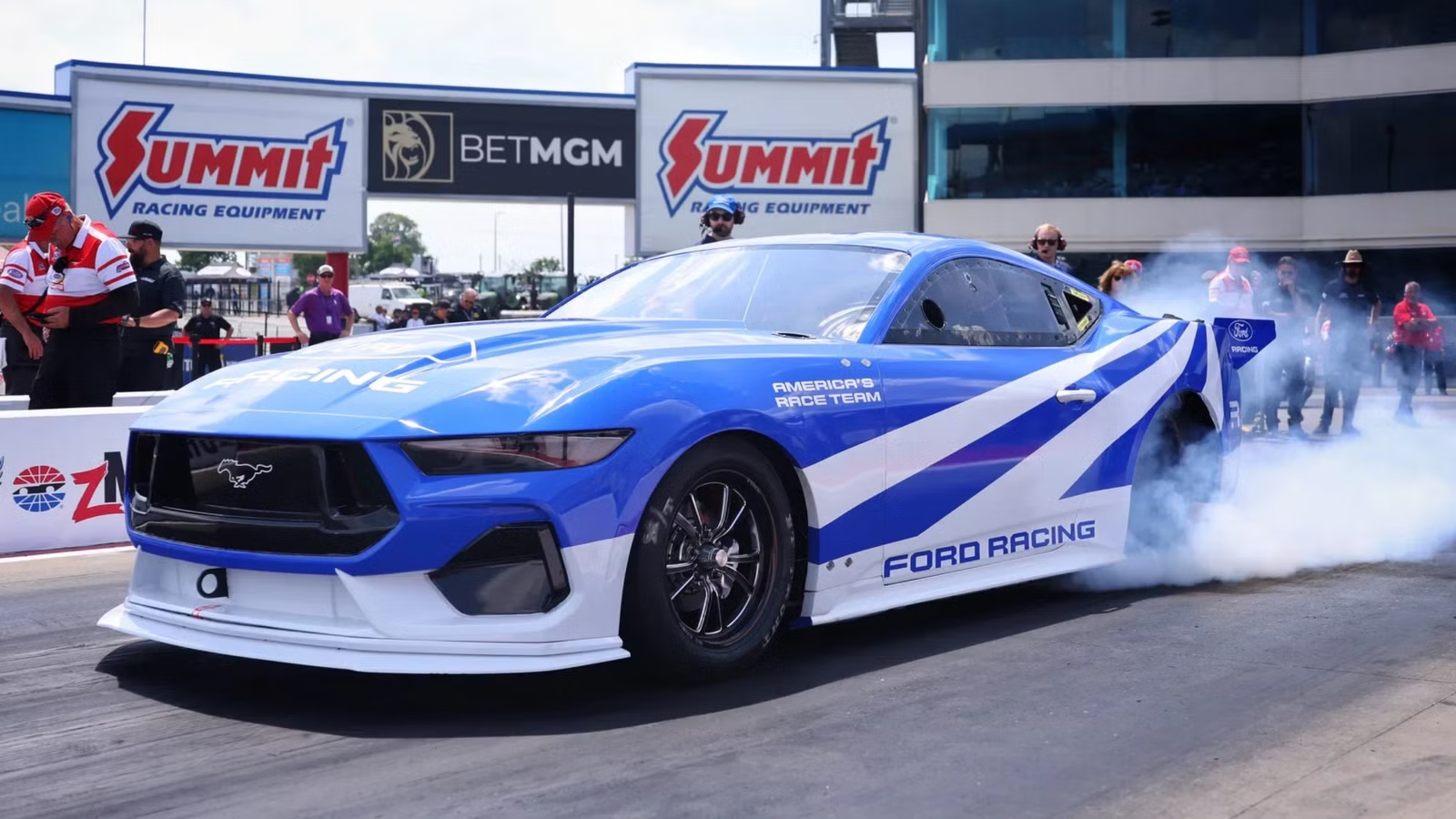
Top-fuel dragsters have 10,000+ horsepower, and top speeds in excess of 340 MPH, which destroy quarter-miles in 4 seconds or less. The 2026 Ford Racing Mustang Cobra Jet 2200 EV doesn’t have quite the power with 2,200 electro-ponies, but can stick an ET at 6.766 seconds at 222.36 MPH, which is pretty damn close and, quite frankly, a major achievement for something that is battery-powered. The thing is, almost nobody cares as this is the equivalent of a computer winning a chess game. It’s not real or even close to the same thing as an internal combustion engine that shatters records. Gearheads are thoroughly unimpressed with this EV that doesn’t even have gears in the technical sense, because it really feels like cheating. It’s like using AI to write your term paper or a Roomba to clean your house; there’s no human touch, so it’s really not an accomplishment.

The Mustang Cobra Jet 2200 is a purpose-built all-electric drag car that Ford developed for reasons that are kind of unclear. It’s not a street-legal ride and almost nobody knows about it, so it is not a great promotional tool that’s going to sell any factory Mustangs to anybody. It somewhat resembles a seventh-gen Mustang, but in a funny car sort of way, so it is, again, not a great advertisement for the iconic pony car. It also doesn’t compete in the top levels of NHRA drag racing with Top Fuel dragsters being the ultimate, followed by Funny Cars, and then Pro Stock, all of which are faster than the Mustang EV. This is essentially a misguided vanity project with no clear target demographic to impress.
While it may seem like we are dismissing the EV, and we are, with plenty more criticism to come, the Mustang Cobra Jet 2200 is nonetheless fairly impressive. Ford worked really hard to maximize the power-to-weight ratio of this EV and strove to push the limits of the technology. With an SFI 25.3D tube-frame chassis and a carbon-fiber body, the car is remarkably light, while its dual electric motors and inverters were built to weigh half as much as conventional ones but actually produce more power. With 2,200 hp and 1,340 lb-ft of torque in a car with a curb weight of 3,325 pounds, this is a genuinely quick machine, even if it doesn’t actually burn fuel.

The Mustang Cobra Jet 2200 uses four 900-volt, 32 kWh battery packs, with one that is movable to affect the weight distribution of the vehicle. It has a Reverse-Acting Centrifugal Clutch (RACC) 5-speed transmission that launches in direct drive, which was designed to eliminate tire spin. It also has a ton of software from launch control to torque optimization that ensures it delivers the right amount of power in every aspect of a drag race. Essentially, this car is nearly foolproof and largely drives itself, removing driver skill from the equation. Technically, somebody still has to steer it, but going in a straight line for 1,320 feet is something most people can manage.


The Mustang Cobra Jet 2200’s predecessor, the Mustang Super Cobra Jet 1800, had the record for an EV in the quarter-mile with a 7.62-second ET. When it comes to street-legal battery-powered cars, it was the Rimac Nevera R that set the standard with a blistering 7.9-second pass, with the standard Rimac Nevera posting a respectable 8.25-second run. Among the street-going EVs, the Pininfarina Battista, which was briefly the king of the track, could hit it in 8.55 seconds, and the Lotus Evija was close behind with 8.60 seconds. All of these EV times are quicker than the fastest street legal ICE machine, which is the 2023 Dodge Challenger SRT Demon 170, which scorched the quarter-mile track in 8.91 seconds.

In April 2026, the Mustang Cobra Jet 2200 had 12 passes at zMax Dragway in Charlotte, North Carolina under 7 seconds that exceeded 200 MPH. The best of those was a 6.766-second run with a peak trap speed of 222.36 MPH, and with that, it made history as the quickest EV of all time. This was not part of any competition; it was simply a demonstration of corporate achievement. Allegedly, Ford is working with the NHRA to develop an all-electric class of drag racing, which is sure to be immensely unpopular, much in the same way people are already over the EV craze for passenger vehicles. Just a few years ago, Ford was building a billion-dollar plant to produce mass quantities of F-150 Lightning EV pickups, and now those trucks have been discontinued, which should be a clue as to the viability of EV drag cars.
Why Nobody Cares About The Mustang Cobra Jet 2200

What gearheads love most about a badass ride with an internal combustion engine is that there are endless possibilities to make that sucker even more badass. They love tinkering with the engine, tuning it and bolting on power amplifiers. With an EV, it’s just electric motors and battery packs, which presumably can be upgraded, but it is not the same thing as fitting a larger supercharger or a performance exhaust. Also, realistically, increasing the performance of an EV involves a software update, which is a far less visceral pursuit. Enthusiasts want to wrench on something, not input computer code, because it is not nearly as visceral an experience.
Then there’s the automated nature of an EV drag car like the Mustang Cobra Jet 2200, which makes it so uninspiring. As mentioned, with all the systems in place, the car effectively won’t allow a poor launch, so virtually any driver can turn in a decent ET. With a rear-wheel-drive ICE car, it actually takes some skill to get off the line clean and power it across the finish line. A 1968 Dodge Hemi Dart factory drag car had nothing close to a modern safety feature like traction control, let alone launch control, and was capable of quarter-mile runs in the 10s with a pro behind the wheel. If an average person tried to race that car, they would likely end up sideways into the wall, possibly in a ball of fire.

The biggest reason why the Mustang Cobra Jet 2200 is eliciting nothing but yawns from enthusiasts is because it doesn’t seem real. Consider a skilled artist with a beautiful sense of composition, technical mastery, and originality who spends a year creating a masterpiece. Meanwhile, someone asks an AI tool to generate a picture that looks almost as good, but is it really on the same level? The answer is obviously no, and that is what any EV drag car is: an inferior cyber-generated imitation of a human-created work of art. It is lazy and unskilled, and soulless and uninspiring. That being said, the 500-hp Mustang Dark Horse is evocative, and Ford should be using its time trying to find a way to extract 1,000+ hp from its impressive gas-burning Coyote 5.0-liter V-8 if it wants to impress enthusiasts.
Sources: Ford

Related posts

Latest Post


No Comments