The Used Luxury Sedan That’s Actually Worth Buying
7 minutes reading
Sunday, 13 Sep 2026 10:01 0 9 autotech
Used luxury sedans have a reputation problem, and most of the time it’s earned. Buyers chase the badge, then discover the running costs that come with it. Buyers can expect five-figure repair bills, warranties that expired years before the loan did, and a resale curve that makes trade-in day sting twice. But there’s an exception hiding in plain sight. This three-year-old Genesis flagship sedan has absorbed the same brutal depreciation as its German rivals, except this time, the car underneath the discount doesn’t come with the baggage.
The math on a used luxury sedan usually looks great until you own it. A three-year-old flagship from Munich, Stuttgart, or Ingolstadt might be 40 percent or 50 percent cheaper than it was new, but the factory warranty is gone or nearly gone, and what replaces it is a maintenance schedule built around expensive parts and specialist labor. RepairPal pegs average annual repair costs at roughly $968 for BMW and $908 for Mercedes-Benz, both well above the industry average.
Edmunds’ cost-to-own data tells a similar story at the point that matters most to a used buyer—the first year after the factory warranty runs out—estimating around $935 in repairs for a BMW 5 Series and roughly $990 for a Mercedes-Benz S-Class. None of that is disqualifying on its own. But it’s exactly why “cheap to buy” and “cheap to own” are two different sentences with German luxury sedans, and why so many buyers end up underwater on repairs within eighteen months of a great-looking deal.
The 2023 Genesis G90 Delivers Flagship Luxury Without The German Headaches
The G90 breaks that pattern because Genesis built its ownership case around the exact weak point that trips up its rivals. Every G90 comes with a ten-year, 100,000-mile powertrain warranty, compared to the four-year, 50,000-mile coverage that BMW, Mercedes, and Audi all offer.
That gap matters enormously on a three-year-old car: a used G90 is still riding on factory powertrain protection long after a comparable 5 Series or E-Class has aged out of coverage entirely. The reliability data backs up that warranty confidence rather than contradicting it. Edmunds estimates a G90 will need about $754 in repairs during its first year out of warranty, versus roughly $935 for a BMW 5 Series and $990 for a Mercedes-Benz S-Class.
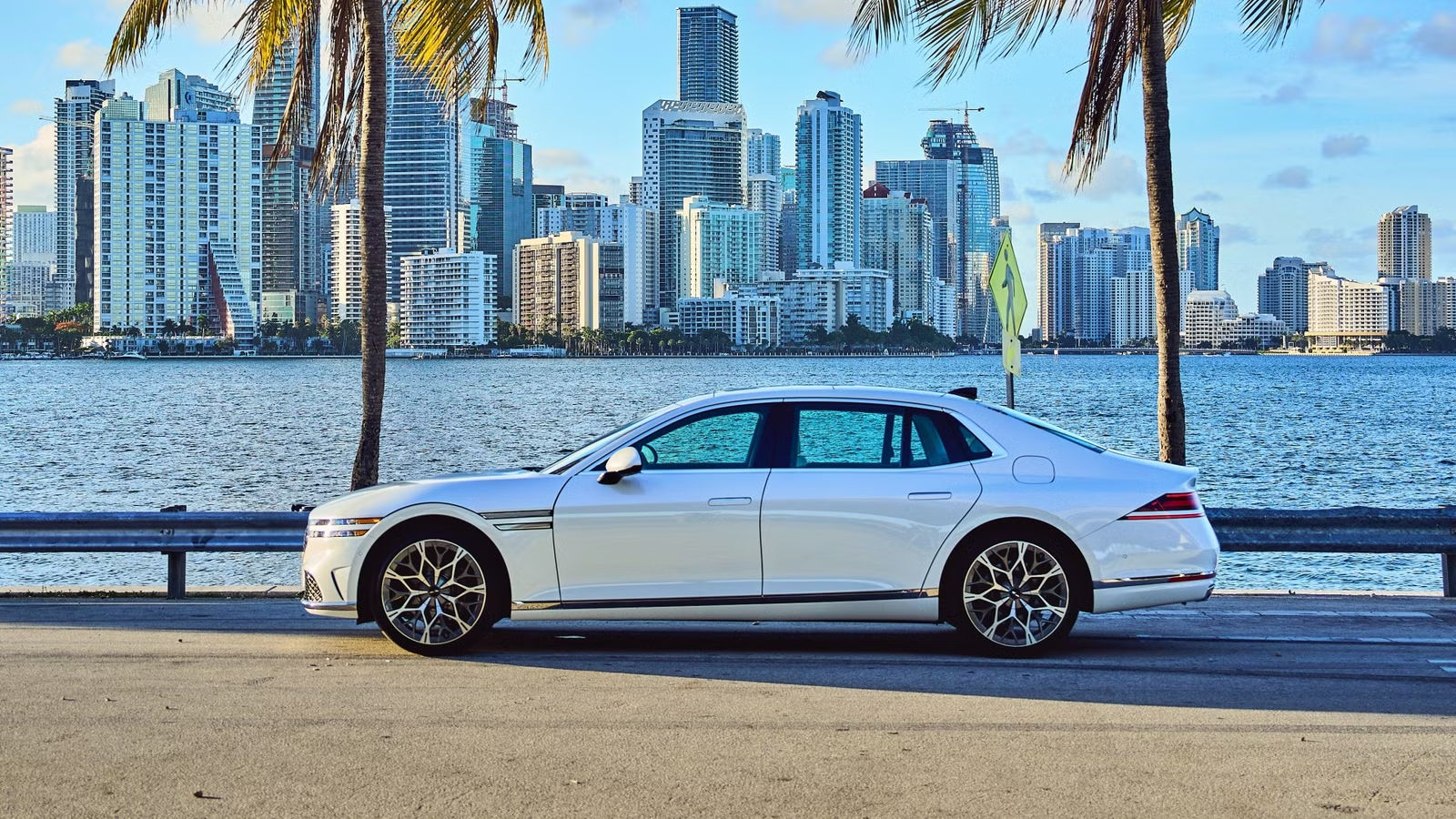
A rear 3/4 shot of a 2023 Genesis G90Genesis
RepairPal’s broader brand data shows Genesis averaging $524 a year in repair and maintenance costs, well below BMW’s $968 and Mercedes’ $908. None of this makes the G90 bulletproof; Genesis still trails the likes of Lexus, and J.D. Power’s dependability studies put the brand in the middle of the pack rather than at the top. But “middle of the pack, at half the repair bill of a German flagship, with double the warranty coverage” is a very different proposition than “cheap German luxury with the meter already running.”
First-Class Cabin, 409 Horsepower, And Infotainment That Still Feels Current In 2026
Front shot of 2025 Genesis G90Chase Bierenkoven | TopSpeed
The 2023 Genesis G90 doesn’t ask for a reliability trade-off in exchange for feeling like a proper flagship. The standard 3.5T trim runs a twin-turbocharged 3.5-liter V6 making 375 horsepower and 391 pound-feet of torque, paired with an eight-speed automatic and standard all-wheel drive.
Step up to the 3.5T e-Supercharger and Genesis adds a 48-volt mild-hybrid system with an electric supercharger, pushing combined output to 409 horsepower and 405 pound-feet. That’s enough for a 0-60 mph run in 4.8 seconds, properly quick for a full-size luxury sedan that also weighs nearly 4,900 pounds and prioritizes ride comfort over lap times.
Comfort Focus That Shows Up Everywhere Else In The Car
A shot of the dashboard in a 2023 Genesis G90Genesis
The e-Supercharger trim adds air suspension, rear-wheel steering, and power-cooled massaging rear seats, while even the base 3.5T ships with a panoramic sunroof, heated and cooled front seats, heated rear seats, and rear power sunshades as standard equipment. Reviewers who’ve spent real time in the car consistently describe the ride as smooth and the cabin as genuinely quiet, with steering and body control that stay composed through corners despite the car’s size.
The technology suite holds up just as well three model years later; a fully redesigned interior for 2023 means the G90’s infotainment layout, driver-assistance features, and materials quality don’t feel like they’re a generation behind what Genesis is selling new today—which isn’t something every used luxury sedan buyer can say about their car’s tech stack.
Where The G90 Makes Sense Financially After Its Biggest Depreciation Hit
Genesis G90 3.5 Liter V6 Twin-Turbo with 48V e-superchargerGenesis
Here is where the used-buying case gets interesting. The 3.5T e-Supercharger stickered at roughly $99,795 when new, and the base 3.5T started at $89,495. Three years later, Kelley Blue Book puts current resale value for a 2023 G90 at around $45,200, with a trade-in value near $37,700, a total drop of about $44,325, or 49 percent of its original value. Private-party asking prices land a bit higher, in the $45,500 to $47,700 range depending on trim and condition.
83 Percent Of Useful Life Left At Only 60 Percent The Original Price
Shot of 2025 Genesis G90 3.5T E-Supercharger rear seats in whiteGenesis
That’s a steep curve, but it’s also mostly finished. CarEdge’s depreciation analysis specifically flags the 2023 model year as the single best value year for the G90, noting that a buyer picking up a 2023 pays only about 60 percent of the original price while the car still retains roughly 83 percent of its useful life. So you’re essentially buying a car that stickered near $90,000 to $100,000 for somewhere in the mid-$40,000s, and the steepest part of the depreciation curve—the part that punishes early owners—has already happened to someone else.
A 2024 or a low-mileage 2021 can also work, according to CarEdge’s broader model-year comparison, but the 2023 is the sweet spot because it combines the newest cabin and tech update with the post-crash pricing. Compare that to a similarly aged S-Class or 7 Series, where the sticker starts $10,000 to $15,000 higher and the repair bills start almost immediately after purchase, and the G90’s discount stretches further than the raw depreciation percentage suggests.
Why 20 MPG Is The G90’s Biggest Flaw — And Why It Doesn’t Matter
None of the numbers above matter if the car is miserable to actually own, and that’s the last box the G90 checks. Between the extended powertrain warranty, below-average repair costs, and a redesigned interior that still feels current, a used 2023 G90 asks very little of its owner relative to what it delivers.
You’re not gambling on air suspension gremlins outliving a four-year warranty, and you’re not budgeting for German dealer labor rates on routine maintenance. The car’s biggest real-world compromise is fuel economy; EPA ratings land at 20 to 21 mpg combined depending on trim, which is unremarkable for the segment but not a dealbreaker for a flagship built to prioritize comfort and quiet over efficiency.
A rear 3/4 shot of a 2023 Genesis G90Genesis
For a buyer who wants genuine flagship presence, twin-turbo power, a hushed cabin, massaging rear seats, and styling that doesn’t read as a budget alternative—without inheriting someone else’s looming repair bill—the 2023 G90 is difficult to beat on the used market right now. It’s not the safest reliability bet in the segment; Lexus still owns that title. But among full-size luxury sedans that have taken a genuine depreciation hit and come out the other side still under meaningful warranty coverage, the G90 stands alone. That’s the case for buying one now, while the pricing sweet spot is still open and before word gets around.
Base Trim Engine
3.5L Twin-Turbo V6 Gas
Base Trim Transmission
8-Speed Automatic
Base Trim Drivetrain
All-Wheel Drive
Base Trim Horsepower
375 hp
Base Trim Torque
391 lb-ft @ 1300 rpm
Fuel Economy
18/26 MPG
Make
Genesis
Model
G90
Segment
Large Luxury Sedan
Infotainment & Features
8 /10
Sources: Genesis U.S., CarEdge, Kelley Blue Book & RepairPal












No Comments