
The Sub-$25,000 Harley Touring Bike That Rewards Riders Who Go Far
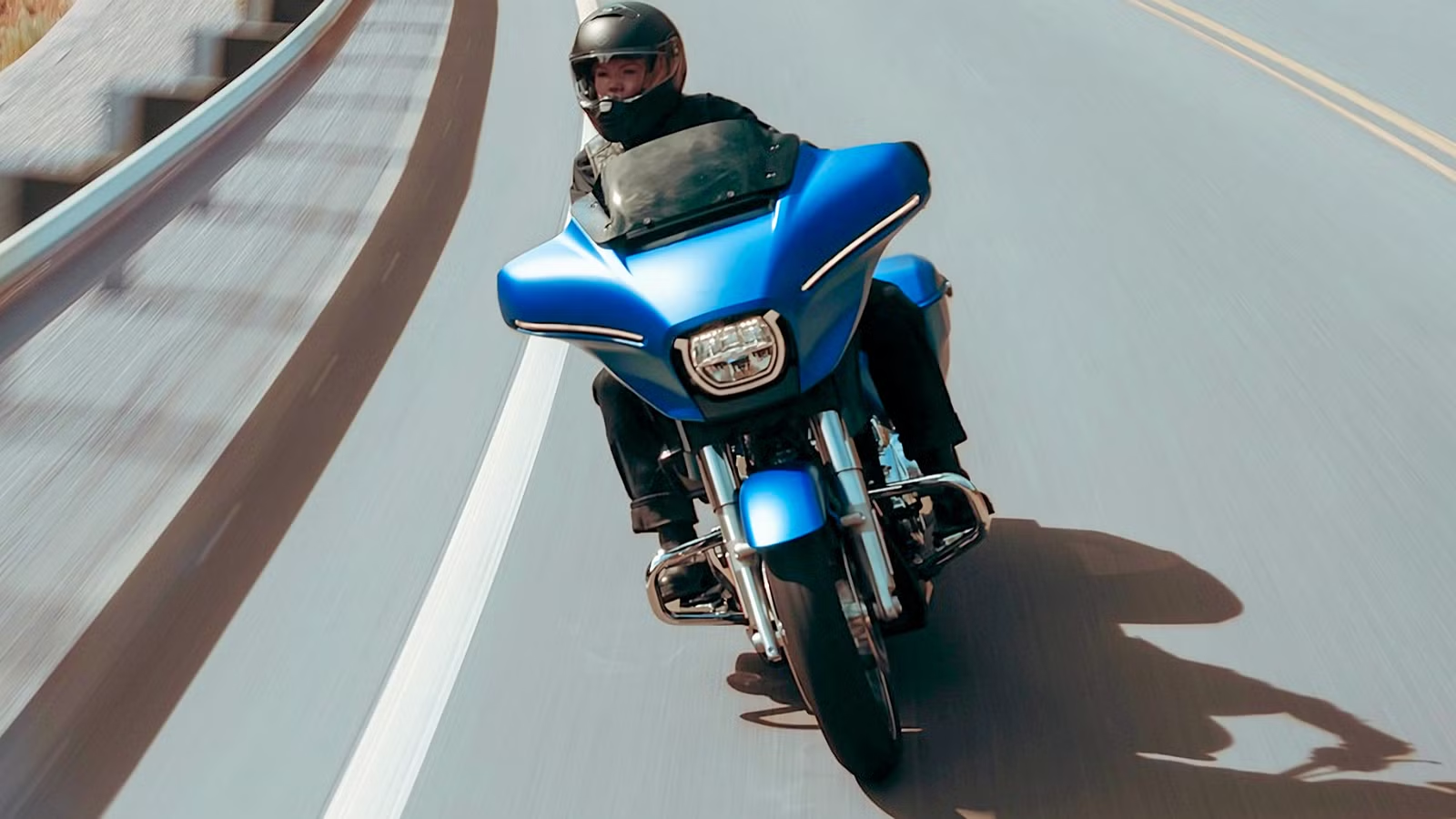
In 2026, Harley-Davidson’s touring motorcycles have a budget problem for the most part. Expect a big infotainment screen, premium paint, and enough comfort tech to survive a thousand-mile weekend, and the sticker price climbs past $30,000. Some flagship trims now brush up against $50,000. Yet the whole point of a touring bike is supposed to be simple: get you somewhere far away, comfortably, without draining the bank account before you’ve even left the driveway. Luckily, Harley has made minor amends to its Grand American Touring range, and you can get a premium bagger under $25,000.
Harley’s Touring Comfort Has Become Expensive Over The Years
Ten or so years ago, a genuinely comfortable touring bike didn’t cost dramatically more than a well-equipped commuter car. That math has shifted. Harley-Davidson’s own CVO and Limited-tier trims — the ones with the biggest screens, the heated everything, the premium Rockford Fosgate audio — have quietly pulled the average price of a “touring” motorcycle upward across the whole segment. Every manufacturer’s flagship keeps setting the bar a little higher, and the rest of the lineup drifts up to meet it. Comfort and tech, once the reason to spend more, are edging toward becoming the price of entry just to be taken seriously as a real tourer.

The numbers back this up. The Road Glide—with its chassis-mounted fairing—sells for over $27,000 without any options. This rises beyond $32,000 if you want a full-dresser, and we’re not even at the CVO range yet. That badge starts at $45,000 and goes beyond $55,000. As a result, a large budget of $25,000 can seem insufficient, leaving you scratching your head over what to do. That’s where Harley’s cunning new market move comes into play, positioning one of its heavy hitters under rivals like the $25,500 Honda Gold Wing and $27,999 Indian Challenger Limited.
The Street Glide Is The Sub-$25k Entry To Harley-Davidson’s Touring Range
Base Price: $24,999


Enter the 2026 Harley-Davidson Street Glide, carrying a lower MSRP of $24,999 (plus an $895 destination charge). That is a sizable $2,750 drop in the entry price, helping this sit well below its own sibling: the $27,799 Road Glide. What’s the catch? Just pillion accommodations, as Harley sells the $24,999 model as a “one-up” version, without any pillion seat or pegs. Other than that, the base Street Glide isn’t a stripped-out placeholder built to get a low number onto a spec sheet. It comes standard with the batwing fairing, hard saddlebags, and the same 12.3-inch touchscreen the pricier bikes use. It’s a legitimate touring motorcycle that happens to cost less.
Big Milwaukee-Eight Twin Power Built For The Long Haul

Under the tank sits the Milwaukee-Eight 117 — not the VVT-equipped version, but it’s still plenty for what this bike is built to do, rated at 105 horsepower and 130 lb-ft of torque. Harley says the torque arrives low in the rev range, which means passing a semi on a two-lane highway doesn’t require a downshift and a running start. Paired with the six-speed transmission and belt final drive, it’s the kind of engine character that rewards patience over revs — exactly what a bike meant to eat highway miles, not lap a track, should feel like.
Heat Management And Powertrain Efficiency On All-Day Runs

Big V-twins run hot, and stop-and-go traffic used to mean roasting your inner thighs while idling at a light. The Street Glide (and Road Glide)’s Milwaukee-Eight uses liquid-cooled heads and a center-mounted radiator specifically to route that heat away from the rider’s legs instead of into them, which is significant on a 95-degree highway crawl. On the open road, Harley estimates around 44 mpg combined, and paired with the 6-gallon tank, that works out to somewhere north of 250 miles between fuel stops on a steady run. For a bike whose entire pitch is going far, that’s not a footnote.
Suspension And Ergonomics Tuned For Mile-Munching

The Street Glide is not particularly small. It weighs 811 pounds in running order, so this is a motorcycle where suspension tuning has a big effect on how tiring a ride becomes. Harley describes the rear suspension as ride-tuned specifically for long-haul comfort, and the current setup uses dual outboard emulsion shocks with preload adjustability and about three inches of rear travel. That ability to adjust the rear end becomes useful when a solo rider suddenly adds luggage, camping gear, or a passenger. The bigger point is what happens over time. A suspension setup that keeps bumps from constantly feeding into your back, hips and shoulders may not impress someone riding around the block.
Ergonomics Meant For Long Distances

Harley lists a 26.4-inch laden seat height, while the riding position is upright, with spacious floorboards allowing the rider to move their feet and change position during longer stints. The one-piece seat is also shaped specifically around longer rides rather than simply looking good in a showroom. On the go, you’ll also appreciate the wind protection. The current Street Glide’s batwing fairing has been shaped using computational fluid dynamics to cut down on helmet buffeting. And better aero here isn’t about styling points. It’s fatigue management, and it compounds in a rider’s favor the same way bad ergonomics works against them.
Tech And Practicality That Keeps Distance Riders Oriented

The 12.3-inch Skyline OS touchscreen runs turn-by-turn navigation, wireless Apple CarPlay, and selectable ride modes, and it’s genuinely useful three states from home when cell signal gets patchy and a paper map isn’t exactly in anyone’s tank bag anymore. Plotting a multi-day route, or rerouting around a storm without pulling over to dig out a phone, is the kind of feature that matters more the farther a rider actually goes — which is more or less this whole bike’s argument on one screen.
Saddlebag Capacity And Touring Practicality

The saddlebags use redesigned one-touch latches, easy enough to work even with thick gloves on a cold morning, and between the two of them hold 2.42 cubic feet of gear — enough for a genuine multi-day trip without immediately reaching for a passenger top box. Riders who want more can still bolt on an accessory Tour-Pak down the line, but the standard bags alone cover most weekend and week-long rides without needing extra hardware from day one.
None of this makes the Street Glide the most powerful, most tech-laden, or most photogenic bike in Harley’s own lineup — the Limited and CVO trims exist for riders chasing exactly that. However, strip away the badge-chasing and look at what actually matters on a 500-mile day, and the base Street Glide covers nearly all of it for almost $8,000 less than the trim one step above it. That’s the real deal behind the sub-$25,000 price tag: the payoff isn’t visible in a parking lot.
Source: Harley-Davidson

Related posts



Latest Post


No Comments