
The Used Cruiser That Still Looks Expensive After A Decade
Cruisers have always been categorized as motorcycles where style matters more than performance. The long wheelbase, exposed components, chrome details, and the riding posture all contribute to a cruiser motorcycle’s identity. Then, the identity starts to fade, and new-age examples take center stage with their swagger. However, every once in a while, there comes an exception that defies this norm of aging with time and becomes ‘aging like fine wine’. These motorcycles keep the charm they had at launch, and they still do today. In the cruiser world, a six-cylinder Honda from decades ago does that quite well.
What Makes A Cruiser Age Gracefully?

Desirability may not apply to all cruiser motorcycles; however, for the few that do, several factors contribute to their longevity. A geometric silhouette that runs from the headlights to the back fender gives cruisers a commanding stance for years to come. Agelessness comes down to the materials used, and for a cruiser, metal, leather, and chrome are the key deciding factors.
They’re not only superior to other materials, but also durable and can be refurbished without losing their original essence. Like the body, the engine is also an art, and cruisers proudly flaunt it. Instead of hiding it behind a plastic casing, cruisers display the cooling fins, pushrod tubes, exhausts, and other components, turning engineering into visual craftwork.

Plus, the use of exceptional mechanical parts means they easily outlast technological advances. When these factors merge into an identity rather than simply a purpose, they look appealing for ages. Only a few cruisers throughout history have lived up to this reputation, and Honda did it with one of the most outrageous cruisers, the Valkyrie Rune.

The Honda Valkyrie Rune Still Looks Like A Million Bucks

Honda has never been shy of experiments, but the Valkyrie Rune takes the crown. This ‘experiment’ dates back to 2000, when then-designer Martin Manchester was given complete freedom to design a series of boundary-pushing, radical concepts for one of their projects. Four clay models (T1, T2, T3, and T4) were created and put on display a year later to gauge audience response.
While all four drew praise from the crowds, the T2 concept captured their unwavering attention. The design was impossible, which is mainly why the masses fell in love. Surprisingly, Honda took up this challenge, and the late Ray Blanc instructed the team to build the bike exactly as it looked. Normally, engineers put in logic to save money and make mass production easier. However, in the rare instances of automobile history, the design team was given absolute power.

The specialized engineering team overcame the frame, the tank, and every manufacturing hurdle, part by part. Two years later, they achieved the impossible, and Honda shocked the world by unveiling the Valkyrie Rune. The production version was identical to the T2 concept showcased, proving what Honda was truly capable of.
The Custom-Built Charm Came At The Cost Of Rarity

Honda built the Valkyrie Rune completely from scratch, and the money that went into production was no joke. At the time of debut, the standard variant cost $24,499, and the upgraded version with chrome wheels came at $26,999. Given its release year, the Rune was easily one of the most expensive motorcycles available. Yet, this was hardly a percentage of what it actually cost to produce one bike.
Reports put the production cost of one Valkyrie Rune between $100,000 and $150,000, with Honda selling at a minimum loss of $75,000 per bike. Honda never officially revealed a production number. It was alleged that around 3,000 units were made, and one unit was assigned to each licensed dealer in North America. Honda incurred a total loss of 225,000 USD on the whole project.
From an accounting perspective, this was one of the worst financial investments Honda ever made. However, what many would consider a failure, Honda saw as a hit. They viewed it as a ‘passion project’ rather than a commercial one. Honda aimed to grab global attention and prove its manufacturing might. Safe to say, the Valkyrie Rune did exactly what they intended.
A Massive Flat-Six And Honda’s Engineering Marvel Compensates For The Old-School Tech

At the heart of Valkyrie Rune is a massive monolith that establishes the bike’s presence. Borrowed from the famous Gold Wing platform, the Rune features a heavily modified liquid-cooled flat-six, producing 1,832cc. The engine, however, is fundamentally re-engineered into a boxer layout that cancels out vibrations and delivers a staggering look.
It churns out 118 horsepower, and with 123 pound-feet of torque at 4,000 rpm, it delivers pulling power right at the twist of the throttle. The layout and six-into-two exhaust system also create a sound unique to the bike. Instead of the usual thumping sound of a cruiser, the Rune produces a howl that sounds more like an aircraft upon acceleration than a motorcycle.
Honda’s Engineering Keeps The Rune Feeling Special

Standard cruisers are usually held together with steel tubing. However, the Valkyrie Rune isn’t a standard cruiser, and steel tubing can’t support its massive engine and body. To solve the crisis, Honda engineered a vehicle-exclusive, gravity-die-cast aluminum diamond frame. Its rigidity ensures the 100-inch-long motorcycle doesn’t flex or bend under heavy usage.
Honda engineers went all out in suspension as they dialed in a MotoGP-inspired setup for the Rune. This is evident in the rear, which features a single-sided cast aluminum swingarm adapted from the RC211V’s technology. The top of the shock absorbers mounts directly on the swingarm, eliminating the bumps usually felt in the seat and freeing up space to lower the seats. The front features a trailing bottom-link suspension, which uses two pushrods to transfer movement to the shock absorbers.

This setup cancels out the usual ‘brake-dive,’ and the bike stays completely level when you apply the front brakes. To stop the 794 lbs (dry weight) anchor, Honda built its largest-ever brakes at the time. The front features dual 330mm full-floating discs paired with two three-piston calipers. The rear has a single 336mm disc engaged by a two-piston caliper. The motorcycle also integrates a Combined Braking System (CBS), ensuring braking power is applied equally at both ends for absolute stability.
No Electronic Intrusion Dulls Down The Ride

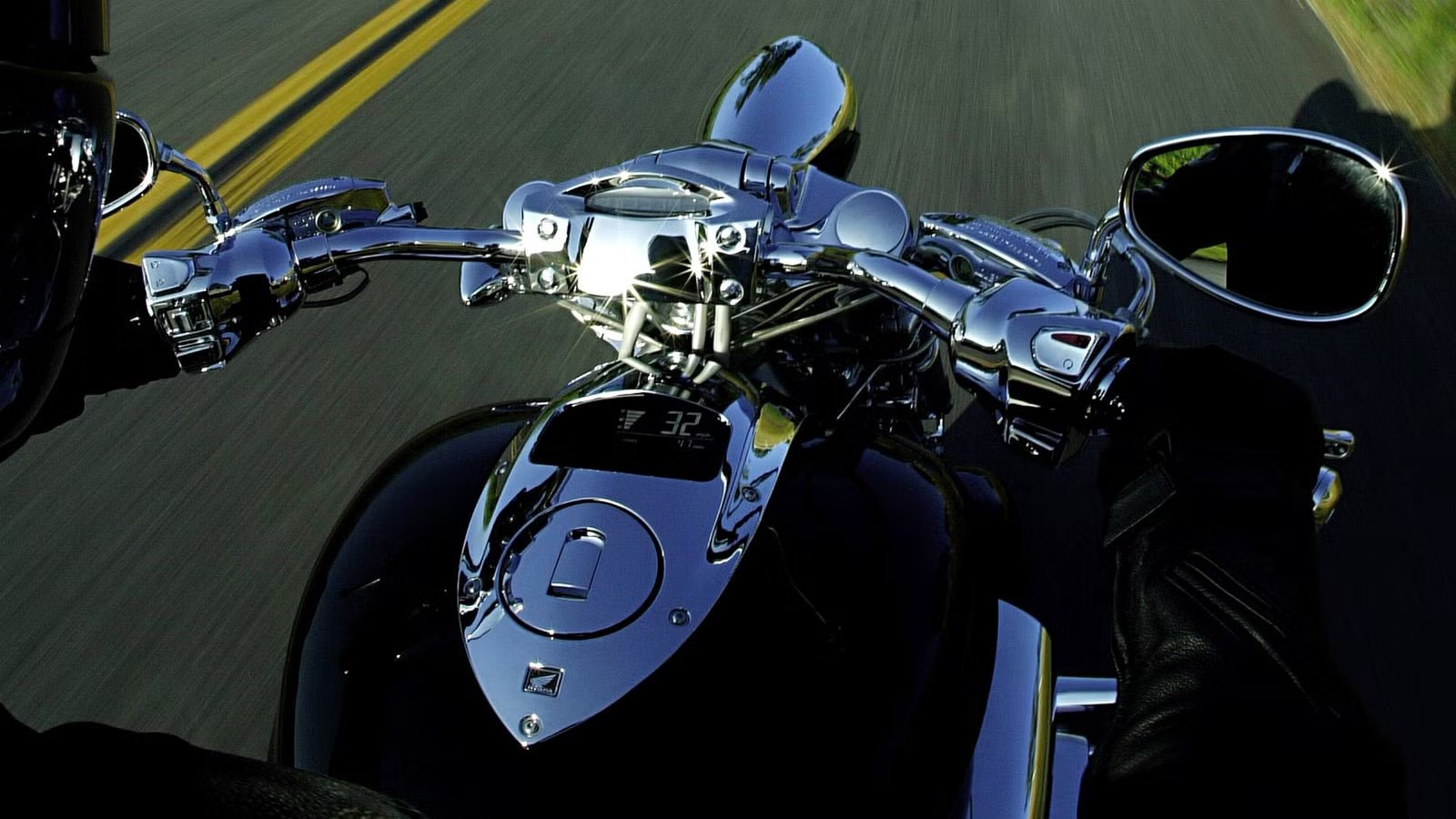
The Valkyrie Rune’s only technological advancement is its engineering. Built at the onset of the digital revolution, Honda strictly steered away from computers. It offers no safety features, ride modes, or adjustable suspension that are considered basic inclusions for a cruiser. The only visible ‘tech’ was a simple, minimalistic display on the 6.1-gallon fuel tank that displayed only the speed, the fuel gauge, and the trip meter.
This was indeed a huge void, and to fill it apart from the technology, Honda’s only option was to provide marvelous hardware, and that they did. They provided stability through geometry, anti-dive through physics, and raw, no-nonsense throttle power. Honda understood the assignment and delivered a chef-d’oeuvre that proved its engineering prowess.
20 Years Later, The Rune Still Looks Like Money

The Honda Valkyrie Rune is one of those gems that looks its part and holds its value no matter the year. The seamless tank with no visible welds, the trailing rear fender that hugs the tires to the end and hides the subframe, and the knowingly exaggerated engine size that gives the bike presence have kept the design evergreen. Coupled with the limited production, the Rune became an instant rarity.
All these factors also contribute to its high valuation even after two decades. The MSRP at launch was around 25,000 USD (keeping both variants in mind). According to the Kelly Blue Book, the trade-in value is $16,600, while the typical listing price is about $21,000. In short, the engineering marvel Honda crafted has matured beautifully and can easily command a significant premium over its MSRP, despite being 20 years old.
Source: Honda Powersports

Related posts



Latest Post


No Comments