
The Sport Bike That Keeps Winning Riders Over
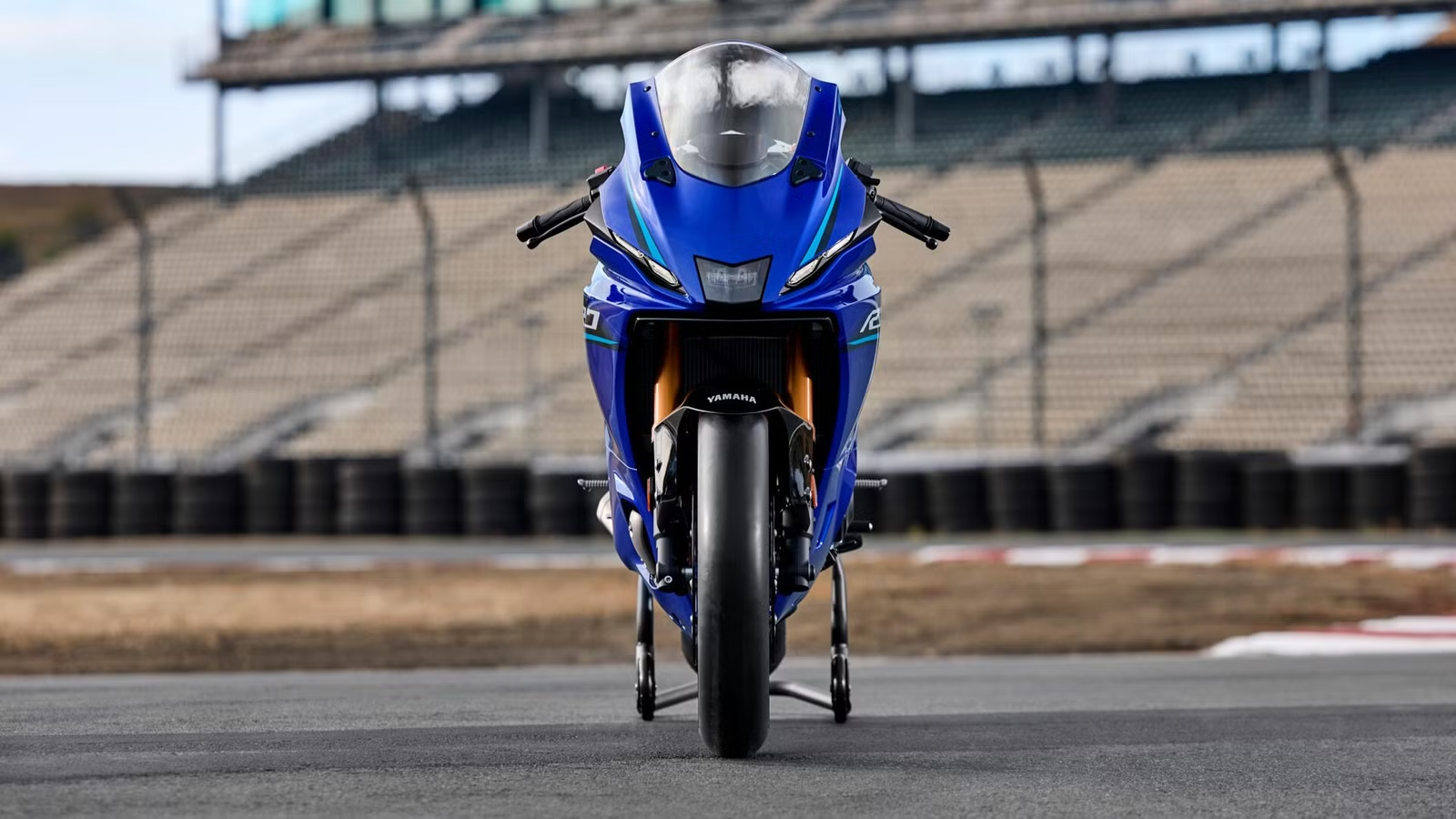
Sport bikes used to ask a lot of a rider. Buy one, live with the wrist pain, and call it love. That trade worked when riders were younger, track days were the weekend default, and a cramped-up riding position was just part of the deal. Riders then started to want something different — a bike that’s genuinely fun on a Tuesday commute, capable enough for a Saturday track day, and doesn’t leave you limping into brunch on Sunday. As a result, the middleweight class of sport bikes has shifted toward a more balanced idea. And there’s one Yamaha that is attracting riders all over the world since its inception.
Winning Riders Over Is A Tough Task For Sports Bikes
For decades, sport bikes were a tough sell outside a very specific crowd. Aggressive ergonomics, peaky power delivery, tiny fuel tanks, and seats that turned a 45-minute ride into a form of punishment — these bikes were built for the racetrack and merely tolerated on the street. That reputation kept the segment niche. Casual riders, new riders, and anyone without a chiropractor on speed dial tended to look elsewhere.

The shift happened when manufacturers stopped chasing bragging rights and started chasing versatility instead. Middleweight twins with usable midrange power, friendlier riding positions, and electronics that don’t punish a learning curve opened the segment up to a much wider audience. A handful of bikes deserve credit for that shift, but one Yamaha has arguably done it better than anyone else.
The Yamaha YZF-R7 Has Been A Popular Midweight Choice Since Its Debut
Base Price: $9,399


That bike is the Yamaha YZF-R7, and it didn’t get here by accident. The 2026 YZF-R7 starts at $9,399, a figure that puts it comfortably under the $10,000 mark, which most riders treat as a psychological ceiling. That price gets you a choice of three colorways — Team Yamaha Blue, Raven, and the surf-inspired Breaker Cyan/Raven — all identically equipped. Riders who want a bit more flash can step up to the 70th Anniversary Edition for $9,699, which wears a white-and-red speedblock livery pulled straight from the legendary 1999 R7 OW02, complete with gold tuning fork emblems. Either way, this remains one of the most complete middleweight packages money can buy in the U.S. right now.
Filling the Void with R-Series DNA

When the R7 arrived for 2022, some riders were disappointed. They expected an evolution of the screaming inline-four R6 and got a 689cc parallel twin instead. On paper, it looked like a major step down in peak performance. In practice, however, the R7 turned out to be a different kind of sport bike. Its CP2 engine, compact dimensions and aggressive chassis gave it enough attitude for the track without making everyday riding miserable. It was less intimidating, less expensive, and more useful at normal road speeds than the high-strung machines it was often compared with.
Over time, the R7 has spent every year quietly proving critics wrong. The major 2026 update addresses some of the R7’s biggest weaknesses while adding technology that would have seemed absurd at this price point a few years ago. The result is much closer to a complete all-round sport bike than the motorcycle that first appeared in showrooms.
Why The YZF-R7 Keeps Winning Riders Over

For new riders, the R7 removes most of the intimidation factor that scares people away from sport bikes altogether. Reviewers have pointed out a manageable power delivery and a forgiving chassis that means the learning curve doesn’t feel like a cliff. At 32.7 inches, the seat height is low enough for most riders to plant both feet confidently at a stoplight, and a claimed 417-pound wet weight keeps it manageable at parking-lot speeds — small details but enormously useful to someone throwing a leg over a sport bike for the first time. That accessibility is exactly why the R7 quickly became Yamaha’s best-selling motorcycle across its entire lineup — not just its sport bike range — since it made its debut in the USA back in 2022.
Experienced Riders Might Not Outgrow It, Either

What’s more impressive is that the R7 doesn’t get boring once a rider levels up. It’s track-day-ready straight from the factory, with a chassis that rewards precise inputs over raw horsepower. A deep aftermarket and accessory ecosystem, backed by an active owner community, makes personalizing or upgrading one easy. And plenty of riders trading down from liter-class superbikes end up here on purpose, chasing genuine enjoyment on a bike they can actually use to its full potential. It also happens to be the weapon of choice in MotoAmerica’s Twins Cup spec racing class.
Recent Updates Make The Yamaha R7 More Attractive Than Ever

The 2026 model rides on a redesigned tubular-steel frame paired with a new cast-aluminum swingarm, both engineered for added rigidity without piling on weight. The KYB 41mm inverted fork now uses lighter aluminum internals with revised damping, while spin-forged wheels shave unsprung mass and wear Bridgestone’s latest Battlax Hypersport S23 tires. Bodywork has been reshaped for better aerodynamics, and the riding position has been quietly revised for more street comfort, since most R7 owners spend far more time commuting than lapping a track anyway.
An Electronics Suite Borrowed From The R1

The bigger story is electronics. A switch to Yamaha’s Y-CCT ride-by-wire throttle opens the door to a full rider-aid suite governed by a six-axis IMU — the same core hardware found on the R1 — enabling cornering ABS, lean-sensitive traction control, slide control, and wheelie mitigation. Riders get YRC ride modes covering Sport, Street, and Rain presets, two custom slots, and four track modes that allow the rear ABS to be switched off entirely. A new bi-directional quick shifter, handling downshifts and not just upshifts, offers an optional MotoGP-style shift pattern.
All of it routes through a 5-inch TFT display with smartphone connectivity via the Y-Connect smartphone application, plus the Y-Trac Rev App for lap timing, ride data logging, and a virtual pit-board feature for track days. Cruise control, which is usable above 25 mph in third gear or higher, and a Back Slip Regulator that tames rear-wheel lockup under hard engine braking round out a feature list that would’ve been unthinkable on a bike this affordable just a few years ago.
The CP2 Engine That Still Does The Heavy Lifting

For all the chassis and electronics work, the heart of the R7 hasn’t changed. Power still comes from the familiar 689cc parallel-twin CP2 engine, built around a 270-degree crossplane crankshaft and a DOHC 8-valve head. Yamaha USA doesn’t officially publish output figures, but Yamaha Europe lists a claimed 72 horsepower at 8,750 rpm and 50 lb-ft of torque at 6,500 rpm. This is the same engine architecture that’s proven itself across the MT-07, Ténéré 700, and Tracer 7 GT, so the reliability pedigree is well established.
Characterful Induction And Low Cost of Ownership

That crossplane crank also gives the R7 a distinctive, uneven-firing rumble that sounds far more interesting than a typical parallel-twin, and Yamaha leans into it. The intake duct and funnel lengths are shared with the MT-07, tuned specifically to amplify the engine’s induction roar under acceleration. Beyond the theatrics, the R7 makes practical sense too. Yamaha rates the 2026 R7 at an estimated 59 mpg, while its 3.7-gallon tank keeps weight and fuel stops in check.
The CP2’s relatively straightforward architecture can also help keep routine ownership costs sensible compared with more exotic performance motorcycles. Insurance is not automatically cheap — the final premium depends on the rider, location, age, coverage and insurer — but a middleweight twin can be a less painful proposition than a full-blooded liter-class supersport for some younger or newer riders.
Source: Yamaha

Related posts

Latest Post


No Comments