
The MotoGP Bike With Lights That Sold Out And Still Lasted Two Model Years
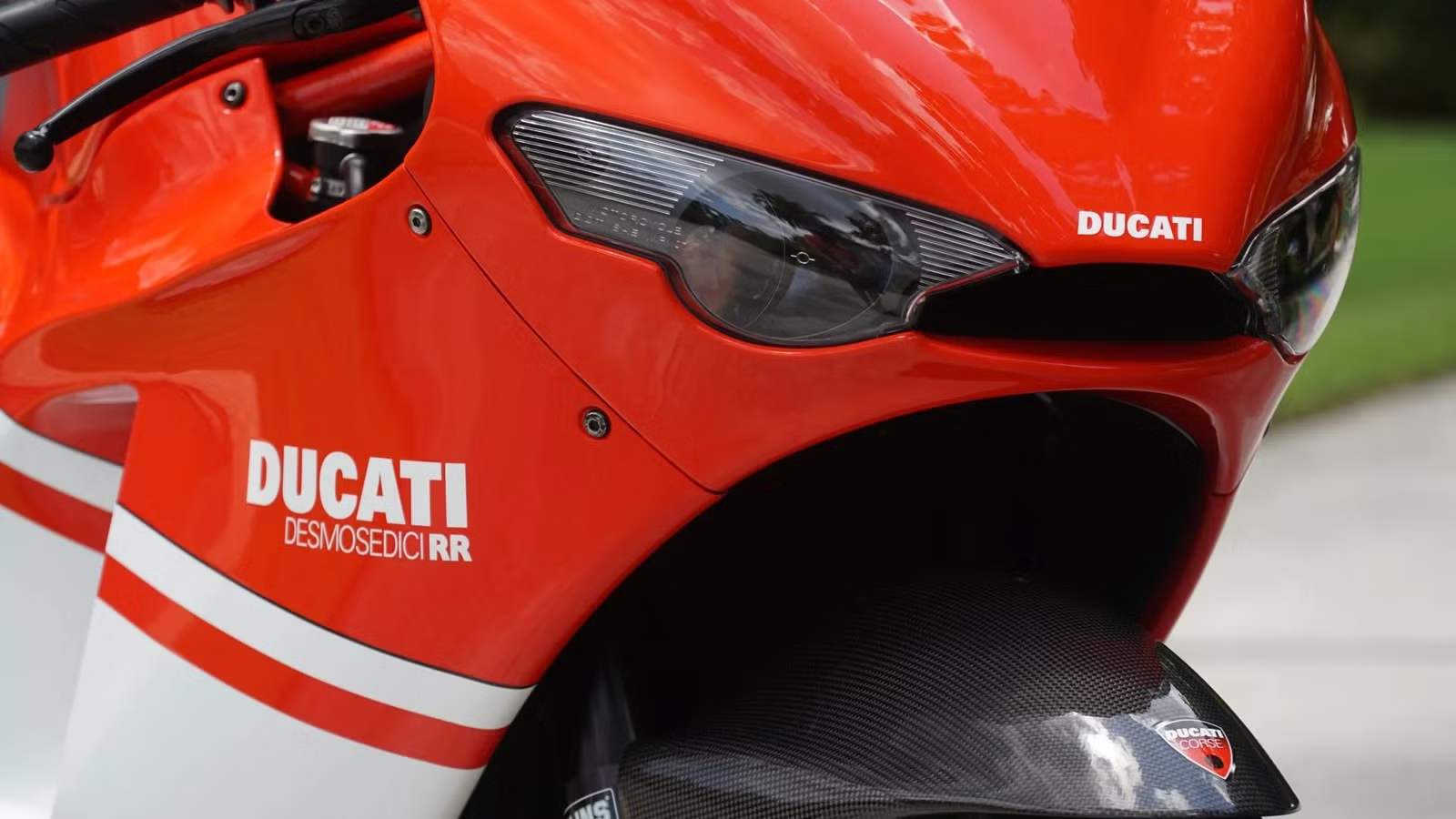
MotoGP has always been about pushing engineering to its limits, and this naturally means that some manufacturers do things a little differently. As the series changed from 500cc two-strokes to 990cc four-stroke engines in 2002, manufacturers were experimenting with increasingly exotic engineering in a bid to find the new level of performance. For a moment, this technology wasn’t quite as far out of reach as you might expect and, for Ducati fans, it was more attainable than ever before.
When MotoGP Was About Raw Engineering, Not Road-Bike Compromises

The mid-2000s was a seriously exciting time in MotoGP, as manufacturers were developing exotic four-stroke prototype machines that could see some road applications. Being that MotoGP is a prototype series, these weren’t gussied-up road bikes, but thoroughbred racing machines designed to win races.
Ducati, having returned to premier-class Grand Prix racing in 2003, wanted to challenge the well-established Japanese brands in their own backyard. Its Desmosedici V4 had quickly established itself as a force to be reckoned with, as Italian Loris Capirossi won six races between 2003–2006. It had captured the hearts and minds of fans everywhere and, for many, the fantasy wasn’t just to own a superbike. It was to own a piece of MotoGP technology.
The Era When Factory Technology Wasn’t Meant To Stay On The Track


Homologation specials are nothing new in the motorcycle world, as MotoGP rival series, the Superbike World Championship, mandated them since its inaugural season in 1988. Bikes like the Honda RC30, Ducati 999R, and Yamaha YZF-R7 had offered riders the chance to get close to what they saw competing on track, tasting that competition aspect and making WSBK machinery more attainable for fans. MotoGP had no such requirements, which only made the appeal of them all the more alluring.
Ducati understood this desire for an even more exclusive, even wilder bike that could offer enthusiasts a taste of something that normal people couldn’t imagine. So rather than producing another road-going homologation with racing influences, or a souped-up road bike with race styling, it made something far more ambitious: a limited-edition road bike directly based on its MotoGP prototype.
The Ducati Desmosedici RR Was A Genuine MotoGP Bike With Headlights

When Ducati unveiled the Desmosedici RR in 2007, it presented an opportunity that hadn’t existed before. Based on the prototype GP6 MotoGP bike, the RR was far more than a road bike with a MotoGP livery. It was essentially a 989cc, V4-engined MotoGP bike that you could ride on the road.
Let’s start with the engine. Both the MotoGP and road bike used a 989cc, 90-degree V4 engine with the same bore and stroke dimensions. Both also had the desmodromic valve actuation and Twin Pulse firing order that had helped make the MotoGP bike such a success. The same six-speed gearbox was even used across bikes. The RR was clearly a MotoGP bike at its heart but, naturally, there were compromises.
The engine, as close as it was to the MotoGP bike, did need some changes. A MotoGP bike is designed for roughly 40-minute races, while a road bike needs to survive everyday use, comply with emissions regulations, and have some degree of durability. While this meant that the RR’s engine had to be designed with production rather than competition in mind, it didn’t mean that power had to be sacrificed. Ducati advertised the RR as having more than 200 HP with its supplied racing exhaust and dedicated ECU, while the standard version created less. That’s still an incredible amount for a road bike and, as such, it needed some considerable technology to keep it in check.

Much like the GP6, the RR used a hybrid tubular steel trellis with the same fundamental geometry alongside an aluminum swingarm. Carbon fiber bodywork helped to keep weight down (and was shaped similarly to the GP6’s), as did forged magnesium wheels, while GP-spec Ohlins front forks and Brembo brakes ensured riders could stop as easily as they could get going. It all culminated in a bike that didn’t look like a MotoGP bike’s funhouse mirror reflection but, by using the same architecture and general design, looked every bit the MotoGP bike for the road that it was. Of course, when it comes to bikes as exotic as the RR, “production” is relative. Just 1,500 examples were made worldwide, and these didn’t come cheap.
Owning A MotoGP Bike Came With A Price Even Its Buyers Couldn’t Ignore

The RR was no ordinary superbike, and it had no ordinary price; starting price was $72,500, to be precise. But as high as this was, that was just the start of a rider’s financial ownership burdens.
First, there’s the maintenance. Not that people buy these bikes as dailies, but the valve servicing needed doing every 7,500 miles and took a reported 10 hours of labor, with the engine needing significant dismantling. Hitting 7,500 miles also means tire wear, and the unusual, bespoke 16-inch Bridgestone on the rear meant that finding replacements could be tricky. Add in the other specialist parts that the RR was made of, and the need for specialist technicians to fit these specialist parts, and it quickly became an expensive choice. MotoGP bikes aren’t cheap and, apparently, neither are road bikes based on them.
The Ducati Desmosedici RR Was The First, But Not The Last

The Desmosedici RR wasn’t the last road-going MotoGP-inspired bike, as Honda’s RCV213V-S is arguably even closer and even more extreme. But the Ducati still deserves a place in history as the first bike of its generation to truly show what was possible when MotoGP met road.
In a serendipitous coincidence, Ducati took its first riders’ and teams’ championships since returning in the same year that the RR was released, courtesy of a dominant performance from Casey Stoner. It added more credibility to the bike, as it wasn’t just a bike inspired by MotoGP, but a bike born from a project that had just conquered the top level of motorcycle competition.
It’s what makes the RR so special today. Ducati could have released a superbike with a livery, or a much more lackluster offering. It didn’t. It brought MotoGP engineering into the hands of ordinary riders, and created one of the most interesting bikes in doing so.
Sources: Ducati, Allmoto, Motor Biscuit

Related posts

Latest Post


No Comments