
10 Sport Bikes That Make Every Ride Feel Like Track Day
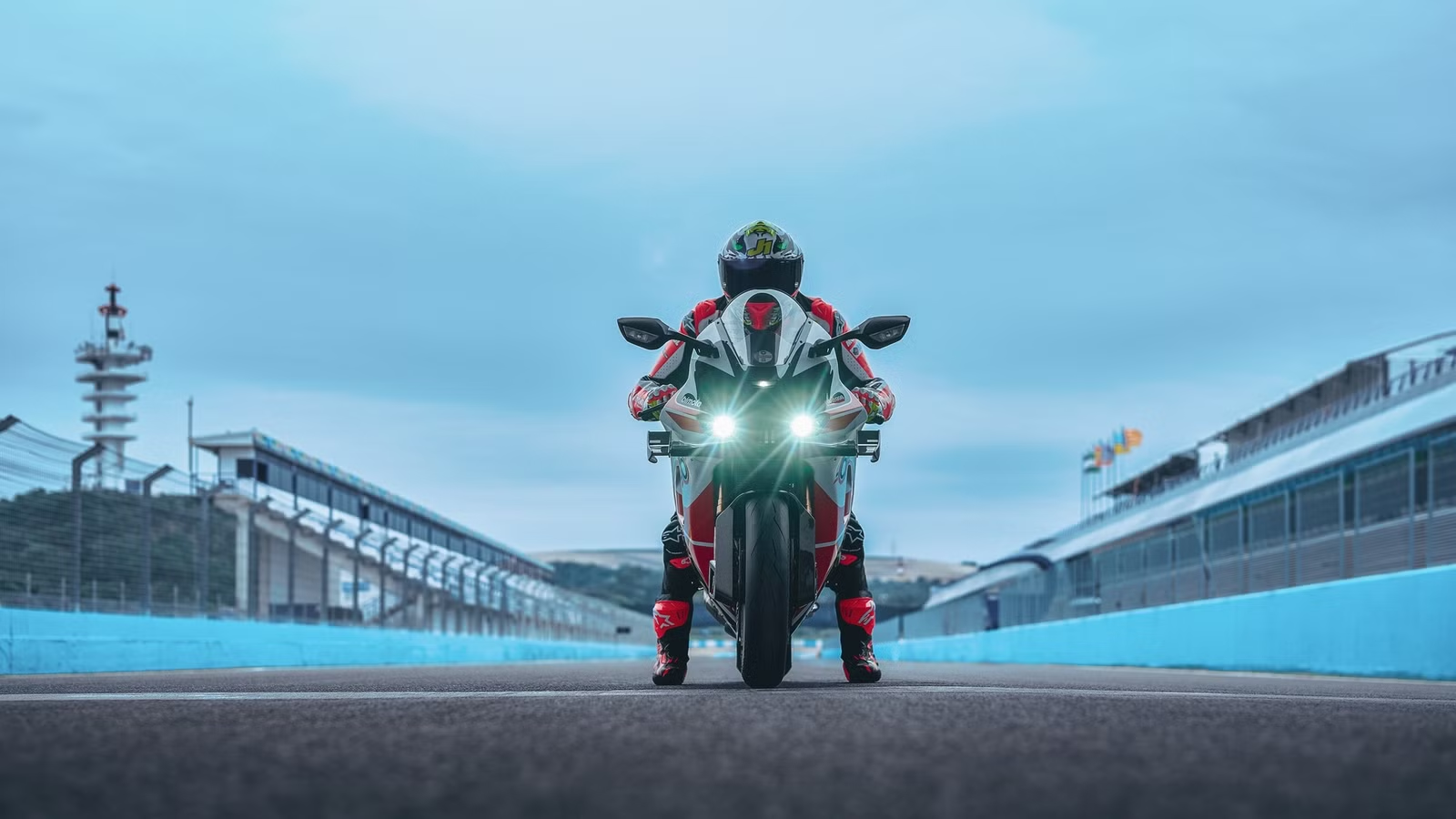
For the longest time, sports bikes were meant to be track-day weapons with a few tweaks to make them road-legal. Today, most such bikes–particularly in the 600-900cc range–favor road use over track day abilities. What do you do then if you want a sports bike that still follows the OG recipe of race on Sunday, ride on Monday?

Well, you consider one of the 10 bikes listed below. Most of these bikes are homologation specials by leading brands, or based on previous race bikes. Neither is easy on the pocket, though, with a couple of machines costing well over $70,000. There’s even a middleweight that sells for over $30,000.
MV Agusta F3 Competizione
Power: 147 HP
The F3 Competizione is the only middleweight on the list. And that’s because it is the most extreme middleweight sports bike in the world right now. The engine is arguably the protagonist, promising 160 horsepower with the race kit. Considering this is an inline-triple with 798cc capacity, that output is simply unheard of in the segment.


Elsewhere, it takes direct inspiration from MV’s WSSP machine. So there’s no shortage of top-drawer track-spec equipment all over. That includes:
- Carbon fiber winglets (17.64 pounds downforce at 150 MPH)
- Carbon fiber wheels (6.61 pounds lighter than regular F3 wheels)
- 43 mm Ohlins NIX30 USD forks with TiN-coated stanchions
- Ohlins TTX 36 monoshock
- 16-way adjustable Ohlins steering damper
- Brembo Stylema brakes
Kawasaki Ninja ZX-10RR
Power: 190 HP

The ZX-10RR seems like one of the most unimpressive homologation specials here. That’s until you find out this has served as the base for one of the most successful WSBK bikes ever in the hands of a certain Jonathan Rea. So right from the chassis to the inline-four engine, everything is built with racing in mind.

That’s made clear when you dive into the details. For instance, the powerhouse has Pankl lightweight pistons and high-performance titanium connecting rods. Similarly, the front fork has titanium coating on the inner tube for smoother operation than the standard 10R. The sub-$30k MSRP makes it a bit hard to justify, though, considering there are way more powerful bikes costing less than this.
Yamaha YZF-R1 M
Power: 197 HP

While the YZF-R1 M has bowed out of production overseas, it soldiers on in the US. So this is arguably your last chance to take home one of the most unique engine layouts in the class. Its uniqueness lies in the presence of a crossplane crankshaft plonked alongside an inline-four layout. This is derived straight from the YZR-M1–Yamaha’s title-winning MotoGP machine.

As for other components, the R1 M features carbon fiber bodywork, Ohlins electronic suspension, and forged wheels. A special livery with a brushed aluminum tank rounds things off. There is a caveat, though: the age. This is essentially the same bike from 2015 without any sizable updates.
Bimota KB998 Rimini
Power: 200 HP

The KB998 Rimini is what happens when one of the greatest chassis makers (Bimota) joins hands with one of the biggest bike brands in the world (Kawasaki). So the base of the KB998 is essentially the ZX-10RR we talked about above. It lends the engine, bodywork, electronics, and Showa suspension. But the chassis and swingarm come straight from Bimota.

These are special, too, as they break away from the norm. Instead of a twin-spar setup, the front half of the frame comprises oval section tubular steel construction, connected to an aluminum triple-clamp up top and unique billet aluminum alloy plates at the rear. The swingarm also has a race-derived billet construction. A final cherry on the cake is the active aero wings!
BMW M 1000 RR
Power: 205 HP

The M 1000 RR is the ex-WSBK championship-winning machine, so this is truly the only BMW that can make rides feel like a track day. There’s a lot of special componentry here, chief among which is the powerhouse. This 999cc inline-four powerhouse boasts the ShiftCam (variable valve timing) tech to not only go toe to toe with its V4 rivals, but even beat them in low-end punch. The US-spec model is detuned to 205 HP, though.

For 2027, BMW claims to have the handling side of things. The big change is the new chassis, said to be around three pounds lighter with 30 percent less wall thickness for improved flex properties. The 45 mm USD forks, monoshock, and forged wheels are the same, though.
Ducati Panigale V4 R
Power: 208.4 HP

The Panigale V4 R is currently dominating the WSBK championship. All the races so far have been won by the said machine, and if that doesn’t tell you how track-oriented this is, we don’t know what will. Credit here goes to the plethora of upgrades over the previous-gen bike. This includes new MotoGP-derived aerodynamics, a double-sided swingarm, an improved chassis, and an electronics package no other bike can match.

Meanwhile, at its heart lies Ducati’s updated Stradale R V4 engine. This has race-derived internals to rev beyond 16,000 RPM, producing well over 230 horsepower with a race exhaust. The road-legal output is much lower, though, and it further drops to under 210 HP due to US noise norms. So not getting a race exhaust is almost a crime.
Honda CBR1000RR-R Fireblade SP
Power: 214 HP

What you’re looking at is the most extreme (and powerful) CBR built so far. Rightly so, as this is the official homologation special for Honda’s WSBK efforts. Thus, you get top-drawer equipment from head to toe, starting with the most powerful naturally aspirated inline-four engine. The output stands at 214 horsepower, achieved via a full 1,000 cubic centimeters of capacity. That peaky power, along with the racy ergonomics, ensures a track-like ride every time you hop on this.

Aside from that, the suspension comes from Ohlins and the brakes from Brembo. The former comprises Ohlins Smart EC3.0 electronic control, which is only present on one other superbike (the Ducati Panigale V4 S). As for the latter, you get Brembo Stylema R calipers–a step up from the usual Stylemas seen in the segment.
Aprilia RSV4 1100 Factory
Power: 220 HP

The new RSV4 might not be a homologation special like some of the other bikes here. Yet, it is the most powerful naturally aspirated mainstream superbike today. That’s down to its 1,099cc, V4 powerhouse, good for 220 horsepower and 94 pound-feet. This pairs up with one of the most sophisticated twin-spar frames in the business, offering impeccable feedback for track duties.

In its latest avatar, the RSV4 also features upgrades drawn from Aprilia’s learnings in MotoGP. So the new aero adds extra front-end stability and the electronic aids have corner-by-corner telemetry tech. All this while, the RSV4 Factory is one of the most well-priced bikes in its category as well.
Ducati Superleggera V4 Centenario
Power: 228 HP

The ‘Superleggera’ moniker is already sacred for Ducati, since it’s only given to its most extreme and exotic machines. But with the brand’s 100-year celebration going on, the bikemaker has whipped up a truly mind-boggling superbike. The big news is the powerhouse, called the Stradale R 1100 V4 engine. It’s good for 228 horsepower in road-legal trim that rises to a whopping 247 ponies with a race kit.
Besides peak power, the Superleggera has a full carbon monocoque chassis, paired to a full carbon double-sided swingarm. This, along with the carbon wheels and carbon discs (a first for a road bike), means a weight of just 381 pounds (wet without fuel). Brembo GP4-HY calipers, Ohlins carbon NIX forks, and Ohlins TTX36 GP LW shock are some other highlights.
Bimota Tesi H2
Power: 231 HP

Technically, this is the least track day-proven bike on the list. After all, it’s based on the straight-line-specific Ninja H2. But with Bimota’s cunning underpinnings, the handling here should be right up there with the best. A chief catalyst for that is the hub-center steering at the front. What that does is take away the front dive characteristics, said to result in a rock-solid front-end feel regardless of the application.

In addition to that, there are several lightweight materials here, cutting weight down to 481 pounds (compared to the H2’s 524 LBs figure). Some of these include:
- Front swingarm with billet and carbon fiber sections
- Rear swingarm with billet aluminum construction
- Carbon fiber bodywork
- Ohlins TTX36 shocks at both ends
- Brembo Stylema calipers
Source: Various manufacturers

Related posts

Latest Post


No Comments