
The Sporty Car That Is Easier To Live With Than Its Rivals
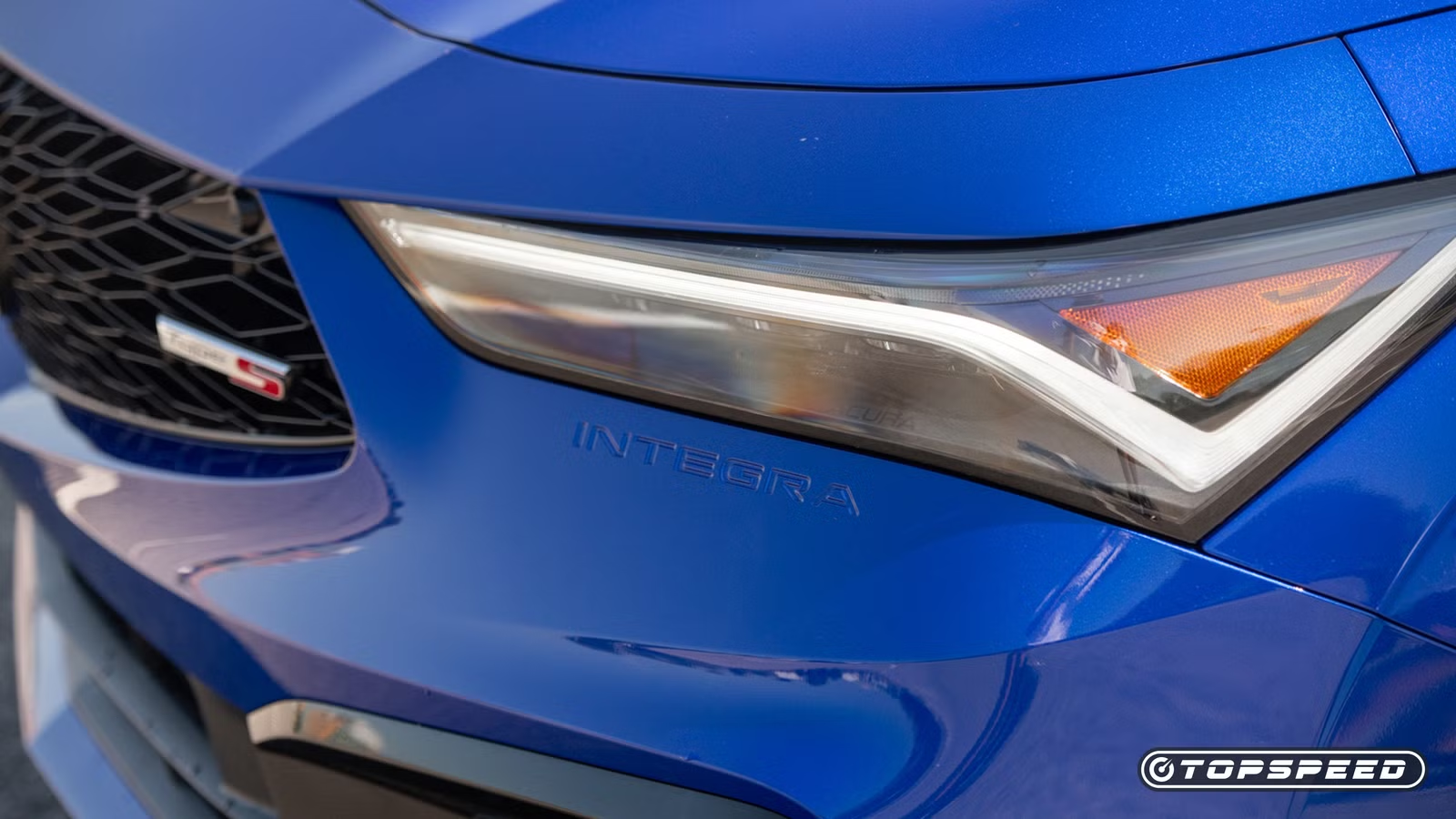
Modern sports car buyers in 2026 actively demand versatility alongside high-performance driving dynamics. While traditional enthusiasts previously prioritized peak horsepower and track metrics above daily usability, contemporary consumers expect high-performance vehicles to function seamlessly as single-car solutions.

Modern buyers balance commuting, long-distance travel, and weekend activities, making interior space, everyday ergonomics, and usable luggage volume crucial deciding factors. Consequently, automakers must engineer sports coupes and liftbacks to offer supportive ergonomics, generous legroom, and expansive cargo areas. Today, practical functionality directly dictates commercial success, transforming utility from an afterthought into a foundational requirement within the performance car segment.
Japan Remains Dedicated To The Compact Sports Car
The state of the premium Japanese sport compact segment in the U.S. has reached a unique evolutionary peak. Historically, this market thrived on a raw and unrefined aesthetic. Older Japanese sports cars offer performance that is measured by loud exhausts, stiff suspensions, and high customizability. This tests the owner’s tolerance for daily discomfort.

In contrast, the current landscape demands a more mature product approach. This forces manufacturers to blend engaging driving dynamics with advanced interior technology and premium cabin insulation. Consumers buying into this segment are no longer willing to compromise daily comfort for handling and agility. Doing so leads to a highly competitive environment where driving fun must coexist with premium execution.
Acura Introduces Sophistication And Practicality To Performance

Acura approaches this segment by executing what can best be described as a value-disruption strategy. Rather than building a high-strung, uncompromising performance vehicle from scratch or engineering a purely cosmetic luxury cruiser, the Japanese brand focuses on highly strategic platform sharing.
Honda’s premium arm prioritizes a mechanically sound enthusiast foundation and reputation for premium materials, improved cabin quietness, and high-end technological amenities. Acura crafts an accessible form of executive-level performance, focused on efficiency and long-term mechanical dependability. This philosophy bridges the gap between everyday commuter necessities and weekend winding-road capability. Doing so establishes a smarter and more affordable Japanese alternative to traditionally expensive German entry-luxury sports sedans.
The Integra’s Interior Maximizes Daily Practicality

The 2026 Acura Integra is a prime example of the premium Japanese brand’s strategy. Honda’s luxury division positions this compact fastback sedan as the gateway into the brand’s premium lineup. The Integra serves as a modern bridge between mainstream fun and entry-level luxury, attracting thousands of buyers looking for an upscale and practical daily driver.

The Acura Integra cabin holds 95.8 cubic feet of total passenger volume, balancing front-row comfort with practical rear legroom and versatile luggage capacity. Up front, occupants receive 37.6 inches of headroom, which expands to 38.6 inches in the Type S trim, along with 42.3 inches of legroom. Rear passengers benefit from 36.4 inches of headroom, though the sloping fastback roofline reduces vertical space slightly compared to the front. However, the rear bench maintains 37.4 inches of legroom, matching many competing midsize sedans. Thanks to its five-door liftback configuration, the Integra provides 24.3 cubic feet of cargo space behind the rear seats. This has significantly more storage area and wider loading access than conventional sedan trunks in its class.
Intelligent Engine Technology Balances Power And Efficiency

The standard Acura Integra A-Spec features a turbocharged 1.5-liter four-cylinder engine, producing 200 horsepower and 192 pound-feet of torque, thanks an operatinonal 17.8 psi of boost pressure. The system sends power exclusively to the front wheels via a refined CVT with synthesized steps.
The result is a manufacturer-estimated 0 to 60 MPH acceleration time of 7.0 seconds with an electronically limited top speed of 135 MPH. The track-ready Integra Type S sources its drivetrain configuration from the accomplished Honda Civic Type R. This consists of a turbocharged 2.0-liter four-cylinder engine producing 320 hp and 310 lb-ft of torque, also to the front wheels. This cuts the 0 to 60 MPH time down to 5.1 seconds.
Fuel Consumption Reinforces The Practicality Aspect

A closer look at recent fuel consumption data reveals why the Integra base and A-Spec trims attract so much attention. Thanks to its CVT-based front-wheel drive system, it achieves an impressive EPA-estimated 29/37/32 MPG on the city/highway/combined cycle, resulting in a total driving range of 400 miles from its 12.4-gallon fuel tank. The EPA also estimates that you’ll spend $750 more on gasoline compared to the average new vehicle in the U.S. Annually, you’ll spend $2,400 on gas, and $4.04 to drive 25 miles. A full tank will cost $64.
Opting for the Type S significantly worsens fuel consumption. The environmental agency estimates a 21/28/24 MPG consumption and 298-mile range. This means you’ll be spending $5,000 more on gasoline, based on a $3,250 annual fuel cost estimate. 25 miles of driving will cost $5.39.
All Trims Offer A Comprehensive Standard Features List

The base Integra trim level starts at $33,400 MSRP. Included as standard is leatherette-trimmed seating, an electrically operated sunroof, Jewel Eye LED headlights, and a 7.0-inch touchscreen infotainment interface. Stepping up to the mid-tier A-Spec package increases pricing to $35,950. This adds performance-focused body styling, including a gloss black rear spoiler, larger alloy wheels, and a sport-oriented interior appearance kit complete with aluminum pedals.

The true sweet spot for daily drivability is the A-Spec with Technology Package. This carries a starting price of $39,200 and gives you access to the optional six-speed manual transmission with rev-match control. This premium package includes microsuede-trimmed sport seats with 12-way power adjustments for the driver’s seat, an expansive 9.0-inch touchscreen with wireless Apple CarPlay and Android Auto, a wireless smartphone charging mat, and a 16-speaker ELS Studio 3D premium audio system. Sitting comfortably at the absolute apex of the lineup is the high-performance Type S at an MSRP of $53,900. Standard features include perforated Ultrasuede seating, an Adaptive Damping System, an Active Exhaust Valve system, and wider 19-inch high-performance wheels.
Appealing Running Costs And Reliability

According to RepairPal, the Acura Integra range carries an average annual maintenance cost of approximately $341, significantly lower than the luxury average. Kelley Blue Book data suggests slightly higher entry-level luxury upkeep near $1,087 annually, while five-year projected maintenance for the high-performance Type S specifically totals roughly $4,978.
Regarding owner input, J.D. Power highlights that the Acura Integra range benefits from an 82/100 consumer-verified overall score, including 82/100 for quality and reliability, 81/100 for the driving experience, 81/100 for resale, and 83/100 for the dealership experience. Edmunds reveals a 4.3/5 average for its owner review section, consisting of 36 reviews. Key strengths of the model include its visual appearance, driving experience, and fuel efficiency.
Acura’s Comprehensive Warranty And Service Plan

The current-generation Acura Integra is supported by a solid factory warranty, featuring a four-year or 50,000-mile limited warranty and a six-year or 70,000-mile powertrain warranty. For 2026, owners benefit from the Acura Maintenance Program, which covers select factory-scheduled services, including oil changes and tire rotations, for the first year or 12,000 miles. Beyond this, the sports sedan benefits from Honda’s Maintenance Minder system, which replaces fixed intervals with condition-based alerts.
Common jobs include the B1 service, covering oil, filter, and tire rotations, typically every 7,500 to 10,000 miles, with estimated out-of-pocket costs ranging from $150 to $300. Regarding its recall history, the Integra has faced a notable campaign concerning a defective steering gearbox assembly that transmits the driver’s steering inputs to the linkage in 2023 to 2025 models, resulting in sticky turning. There’s also a recent 2026 recall involving improperly tightened seat cushion frames.
A Poised Suspension Complements The Drivetrain

What makes the 2026 Acura Integra Type S such a definitive sports sedan is its specially engineered chassis, which the brand fine-tunes for dual-purpose use. A-Spec models incorporate a MacPherson strut front and multi-link rear suspension, while the Type S inherits a more sophisticated dual-axis strut front suspension, specifically designed to mitigate torque steer and sharpen turn-in precision.
To balance track-ready stiffness with daily civility, A-Spec trims with the optional Technology Package, as well as Type S models, benefit from an adaptive damper system. This allows you to toggle between Comfort mode for uneven surfaces and routine commuting, while Sport+ mode accommodates maximum body control.

Braking systems vary across the range as well, with the base model featuring 12.3-inch front rotors, while the Type S adopts larger 13.8-inch ventilated front discs with Brembo four-piston monobloc aluminum calipers. Wheel options grow in scale and grip as you move up the catalog, starting with 17-inch alloys on the base, 18-inch Berlina Black wheels on the A-Spec with all-season tires, and lightweight 19-inch Shark Gray wheels for the Type S. The Type S comes factory-equipped with high-performance summer tires ideal for light track use and daily commuting.
Sources: Acura, Edmunds, J.D. Power, the EPA, iSeeCars, RepairPal, and KBB.

Related posts






Latest Post


No Comments