
Here’s The Resale Value Of The Harley-Davidson TriGlide Ultra After 6 Years
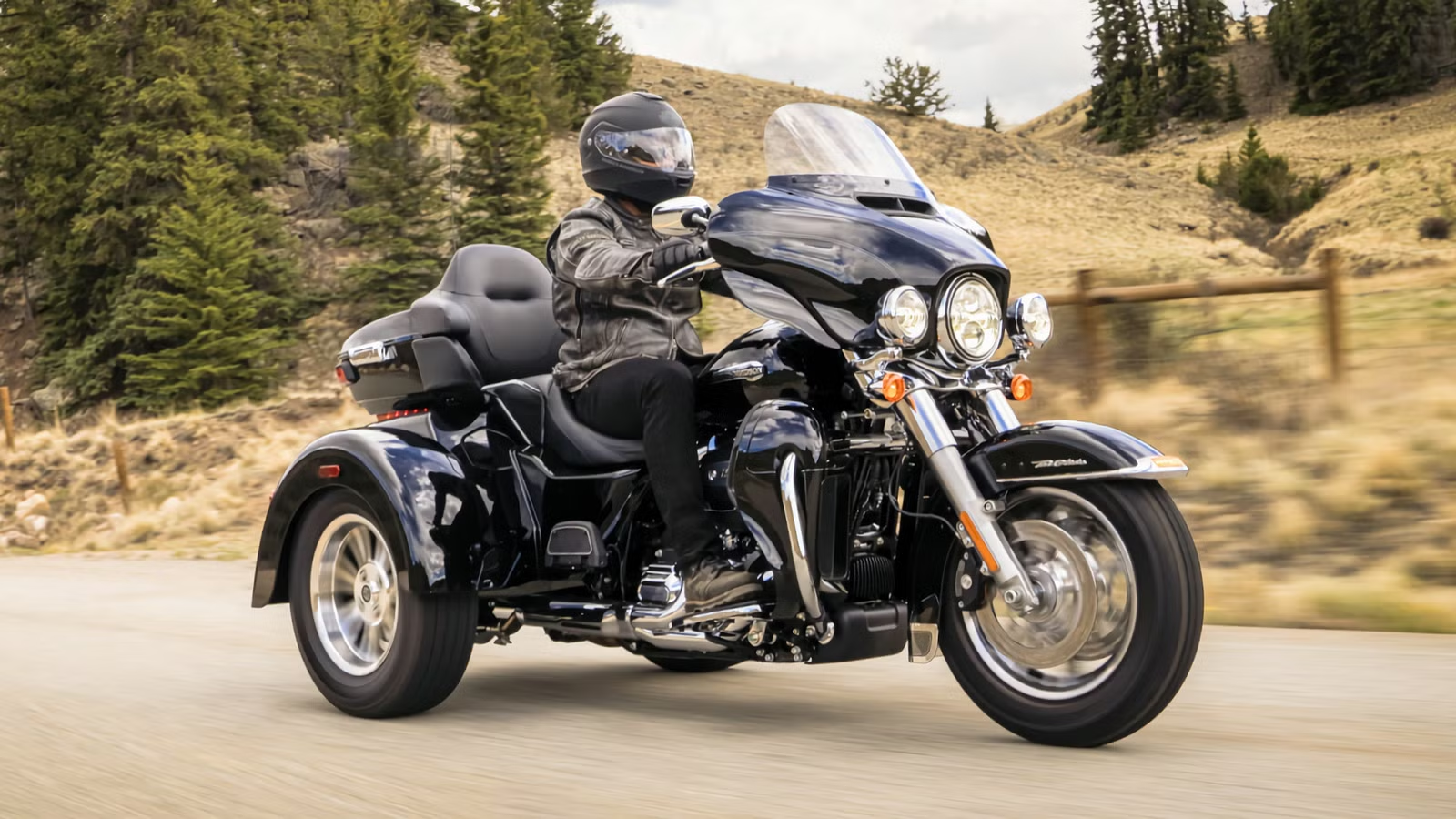
Harley-Davidson’s Tri Glide Ultra has always commanded a premium price, and that means depreciation is a very real concern — one that can cost you serious money when it’s time to sell or trade in. The good news is that you’re not entirely at the market’s mercy. Smart ownership habits — consistent maintenance with documented receipts, careful attention to the finish, and resisting the urge to over-customize — can meaningfully protect your investment. With that in mind, let’s dig into what the used market actually looks like for a six-year-old Tri Glide Ultra and what you can realistically expect to walk away with. To give you the most accurate information possible, the data used to compile this article was sourced from authoritative sources and from my experience as a certified Harley-Davidson mechanic.
Tri Glide Ultra Depreciation: What Your $35K Trike Is Worth Now
How Condition, Custom Work, And Market Trends Shape Your Trike’s True Value

The 2020 Tri Glide Ultra carried an MSRP of at least $34,999, making it one of the priciest models in Harley’s lineup that year and a significant step above its closest rivals. Like any premium motorcycle, it takes a hit the moment you roll out of the dealership — the days of waiting-list premiums are long gone. What’s worth understanding, though, is that with bikes and trikes, condition is a far more important price driver than mileage.
Any custom work you’ve had done will return a fraction of what it cost, so keeping things stock — or sticking to factory options and accessories — works in your favor at resale time. According to Kelley Blue Book, the trade-in value on the 2020 Tri Glide Ultra averages $24,600, while the private-party resale price sits around $29,965, meaning a direct sale to an individual buyer could land you somewhere in between. Browsing the used market, sellers are asking between $22,000 and $33,000 for six-year-old Tri Glide Ultras, with the spread reflecting differences in options, accessories, and overall condition.
Tri Glide Ultra Powertrain: Big Engine And Big Control
Built For Effortless Muscle And Maneuverability


The Tri Glide Ultra is a lot of machine to manage, so H-D fitted its powerful Twin-Cooled Milwaukee-Eight 114 engine to get this beast moving. Harley has always favored long-stroke layouts, and this unit is no exception: a 102 mm bore paired with a 114 mm stroke yields 1,868 cc of total displacement and a 10.5:1 compression ratio. The engine is primarily air-cooled, but small water jackets surround the exhaust valve seats to draw off heat from that critical area, with discreet radiators tucked into the fairing lowers to shed that heat to the atmosphere.
Power flows through a slipper-assist clutch that keeps lever pull light and the friction zone broad — a real advantage for precise control at low speeds. A six-speed Cruise Drive transmission and belt final drive complete the drivetrain. Electric reverse means you’ll never have to muscle the trike around a parking lot or stress about an awkward slope when you park. Traction control and the Boom!™ Box 6.5GT come standard equipped.
Harley-Davidson Tri Glide Ultra Engine And Performance Specifications
|
Engine |
Twin-Cooled™ Milwaukee-Eight® 114 |
|
Displacement |
1,868 cc |
|
Compression |
10.5 : 1 |
|
Power |
93 HP @ 5,020 RPM |
|
Torque |
121 LB-FT @ 3,250 RPM |
|
Transmission |
6-Speed Cruise Drive® |
|
Claimed Fuel Economy |
42 MPG |
|
Tank Range |
252 miles |
|
Top Speed |
~100 MPH |
Strength, Braking, And Power Delivery Are The Tri Glide’s USPs

Mild-steel tubing forms the Tri Glide Ultra’s frame, with a rectangular cross-section backbone adding meaningful rigidity to the structure. A double-downtube/dual-cradle front section fully supports the engine and offers the cases a degree of protection from curb strikes and road debris. The swingarm section likewise uses hollow rectangular stock for extra stiffness at the rear.
The combination of steering-head angle and triple-tree offset kicks the forks out to 32 degrees with 3.4 inches of trail. It’s worth noting, however, that these geometry figures don’t translate to handling the same way they would on a two-wheeler — on a trike, it ultimately comes down to rider input to steer the front end, rather than relying on the self-centering geometry and counter-steering.
Dual front brakes handle the single front wheel, while each rear wheel gets its own disc and caliper, with a stock ABS feature to help you safely extract maximum stopping power from the anchors. The front tire is motorcycle-proportioned, but the rear tires are closer to automotive in design, with wide contact patches that put as much power to the pavement as possible.
Harley-Davidson Tri Glide Ultra Chassis And Suspension Specifications
|
Frame |
Mild steel, double downtube/ cradle |
|
Front Suspension |
49 mm Showa DBV forks |
|
Rear Suspension |
Preload-adjustable rear shocks |
|
Rake/ Trail |
32°/ 3.94 inches |
|
Wheels |
Cast aluminum |
|
Front Tire |
MT90B16 72H |
|
Rear Tire |
P205/65-15 92T |
|
Front Brake |
Dual 300 mm disc, four-piston caliper |
|
Rear Brakes |
Dual 270 mm discs, single-piston calipers |
The Tri Glide Ultra Combines Comfort, Storage, And Classic Style
Delivers Amazing Passenger Comfort And Serious Storage For Life On The Road
H-D went with its tried-and-true touring formula for the Tri Glide Ultra. It starts with a classic full-size fender complete with chrome skirting, piping, and script. Above, a whisker bar mounts a pair of auxiliary lights to supplement the single headlight. The Batwing fairing has been trimmed down slightly compared to earlier iterations, improving aerodynamic penetration and lending the front end a sportier profile.
Vents punch straight through the fairing to manage airflow in the pocket, and the windshield is fixed. The cockpit blends round analog gauges with electronic displays for a classic-meets-modern feel. A comfortable seat is paired with a wide pillion pad and a supportive backrest for passenger comfort on long hauls. A Tour-Pak combines with a large trunk for a total of 6.8 cubic feet of storage — more than enough for extended road trips, or everyday errands.
Harley-Davidson Tri Glide Ultra Design Specifications And Dimensions
|
Length |
105.1 inches |
|
Width |
54.7 inches |
|
Height |
56.3 inches |
|
Seat Height, Laden |
27.1 inches |
|
Wheelbase |
65.7 inches |
|
Ground Clearance |
4.9 inches |
|
Fuel Capacity |
6 gallons |
|
Curb Weight |
1,243 lbs |
Tri Glide Ultra Vs. Freewheeler: Touring Comfort Or Stripped-Down Speed?
The Freewheeler Trades Long-Haul Luxury For Lighter Weight And Punchier Performance
Three-wheel vehicles remain a niche segment, with H-D standing as the only major manufacturer still producing a factory trike. The Motor Company diversified its trike lineup with the drag-focused Freewheeler model. It shares a similar powertrain with the Tri Glide Ultra but sheds the full touring kit — no Tour-Pak, no loaded fairing — which translates directly into better straight-line acceleration. The electronics package keeps things manageable when you’re pushing hard. Storage isn’t abandoned entirely: the trunk remains, offering roughly the equivalent of two saddlebags, so the Freewheeler can still handle day-to-day duties alongside its performance credentials.
Tri Glide Ultra Vs. Can-Am Spyder RT Limited: Classic Cruiser Meets High-Tech Delta
Can-Am’s Stable, Tech-Heavy Reverse Trike Offering More Storage, Safety, And Semi-Auto Convenience
Can-Am takes a fundamentally different approach to the three-wheel concept, reversing the wheel arrangement to place two wheels up front and one at the rear — a configuration known as a delta trike. This layout gives the Spyder RT Limited an inherent stability advantage over traditional trike designs, and a comprehensive electronics suite reinforces that safety margin further. Storage is generous, with saddlebags, a top case, and a frunk — a front-mounted trunk — combining for a total of 47 gallons of secure, weatherproof storage.
Power comes from a Rotax inline triple displacing 1,330 cc, liquid-cooled and backed by a semi-automatic six-speed transmission that allows the rider to choose between fully automatic twist-and-go operation and manual push-button gear selection. Rotax engines have a well-established pedigree, with close relatives powering both marine and light aircraft applications. On the passenger side, a full touring pillion setup puts the Spyder RT Limited on par with the Harley in terms of two-up comfort.
Harley-Davidson Tri Glide Ultra vs. Can-Am Spyder RT Limited Engine And Performance Specifications
|
Model |
Harley-Davidson Tri Glide Ultra |
Can-Am Spyder RT Limited |
|
Engine |
V-twin |
Inline-3 |
|
Displacement |
1,868 cc |
1,330 cc |
|
Power |
93 HP @ 5,020 RPM |
115 HP @ 7,250 RPM |
|
Torque |
121 LB-FT @ 3,250 RPM |
96 LB-FT @ 5,000 RPM |
|
Transmission |
6-speed manual |
6-speed semi-automatic |
|
Top Speed |
~100 MPH |
108 MPH, governed |
Sources: Harley-Davidson, Can-Am, Kelley Blue Book, Harley-Davidson Marketplace

Related posts


Latest Post


No Comments