The Sports Car That Quietly Makes More Sense Than A Porsche
8 minutes reading
Tuesday, 25 Aug 2026 12:00 0 74 autotech
There’s a sports car sitting on Lexus dealer lots right now that most enthusiasts have quietly stopped talking about, and that’s a mistake. It isn’t chasing lap times or turbo boost figures. It’s doing something rarer. And that’s building a case, point by point, for why the smart money in this segment might not be German at all. From the engine bay to the options sheet, it answers questions Porsche buyers don’t always think to ask until they’ve already signed the paperwork.
Start with the number that matters most. 471 horsepower and 398 pound-feet of torque are produced by a 5.0-liter V8 with no turbochargers, no electric assist, and no artificially piped-in engine note. That last part matters more than it sounds. In an era where even the 911’s flat-six relies on turbocharging to hit its numbers, the LC 500’s engine revs to 7,100 rpm on its own effort, building power the old-fashioned way, through displacement and revs rather than boost pressure.
Porsche still builds a naturally aspirated flat-six, but only in the GT3 and its variants, cars that start north of $200,000 and prioritize track capability over daily comfort. Everywhere else in the current lineup—the Carrera, the Panamera, the Taycan—power comes from turbocharged or electric powertrains. That’s not a knock on those cars; turbocharging and electrification are simply where the performance industry has moved. But it does mean that if a naturally aspirated engine is non-negotiable for you, Porsche’s showroom floor gets very small, very fast.
Close-up shot of 2018 Lexus LC 500 engine bayBring A Trailer
The Lexus LC 500 pairs that V8 with a 10-speed automatic transmission, an unusual choice in a market that’s largely moved to the ZF eight-speed or dual-clutch units, but one that Lexus tuned specifically to keep the engine in its powerband and deliver quick, decisive downshifts. The result is a car that sounds like nothing else on sale today, a rising, mechanical howl that peaks somewhere around 6,000 rpm and doesn’t need speakers or software to make it happen.
A Grand Tourer With The Drama Of A Supercar And The Manners Of A Luxury Coupe
A front quarter tracking shot of the Lexus LC 500 coupeLexus
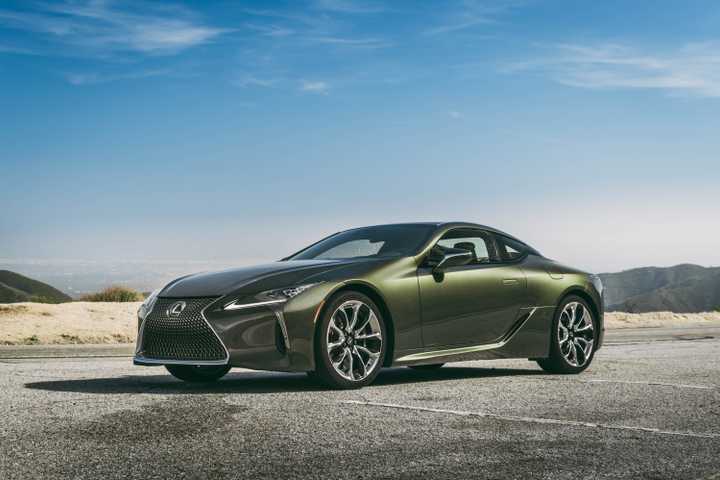
The Lexus LC 500’s proportions tell you what kind of car this is before you’ve even opened the door. Long hood, short overhangs, a cabin pushed rearward—the classic grand tourer silhouette, borrowed from decades of Italian and British coupes that prioritized covering ground in style over setting records at the Nürburgring. It’s a look that draws stares in a way few Japanese cars have managed, and it does so without resorting to the aggressive vents and wings that define modern supercar design language.
The LC 500 Isn’t Trying To Be A 911 GT3, And That’s Precisely The Point
Close-up shot of 2018 Lexus LC 500 interior showing front seats and dashLexus
Where a sports car built for outright performance asks you to tolerate stiff suspension, minimal sound insulation, and a cabin stripped of comfort features, the LC 500 refuses that trade-off entirely. The adaptive suspension smooths out broken pavement without turning the car soft, and the cabin stays hushed at highway speeds in a way that makes long stints behind the wheel feel effortless rather than punishing.
That dual identity—visual drama paired with genuine comfort—is where the LC 500 quietly outmaneuvers a lot of its rivals. A Panamera GTS will match it for comfort but costs considerably more and looks like a sedan doing its best impression of a coupe. A 911 will out-corner it without much argument, but ask that car to be genuinely relaxing on a six-hour drive and the compromises start to show: a firmer ride, more road noise, less rear-seat usability (not that the LC’s back seats are spacious, but they exist).
Where Sculpted Design Meets A Cabin That Feels Worth Every Dollar
Interior of a 2024 Lexus LC 500Lexus
Step inside and the 2026 LC 500 makes an immediate case for itself. Semi-aniline leather covers the seats and door panels with a softness that feels genuinely premium rather than merely adequate, and the stitching detail throughout the cabin looks handcrafted rather than stamped out on an assembly line. A 12.3-inch touchscreen sits atop the dashboard, and the available Mark Levinson audio system, a 13-speaker setup tuned specifically for the cabin’s acoustics, delivers a level of clarity that few rivals at this price point can match.
It’s worth being honest about the one area where the LC 500 has drawn criticism: earlier model years relied on a trackpad-based infotainment interface that reviewers consistently flagged as fussy and imprecise, particularly while driving. Lexus addressed this with a touchscreen-first update, and the current interface is considerably more intuitive than the system that greeted the car’s original 2017 launch. It’s a reminder that the LC’s real strength isn’t cutting-edge tech; it’s material quality and build integrity, the kind of craftsmanship that doesn’t show up on a spec sheet but becomes obvious the moment you run a hand along the dashboard.
Why The Exterior Design Deserves Equal Credit
2025 Copper Lexus LC500 front shot parked on the roadTopSpeed | Garret Donahue
Lexus’s “spindle” grille is polarizing on some models, but on the LC 500 it works, integrated into a body that curves and creases in ways that photograph well from literally any angle. Cars in this segment often look better in person than in pictures, or vice versa. The LC 500 manages to look genuinely striking in both contexts, which is no small feat for a design that’s now approaching a decade old and still turns heads at the valet stand.
The Lexus Formula That Makes Everyday Driving Surprisingly Special
2026 Lexus LC 500 Inspiration Series rear 3/4 shotLexus
Here’s where the LC 500 quietly wins the argument that matters most for anyone actually planning to own the car rather than just admire it—and that’s reliability. Lexus has built its entire brand identity around dependability, and the LC 500 inherits that reputation.
Consumer Reports and J.D. Power surveys have consistently placed Lexus at or near the top of reliability rankings for years running, a distinction that simply doesn’t extend to Porsche, which, while improved in recent years, still carries a reputation for pricier, more frequent maintenance, particularly once cars move out of factory warranty.
Depreciation Tells A Similar Story, Though Not Necessarily In The LC’s Favor At First Glance
Front 3/4 shot of 2026 Lexus LC 500 ConvertibleLexus
Like most low-volume luxury coupes, it isn’t a car bought for resale value. But the ownership costs behind that curve matter more than the curve itself. Routine maintenance, parts availability, and dealer service costs all skew dramatically cheaper across a Lexus ownership lifecycle than a comparable Porsche, and Lexus dealers have built a reputation for a hassle-free service experience—loaner cars, straightforward pricing, minimal upselling—that stands in contrast to complaints some Porsche owners raise about dealer experiences varying wildly by location.
Then there’s the daily-usability case. A comfortable ride, a hushed cabin, genuinely useful (if compact) rear seats, and a trunk that doesn’t demand you pack for a weekend trip like it’s a NATO deployment. None of these things show up in a magazine spec comparison, but they define what it’s actually like to live with a car for five years rather than five minutes.
Why The LC 500 Could Be The Smarter Alternative To A Porsche
Measured directly against a 911 Carrera, the LC 500 won’t win on outright dynamics; Porsche’s steering feel and cornering composure remain class benchmarks that Lexus doesn’t seriously contest. But measured against the ownership experience of a Panamera, or even a well-optioned Taycan, the LC 500’s case gets considerably stronger. A lower price of entry, a naturally aspirated soundtrack neither of those cars can offer, and a maintenance reputation that doesn’t come with the anxiety of watching the odometer creep toward 60,000 miles.
The LC 500 isn’t trying to be a Porsche, and that’s exactly why it works as an alternative to one. It offers a different set of priorities—comfort over outright cornering grip, long-term reliability over badge prestige, a naturally aspirated V8 over turbocharged efficiency—and executes each of them with enough polish that the compromises stop feeling like compromises at all. For a buyer cross-shopping a Panamera or eyeing a Taycan but hesitant about EV ownership, the LC 500 doesn’t just compete. It makes a genuinely persuasive case for walking straight past the Porsche showroom altogether.
Base Trim Engine
5L V-8 ICE
Base Trim Transmission
10-speed automatic
Base Trim Drivetrain
Rear-Wheel Drive
Base Trim Horsepower
471 HP @7100 RPM
Base Trim Torque
398 lb.-ft. @ 4800 RPM
Base Trim Fuel Economy (city/highway/combined)
15/25/18 MPG
Base Trim Battery Type
Lead acid battery
Make
Lexus
Model
LC Coupe
Sources: Lexus U.S., Consumer Reports and J.D. Power











No Comments