
The Highest Rated Horsepower Ever In A Three-Cylinder Engine
Three-cylinder engines have long been typecast as the sensible choice — small, frugal, and utterly unremarkable. That reputation made sense for decades, when the layout was reserved almost exclusively for city cars and entry-level commuters. But a quiet revolution has been underway, and the results are anything but ordinary. A handful of engineers have pushed the three-cylinder format to places that would have seemed absurd not long ago: the BMW i8 proved the layout could anchor a flagship sports car, the Toyota GR Corolla wrung 300 hp from just 1.6 liters, and Nissan built a 400-hp three-cylinder prototype for Le Mans. Each of those was remarkable. None of them is the story here.

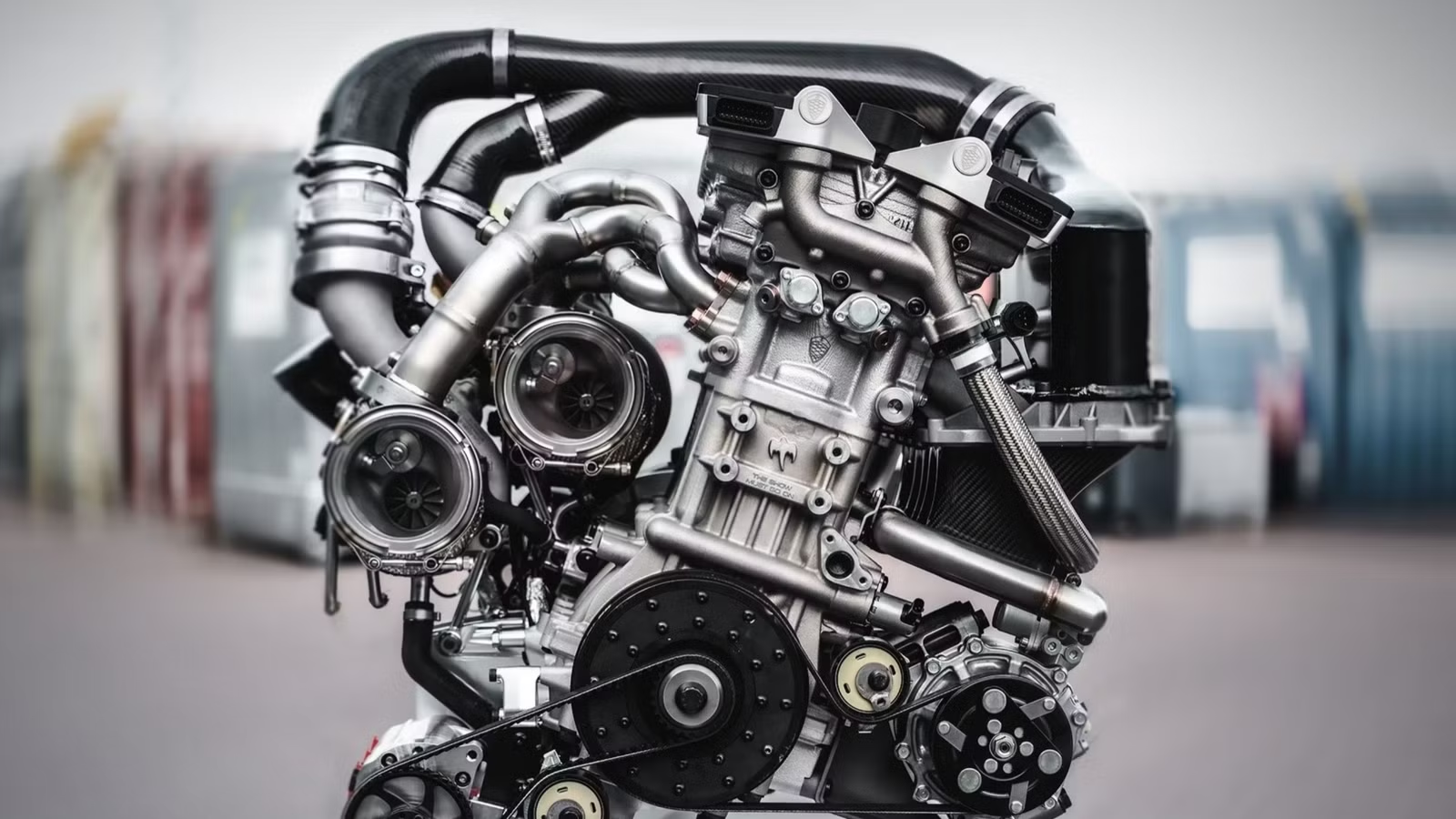
The story here is a 600-hp, road-legal three-cylinder engine built by a small Swedish hypercar company — an engine whose power density puts it in the same conversation as Formula 1 power units. What follows is a deep dive into the bleeding-edge technology behind the world’s most powerful three-cylinder engine ever engineered for a production vehicle.

For this article, we limited our search to production car engines only, including both limited-run and series production. There are numerous custom-made and race car three-cylinder engines, like the 400-hp Nissan ZEOD RC. But those don’t make the cut as they are off-limits for road use. It is worth noting that the most powerful three-cylinder engine mentioned here has yet to go into full production, but as working examples are up and running in a production-worthy state, it made the cut.
The Three-Cylinder Engine’s Hidden Identity Problem
Ask most car enthusiasts what they think of three-cylinder engines, and you’ll get a predictable answer. Economy. Practicality. The sensible choice for a city commuter that sips fuel and keeps insurance premiums low. For decades, that reputation was earned honestly — three-cylinders were the workhorses tucked under the hoods of subcompacts, doing their best to move people from A to B without drama or spectacle.
That perception has been slowly dismantled over the past decade. The BMW i8 turned heads with its turbocharged 1.5-liter three-cylinder producing 228 hp, proving the layout could live inside a flagship sports car without embarrassment. Toyota went further, cramming 300 hp out of a 1.6-liter three-cylinder in the GR Corolla — a rally-bred hot hatch that humiliated far more expensive machinery at track days. Even Nissan built a 400-hp three-cylinder racing prototype for Le Mans, though it never saw a public road.
Each of these was a statement. None of them were the final word.
Because somewhere in Sweden, an engineer looked at the three-cylinder’s fundamental architecture — its compact dimensions, its low weight, its surprising cylinder displacement potential — and decided that 300 hp wasn’t a ceiling. It was barely a starting point. What came next doesn’t fit neatly into the category of “efficient small engine.” It doesn’t fit neatly into much of anything, really. It has more in common with the specific-output figures of Formula 1 power units than it does with the engine in your neighbor’s hatchback.
Koenigsegg’s Tiny Friendly Giant Produces 600 HP
A Twin-Turbocharged Three-Cylinder Engine Without A Camshaft

This is the wildest three-cylinder engine ever made, period. And whoever came up with the name “Tiny Friendly Giant” clearly has a sense of humor. Koenigsegg has created an engineering marvel with its 2.0-liter three-cylinder engine. Each of its three cylinders has a bore and stroke of 95 mm and 93.5 mm, respectively. Those are substantial dimensions — and necessarily so, because each cylinder must produce 200 hp on its own. Koenigsegg’s 2.0-liter engine’s cylinders are actually larger than those found in the company’s own monstrous V8s, such as the Agera and Jesko, to name a few.
No Camshaft And Twin Turbochargers

The new technological features that Koenigsegg has incorporated into its smallest engine are mind-boggling. For starters, there are no camshafts on this engine. That’s because the traditional camshaft has been replaced with an ingenious Freevalve technology. Instead of a conventional camshaft setup, this system uses a series of hydraulic and pneumatic actuators to control the intake and exhaust valves independently. The key advantage is that each valve operates on its own terms, free from the fixed open-close profile dictated by a camshaft lobe.
A standalone controller linked to the ECU continuously adjusts the opening and closing timing of the intake and exhaust valves in response to engine demands. Freevalve also allows Koenigsegg to combine Variable Valve Lift and Variable Valve Duration in a single system — something not possible with a traditional camshaft setup. This engine runs four valves per cylinder: two intake and two exhaust. The customization possibilities are remarkable with this electronically actuated valve control unit, optimizing air-fuel flow for both efficiency and outright performance.
Then there’s the unusual pairing of two turbochargers on a three-cylinder motor. A single turbo has always been the norm for three-cylinder applications. In fact, the most powerful series-production three-cylinder car engine ( the 300-hp Toyota GR Corolla) also uses just one turbo. But Koenigsegg takes the road less traveled, deploying two different-sized turbos to minimize lag across the rev range.
It is a sequential setup, with the smaller turbo spooling up first from as low as 1,700 RPM. The larger turbo comes online once the engine revs climb past 3,000 RPM. In this way, the notorious low-end turbo lag is minimized, and the transition between the two turbos is seamless. One exhaust valve on each cylinder feeds the small turbo, while the other is coupled to the large unit. The electronically actuated valvetrain plays a crucial role in synchronizing engine revs and turbo spool for a smooth power delivery throughout the range.

Koenigsegg Tiny Friendly Giant Engine Specs
|
Engine Configuration |
Inline-3; Sequential Twin-Turbocharged |
|
Engine Displacement |
2.0-liter (122 cu-in) |
|
Bore X Stroke |
3.75 X 3.68 in. (95.0 X 93.5 mm) |
|
Compression Ratio |
9.5:1 |
|
Engine Power |
600 hp |
|
Engine Torque |
442.8 lb-ft |
|
Engine Weight |
154.3 lbs. |
(Data sourced from Koenigsegg)
Koenigsegg Couples The Inline-3 To Electric Motors For A 1,000+ HP Four-Seater Hypercar
The Combined Power Output Was Initially Proposed To Be 1,700 Horsepower

The Tiny Friendly Giant alone is already an impressive motor, and one can only imagine what a Koenigsegg sports car powered solely by this engine might look like. That remains speculative, however, because this 2.0-liter three-cylinder was designed specifically for the Gemera four-seat hypercar. Adding two seats puts Koenigsegg in a very tight spot when it comes to packaging, and this compact engine was the direct result of that constraint. It is assisted by three electric motors.
Unlike conventional hybrids, the electric motors here are expected to do serious heavy lifting. Two motors flank the 2.0-liter three-cylinder, which is mounted longitudinally at the rear. Each of these motors is rated at 500 hp and 738 lb-ft of torque.
The third electric motor sits along the driveshaft tunnel leading to the front axle and is rated at 400 hp and 369 lb-ft. The trio of motors is fed by a 16.6 kWh 800V battery pack mounted under the floor. On electric power alone, the Gemera can travel up to 31 miles.

The Gemera is technically Koenigsegg’s first-ever AWD vehicle. We say technically because not all wheels are driven directly by the combustion engine. The front wheels receive power from the motor positioned along the driveshaft, while the rear wheels are each powered by a dedicated 500 hp electric motor. So, technically, all four wheels are connected to an electric motor, enabling torque vectoring at every corner.
The transmission is equally unconventional: a direct-drive unit sends power to the wheels via a fixed-ratio gearbox with two gear ratios, one for each axle. All of these sophisticated features combine to give the Gemera a proposed output of 1,700 hp and 2,581 lb-ft of torque through all four wheels. Theoretically, this powertrain setup could generate a staggering 8,113 lb-ft of torque, but that figure has to be dialed back sharply due to the mechanical limits of the transmission, wheels, and tires. These were the technical numbers Koenigsegg proposed when the Gemera was unveiled in 2020. The production-spec version was subsequently revealed with notable powertrain changes. Below is a summary of the originally proposed figures.

Koenigsegg Gemera Proposed Specs, 0-60, And Top Speed
|
Powertrain |
2.0-liter twin-turbocharged three-cylinder coupled to three electric motors |
|
Transmission |
9-Speed LSTT |
|
Combined Power |
1,700 hp |
|
Combined Usable Torque |
2,583 lb-ft |
|
0-60 MPH |
1.9 seconds |
|
Top Speed |
250 MPH |
(Data sourced from Koenigsegg; it should be noted that the specs above were those listed when the Gemera three-cylinder was unveiled. The final production figures differ, and are mentioned below.)
Here’s Why We Won’t Be Seeing The Koenigsegg Three-Cylinder Anytime Soon

Sadly, this technological marvel of a three-cylinder engine will not be going into the Gemera or any other car in the near future. It was slated for use in the four-seat Gemera, but Koenigsegg shelved the engine after almost all Gemera buyers opted for the available Hot-vee V8 option.
Christian von Koenigsegg explained on the Top Gear Magazine podcast, “There were so few left that asked for the three-cylinder [that] we managed to convince almost all of them [to buy the V8].” Hence, the decision. But it’s not the end of the road for the Tiny Friendly Giant — he added, “It’s still interesting; we’re still working on it, and we might eventually do it in the Gemera as well, perhaps, one day, in some version.”
The production version of the Gemera also received significant powertrain changes, including a reduction in total system power to 1,381 hp and a consolidation from three electric motors down to one. That single unit is dubbed the “Dark Matter” — a formidable motor producing 800 hp and 922 lb-ft of torque. The gearbox was also swapped from the direct-drive system to the Light Speed Transmission first developed for the Jesko.
Tiny Friendly Giant Three-Cylinder Vs Hot V8: Final Production-Version Specs Compared
|
Engine |
Tiny Friendly Giant (TFG) Inline-3 |
Hot V8 (HV8) |
|
Engine configuration |
Twin-turbo inline-3 |
Twin-turbo V8 |
|
Displacement |
2.0 liters |
5.0 liters |
|
Hybridization |
Dark Matter E-motor (800 hp/922 lb-ft) |
|
|
Horsepower (ICE) |
600 hp |
1,479 hp |
|
Torque (ICE) |
442.8 lb-ft |
1,106 lb-ft |
|
Combined Outputs |
1,400 hp/1,364 lb-ft |
2,269 hp/2,028 lb-ft |
(Data sourced from Koenigsegg)
What the Tiny Friendly Giant Tells Us About Where Engines Are Headed

It would be easy to file the Tiny Friendly Giant away as an engineering curiosity — a tour de force that exists mostly to prove a point, shelved in favor of a more conventional V8 that customers actually wanted. But that reading undersells what Koenigsegg has accomplished and why it matters beyond the Gemera’s order books.
The TFG is a working demonstration that the internal combustion engine still has unexplored territory. At 300 hp per liter from a road-legal powerplant, it matches the specific output of some of the most exotic naturally aspirated engines ever built — without the complexity, weight, or operational limitations those units typically carry. The Freevalve camshaft-less system, in particular, represents a genuine rethinking of an engine component that has remained fundamentally unchanged for over a century. The ability to independently control every valve’s timing, lift, and duration in real time is not an incremental improvement. It is a different paradigm entirely.
Christian von Koenigsegg has said the engine’s future remains open. That matters. Because the TFG isn’t just an engine — it is a proof of concept for a broader philosophy: that the path forward for combustion power isn’t simply adding more cylinders or more displacement, but rethinking the fundamental mechanisms that govern how air and fuel meet, burn, and translate into motion.
Sources: Koenigsegg, Topspeed, Carbuzz

Related posts



Latest Post


No Comments