
The Rarest Ford Small Block Muscle Car Ever Produced
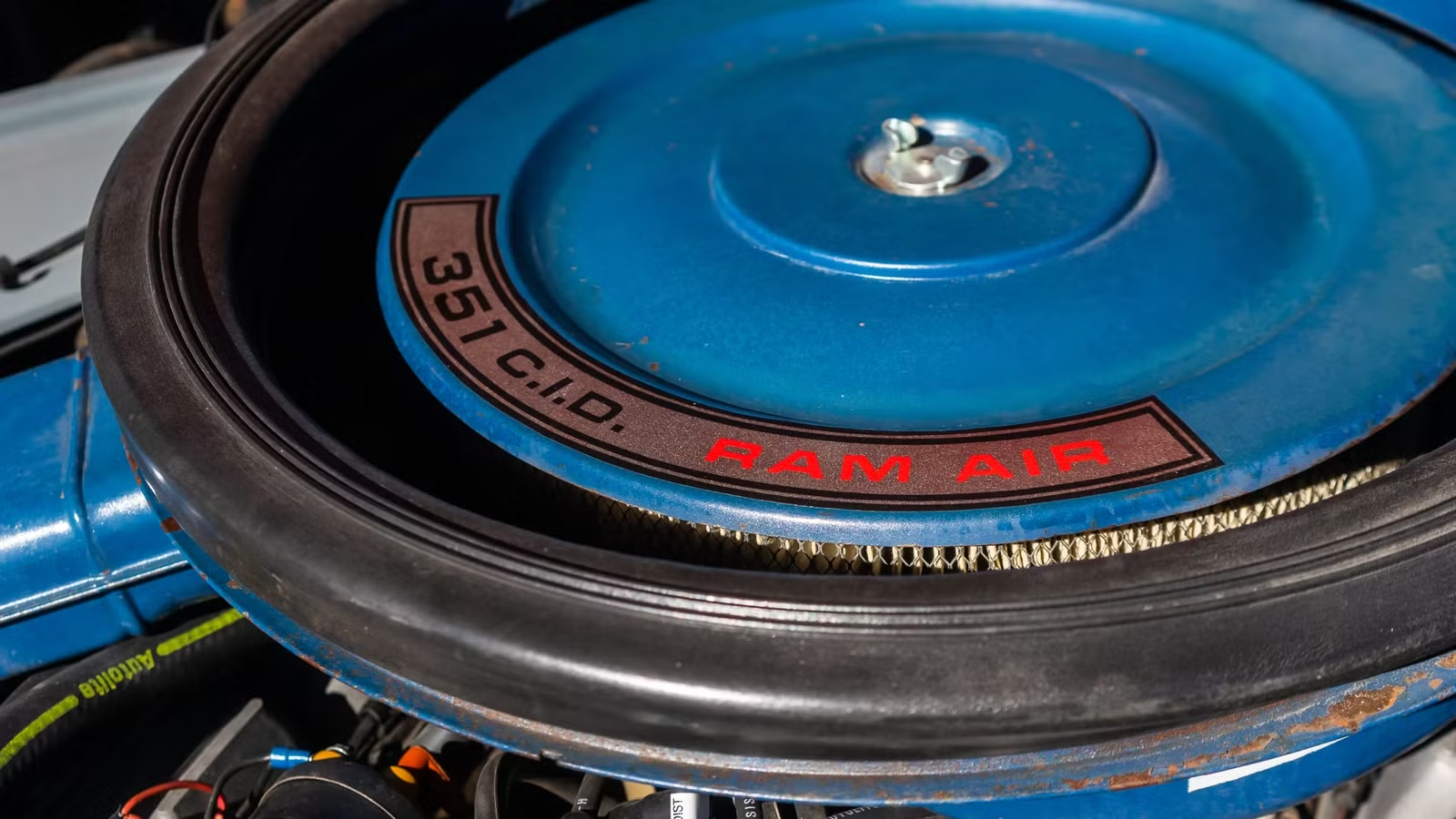
Ford’s small block muscle cars occupy a special place in muscle car history — nimble, accessible, and surprisingly capable, they defined an era when performance didn’t have to come at the cost of everyday usability. Models like the Mustang, the Torino, and the Falcon captured the imagination of American buyers throughout the 1960s and into the early ’70s. Though they couldn’t match the raw thunder of their big block counterparts, small block Fords proved enormously popular precisely because they made for more tractable daily drivers.

Despite the ubiquity of Ford small blocks during the golden era of American performance, there are specific models and variations that have become genuinely rare today. Between limited-edition packages, unique color schemes, and special small-batch configurations, you may be surprised at just how few of certain Fords aren’t as common as you might expect. With that in mind, we directed our search toward finding the rarest of the lot, with a particular focus on small block muscle.
The Boss 351 Is The Rarest Ford Small Block
There are a number of rare muscle cars throughout Ford’s history, but the most elusive examples tend to be big block prototypes and promotional vehicles built ahead of their official debut. By contrast, most of Ford’s small block muscle cars — typically powered by the 289 or 302 — were produced in vast quantities. After all, the first-generation Mustang was a resounding success, enormously popular among buyers for its approachable power and striking looks. Built for just one model year (1971) and in comparatively limited numbers (1,806), the Ford Mustang Boss 351 is already one of the rarer Ford small blocks, second only to the Boss 302 produced in 1969 (1,628). Throughout its production run, buyers gravitated toward a handful of popular colorways — Grabber Yellow and Light Pewter Metallic among them — making mid-cycle and special-order options exceptionally hard to find today. With just four examples produced in total — and among those just one with a white interior — a 1971 Ford Mustang Boss 351 in Calypso Orange over White is, by our estimation, among the rarest small block Fords ever produced.
Calypso Coral Is An Especially Rare Option

A Calypso Coral 1971 Mustang Boss 351 is so elusive today because the color wasn’t technically a regular production option. At the time of the Boss 351’s debut, Ford offered a number of Mustang colorways ranging from Raven Black to Grabber Green. Calypso Coral had previously appeared as a factory option for both the 1969 and 1970 models, and far more buyers made it their Mustang color of choice in those years. In 1969, a reported 411 Mustangs received the special orange paint, and 1970 saw that number climb to as many as 12,368. Among the other colors offered for the 1971 Mustang Boss 351, Grabber Lime and Medium Yellow Gold rank as the next rarest hues — only 67 examples were painted in each option.
Trim Makes This Boss One-Of-A-Kind
When you factor in transmissions, trim, and other add-ons, it’s possible to get even more particular. For instance, Ford painted a reported 136 Boss 351s in Dark Green Metallic, and just three of those were built with a Green stripe cloth and Corinthian vinyl interior. While that particular combination puts it close in terms of rarity, it can’t top the lone Calypso Coral example specced with a white interior. It last crossed the block at Mecum’s Kissimmee auction in 2019, and the car was optioned so extensively that it carried a two-page window sticker when first sold. With verification courtesy of the original build sheet, it’s truly the only one of its kind.
How The 351 Boss Compared To The 302 And 429
Ford offered the Boss 302 and Boss 429 Mustangs simultaneously for 1969 and 1970 before discontinuing both models in favor of the Boss 351 for 1971. While Ford had developed the Boss 302 for Trans-Am racing and the Boss 429 for NASCAR, the Boss 351 wasn’t tasked with homologation — it was all about street and strip performance.
Ford Mustang Boss Performance Comparison
|
Boss 302 |
Boss 351 |
Boss 429 |
|
|---|---|---|---|
|
Production |
1969-1970 |
1971 |
1969-1970 |
|
Engine |
302 CID V8 |
351 CID V8 |
429 CID V8 |
|
Compression |
10.5 |
11.7:1 |
10.5:1 |
|
Power |
290 Horsepower |
330 Horsepower |
375 Horsepower |
|
Torque |
290 LB-FT |
370 LB-FT |
450 LB-FT |
|
Original MSRP |
$3,450 |
$4,124 |
$4,798 |
CJ, Ford, Hagerty Under the hood, the Boss 351 featured a Cleveland V8 making 330 horsepower and 370 lb-ft of torque, slotting it neatly between the 302 and the 429. While Ford had previously used Cleveland heads on the Boss 302’s Windsor engine, the two blocks made for markedly different performers. With half an inch more stroke, the Boss 351 boasted both a higher compression ratio and greater displacement than the 302 that had preceded it. On the road, this made the 351 the most balanced, well-rounded performer of the trio. As Car and Driver found in its period review, “The engineers come off as the real heroes in the development of the Mustang Boss 351. It offers drag strip performance that most supercars with 100 cu in more displacement will envy and generates high lateral cornering forces.”
What A Boss 351 Mustang Is Worth Today

If you’re looking to add a Boss 351 to your stable, the good news is that they’re generally on par with 1969 302s and significantly less expensive than the 429s. Even for a nicer example, Hagerty’s valuations suggest it’s possible to spend less than $100,000 — though the market continues to move. Considering the low production count and strong performance credentials relative to the other Boss Mustangs, this makes the 351 comparatively under-appreciated.
Ford Mustang Boss Valuations
|
1969 Boss 302 |
1969 Boss 429 |
1970 Boss 302 |
1970 Boss 429 |
1971 Boss 351 |
|
|---|---|---|---|---|---|
|
Fair |
$38,900 |
$122,000 |
$38,900 |
$115,000 |
$44,000 |
|
Good |
$63,300 |
$189,000 |
$63,300 |
$170,000 |
$63,100 |
|
Excellent |
$89,100 |
$294,000 |
$100,000 |
$272,000 |
$89,400 |
|
Concours |
$125,000 |
$363,000 |
$131,000 |
$348,000 |
$124,000 |
Hagerty The Calypso Coral car featured above sold for $82,500 back in 2019, so it didn’t command a significant premium for its colorway — at least relative to valuations at the time. Since then, however, Boss 351s in other desirable paint schemes have cleared much more at auction. In 2022, Barrett-Jackson sold a Grabber Green Metallic example for $198,000, which stood as Classic.com’s top result for the model. More recently, Mecum sold a Grabber Lime Boss 351 for $105,000.
Other Boss 351 Pricing Considerations
- Classic.com average sale price: $81,718
- Classic.com low sale price: $25,000
- Classic.com median sale price: $79,200
Other Rare Ford Mustang Small Blocks

Trim Options Can Determine Rarity
Spend enough time digging for rare Ford small blocks, and you’re likely to find more than one example that can claim “1-of-1” status, as some buyers were very particular about their trim and equipment specifications back in the day. While this example from Mecum’s 2025 Kissimmee auction is one such car, we felt that the rarity of the orange colorway above trumped optioned items alone. After all, Ford built 186 Boss 351s in Bright Red compared to just four in Calypso Coral.
Shelby’s GT350R Is A Rare Race Car
With eyes on the Chevrolet Corvette, Ford tasked Carroll Shelby with transforming the Mustang GT350 into an amateur racing competitor. What resulted was the 1965 GT350R, a fastback coupe with its 289 engine built to 350 horsepower, its body significantly lightened, and its fuel cell replaced with a 34-gallon endurance tank. Though just two prototypes and 34 production cars exist, they’re technically Shelby’s work rather than Ford’s.
The Mach 1 Twister Special Is One Rare 351
Assuming you’re after an elusive limited-edition model, Ford’s Mach 1 Twister Special makes for an exceptionally rare small block — all the more so because of its unusual backstory. American Raceways International had contracted Ford to build a run of promotional pace cars, but the company went bankrupt before it could take delivery. Ford changed course and offered the Mustang Mach 1s as Twister Specials through Kansas City dealerships instead. Adding to the intrigue, an engine shortage meant that only half of the 96 Mustang Mach 1 Twister Specials received the 428 Cobra Jet as originally intended. The other 48 were fitted with Ford’s four-barrel 351 Cleveland. Sources: AMM, Classic.com, CJ Pony Parts, Hagerty.

Related posts


Latest Post


No Comments