
The Dual-Sport That Challenges Honda
It is a known fact that Honda simply dominates the motorcycle market. Just look up the numbers, be it income, units sold, or market share. The brand does that by using part-sharing, customer know-how, and decades of experience, all of which help whip up fine products that keep attracting customers year on year. That is true for all segments, right from small cruisers and dual-sports to flagship superbikes and 900-pound tourers.

However, competition keeps going up each year, too. New brands from all over the world try to exploit Honda’s weaknesses and offer products that are more attractive on paper. A fine example of that has recently come in the entry-level dual-sport space, with its eyes set on challenging Honda’s renowned CRF300L.
The KTM 390 Enduro R Exploits The CRF300L’s Shortcomings
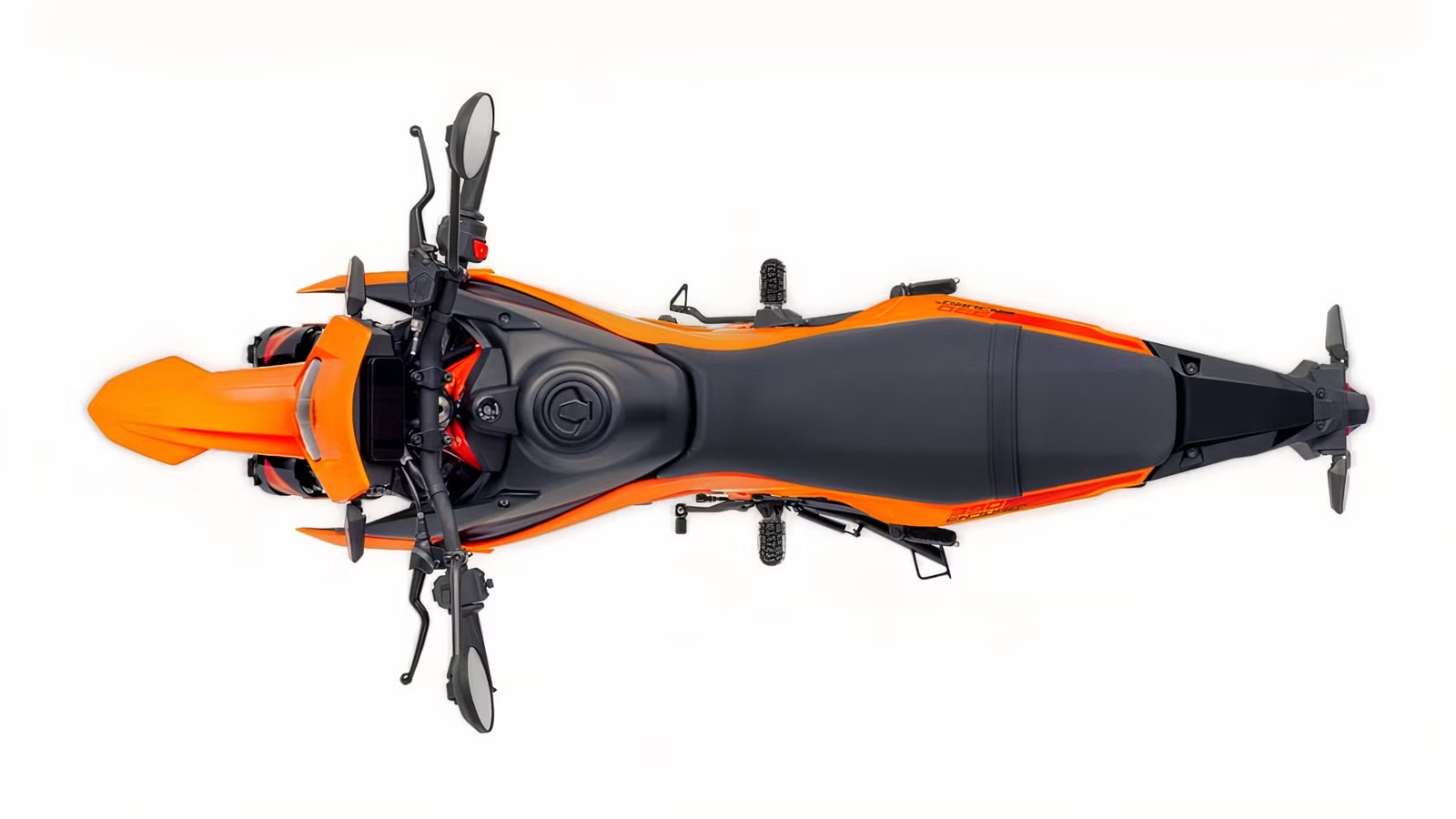
We’re talking about the 390 Enduro R—KTM’s answer for the budget dual-sport segment. It takes a different approach from regular Japanese options like the CRF300L, bringing a class-leading compilation of modern tech and power. Its 390 Duke-derived chassis elements further promise great on-road abilities, unlike its rivals that aren’t based on any naked bike. All this while, the dual-sport basics like off-road-spec long-travel suspension and spoke wheels are still offered.

A Strong MSRP Makes The 390 Enduro R Brilliant Value For The Money

All the premiumness doesn’t cost a bomb, either. The 2026 390 Enduro R sells for $6,049–just $300 more than the CRF300L and $450 down on the CRF300L Rally. Given the premium equipment on offer, the money seems well justified to us. In fact, some of the bits you get here are so advanced, you can’t even source them for the CRF (officially or unofficially). On that note, here’s a lowdown on what all you get.
Adjustable WP Apex Suspension Ties Up With Spoke Wheels

Starting with what matters most, the 390 Enduro R has rugged underpinnings. A two-piece chassis serves as the centerpiece, where the front has a steel trellis section and the rear a bolt-on subframe. The latter is different from what we see on the 390 Duke to focus more on off-road abilities. Tied to each end is WP Apex suspension. The 43 mm upside-down forks sit up top with nine inches of travel, with the rear monoshock offering the same. You also get rebound and compression/rebound and preload adjustability–an underrated plus over Japanese rivals.

Coming to the wheels and brakes, a 21-inch spoke wheel is present at the front and an 18-inch spoke wheel at the rear. Both ends have knobby tires and single disc brakes (285 mm F/240 mm R) for company. All of these underpinnings result in keeping the curb weight at 350 pounds (without fuel). Yes, that’s substantially more than the CRF300L, but it should help better the on-road stability. Over 10 inches of ground clearance and a saddle height of 35 inches round things off.
Class-Leading 399cc Single-Cylinder Engine Brings Over 40 HP

Then, you have the engine. You get KTM’s new LC4C powerhouse here also seen on the new 390 Duke and 390 SMC R. It’s fully liquid-cooled, fires up at a 12.6:1 compression ratio, and displaces 399 cubic centimeters. All that helps produce 44 horsepower and 28.7 pound-feet of torque, where the former is simply in a league of its own in the segment. The CRF has around 25 horsepower, for reference. A six-speed transmission puts the power to the ground via a chain drive.

Like the engine, the tech around the engine is quite advanced. KTM has thrown in a six-axis IMU and ride-by-wire as standard here, both of which enable bits like cornering ABS, ride modes, and traction control. The ABS is switchable, and you can also equip a bi-directional quickshifter for extra money (not even an option on the CRF). Rounding off this premium experience is a 4.2-inch TFT instrument cluster (segment-first), a USB-C port, all-LED lights, and adjustable hand levers.
Why The 390 Enduro R Might Make More Sense Than The CRF300L


If you’re into small dual-sports, someone must’ve recommended you the CRF300L already. That’s not random. This has been the top dog in its segment, offering dual-sport fanatics an unbeatable blend of reliability and hardcore off-road capabilities. The price adds to the equation. Back in 2021, the ABS-equipped CRF300L sold for $5,549, and after five years, despite updates, the MSRP has only grown by $200 bucks. Another key factor is Honda’s three-variant lineup: CRF300L, CRF300LS, and CRF300L Rally. The LS is the low-seat version, while the Rally brings more highway usability.
However, this overall simplicity can make new riders feel unsatisfied. That’s particularly true for someone who wants new-age tech in their bikes, regardless of the cubic capacity. Likewise, the performance here is under 30 horsepower, which might bore you once you gain experience or show its limits when you push hard on paved roads. That is exactly where the 390 Enduro R starts making a lot of sense as a dual-sport purchase. You’re paying $300 more for a much more modern product head to toe, and if you value that, it’s a no-brainer.
Source: KTM USA

Related posts


Latest Post


No Comments