
The Rarest Ford Ranger Ever Built Just Sold for $55,000
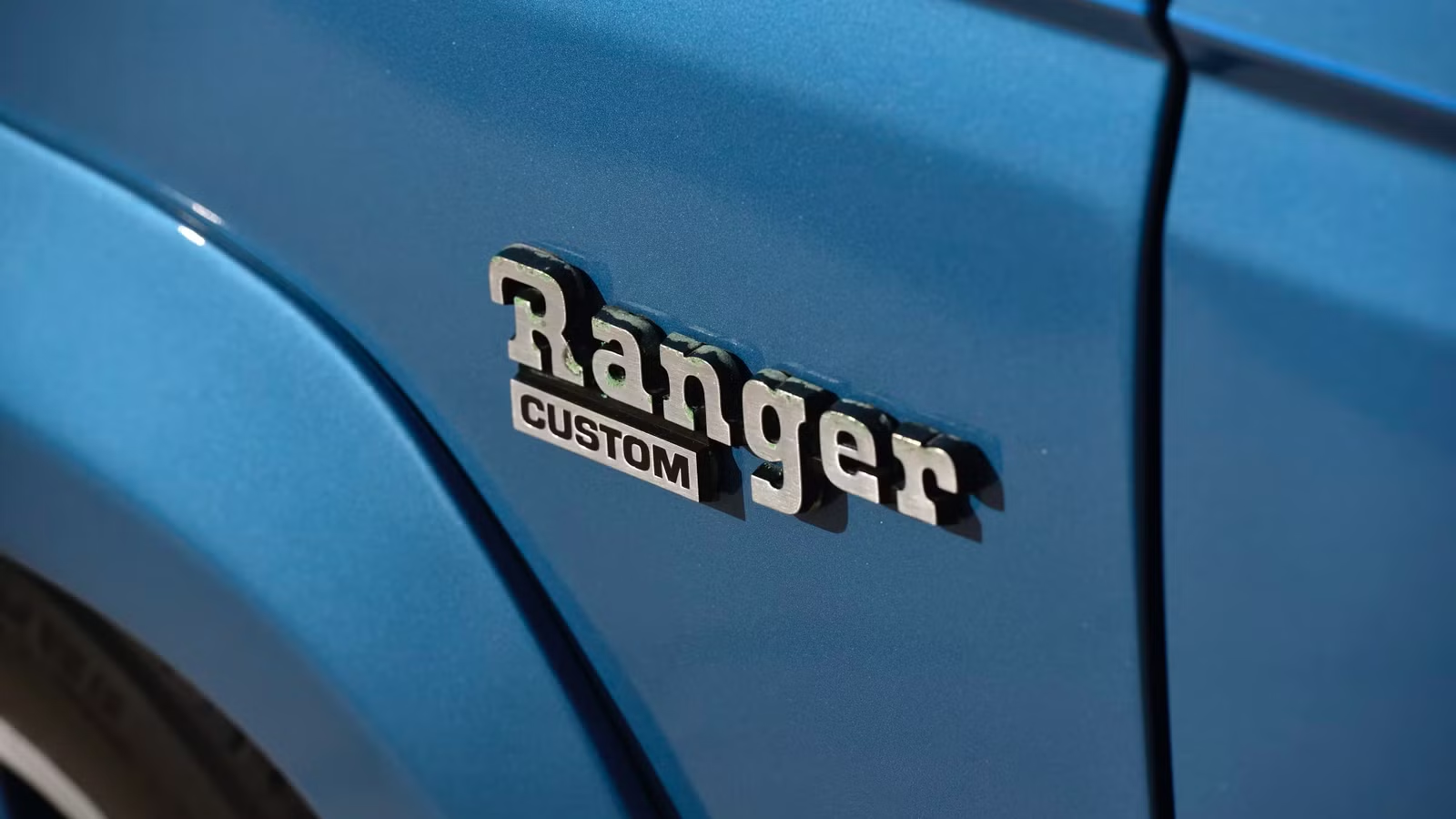
Factory performance trucks are big business today, with toughened machines like the Ford Raptor R and Ranger Raptor turning pickups into genuine enthusiast hardware. The idea behind them is older than most fans realize.

Decades before any modern super-truck existed, a championship-winning tuner best known for Mustangs quietly applied his formula to a compact Ford pickup. He built so few that most Ford fans have never seen one in person, and the survivors rarely surface. One of them just became the most expensive Ford Ranger ever sold at auction.
America’s Favorite Mustang Tuner Bet His Reputation On A Pickup
Steve Saleen entered the late 1980s withone of the most credible names in American tuning. His modified Mustangs paired aggressive bodywork with serious chassis engineering, and his race teams proved the package by winning on track. Customers bought Saleens because the cars earned their reputation in competition rather than on a show stand.

In 1987, Saleen took that formula somewhere nobody expected by entering the SCCA Coors Race Truck Challenge with a modified Ford compact pickup. The program clicked immediately, and Saleen collected two wins during that first season. The truck effort kept building from there, and by 1991 Saleen had claimed the SCCA Race Truck title outright with five wins in six races.

Saleen had always followed the same playbook with his Mustangs, proving the hardware in competition and then selling a road-going version to the public. The race truck’s success justified the same treatment, and in 1988 a small batch of street versions quietly went on sale.
The timing lined up with a broader moment, too, as compact street trucks were gathering steam in the late 1980s, with small-truck racing and the sport minitruck scene making little pickups cool for the first time. A hand-built pickup from a proven race shop fit that moment perfectly.
The 1988 Saleen Ranger Sportruck: Only 27 Were Ever Built

The 1988 Saleen Ranger Sportruck was a one-year-only special tuned model that remains the rarest version ever built on a first-generation Ranger. Saleen produced just 27 in total, splitting the run into 24 street trucks and three examples reserved for racing. Numbers that small put the Sportruck in rarer company than almost any muscle car of the classic era.
But documentation is what sets these trucks apart from ordinary tuner specials. Each street truck received a sequential Saleen number and an entry in the Saleen Registry, the same system the company used to track its Mustangs. That paper trail still matters today, because it separates genuine Sportrucks from body-kit lookalikes and gives collectors a verifiable record of every truck built.
Every street truck was also finished by hand to the same specification, which made the Sportruck less a dealer appearance package and more a serialized entry in Saleen’s own catalog. Plenty of flashy trim packages moved through Ford showrooms in the 1980s, but almost none carried a tuner’s personal build number.

Saleen fitted a full ground effects kit that smoothed the Ranger’s boxy lines, added his signature stripes, and mounted color-keyed 15-inch alloy wheels. The bodywork alone made the truck recognizable from a block away. Nearly every Sportruck left the shop wearing white paint with blue trim, a detail that would eventually make one particular truck very important.
Ford never offered anything comparable from its own factory. The Ranger GT of the late 1980s came closest with a sport suspension and body kit, but it remained a trim package rather than a hand-finished tuner special. That leaves the Sportruck as the closest thing to a sanctioned performance Ranger the first generation ever received, which explains why Ranger devotees treat it as the model’s crown jewel.
The 2.9-Liter V6 Stayed Stock While The Chassis Tuning Made It Faster

Saleen left the drivetrain almost entirely untouched, using the Ranger’s fuel-injected 2.9-liter Cologne V6 and a five-speed manual transmission, and the Barrett-Jackson listing for one surviving example notes a 3.73 rear end as the lone driveline change. With roughly 140 hp on tap, straight-line performance matched an ordinary 1988 Ranger.

Saleen built his reputation on the belief that handling mattered more than horsepower, and the untouched engine reflected that philosophy rather than cutting corners. The Sportruck received the full Racecraft Suspension System that defined his Mustangs, which turned a compact pickup into something that cornered with real composure at a time when most trucks wallowed through bends.
Power front disc brakes and power steering completed the chassis work. Twin exhaust tips matched the design Saleen used on the 1989 SSC Mustang, tying the little truck visually to the company’s flagship. None of it sounds exotic today, but the package made the handling upgrades usable in everyday driving rather than just on a favored back road.

The cabin received the same attention as the suspension. Sport bucket seats trimmed in charcoal and light gray cloth with red piping matched custom door panels, while a MOMO steering wheel with a blue leather rim replaced the factory item. Saleen-specific gauges brought a 140-mph speedometer, and a period-correct Pioneer Super Tuner III stereo handled entertainment.

Comfort equipment ran deeper than most tuner specials of the era. Air conditioning, cruise control, tinted glass, and a tilt steering column all made the cut. The finishing touch sat in the glovebox area, where Steve Saleen added his actual signature in silver ink rather than settling for another badge.
There’s Only One Regatta Blue Sportruck Ever Built

One truck towers over the other 23. Saleen number 88-0009 was the ninth street truck built and, according to the Mecum Auctions listing that recently returned it to the spotlight, the only 1988 Sportruck finished in Regatta Blue. Within a 24-truck street run, that paint choice makes it a genuine one-of-one.
The truck has had a single owner from new, shows just 1,682 miles on the odometer, and still wears its original window sticker and temporary tag. No other known Sportruck comes close on mileage, which makes 88-0009 the reference example for the entire model.
The Sportruck’s other well-documented survivor tells a different story. Truck number 27, the last of the 27 built, crossed the auction block at Scottsdale in 2009 as a white example showing under 33,000 miles. Even that figure counts as careful preservation for a compact pickup from 1988.

Nobody knows exactly how many of the other 22 street trucks still exist. The Saleen Registry preserves the build records, but decades of quiet ownership mean survivors tend to reveal themselves only when one finally comes up for sale.
Most of the remaining trucks have simply vanished from view. Small pickups were bought as tools and used up accordingly, and even limited-run specials rarely escaped that fate. Surviving examples almost never change hands publicly, and communities like The Ranger Station and the Saleen collector world track every documented truck as a known quantity.
Experts Predicted $90,000 And The Market Remained Grounded

For decades, the market barely acknowledged these trucks. When truck number 27 sold at that 2009 Scottsdale auction, it brought just $6,050, which was ordinary used-Ranger money for a hand-built Saleen with full documentation. That figure stood as the model’s only meaningful public data point for years.
The Regatta Blue truck had previously traded at $39,500, already a Sportruck record, before heading to Mecum’s Kissimmee sale in January 2026. Ahead of the auction, Hagerty pegged the estimate at $75,000 to $90,000 and predicted the truck would become the world’s most expensive Ford Ranger.

The truck instead sold for $55,000 on January 15, 2026, landing well short of the estimate but still making history. Classic.com now records that result as the highest price ever paid for any first-generation Ford Ranger.
Comparable Sportruck sales span roughly $5,900 to $25,000, so the blue truck more than doubled the top of its own market on the strength of color, mileage, and paperwork. That pattern points to a genuine cult following rather than auction-week hype.
The Sportruck argued three decades earlier that a compact pickup deserved sports car engineering, and Ford eventually built that exact truck itself and badged it Ranger Raptor. Saleen’s gamble only looks prophetic in hindsight, which may be the most fitting legacy for a truck almost nobody noticed when it was new.
Sources: Mecum Auctions, Hagerty, Classic

Related posts




Latest Post



No Comments