
Why Chevy Small-Blocks Make Ford And Mopar Builds Look Overpriced And Overcomplicated
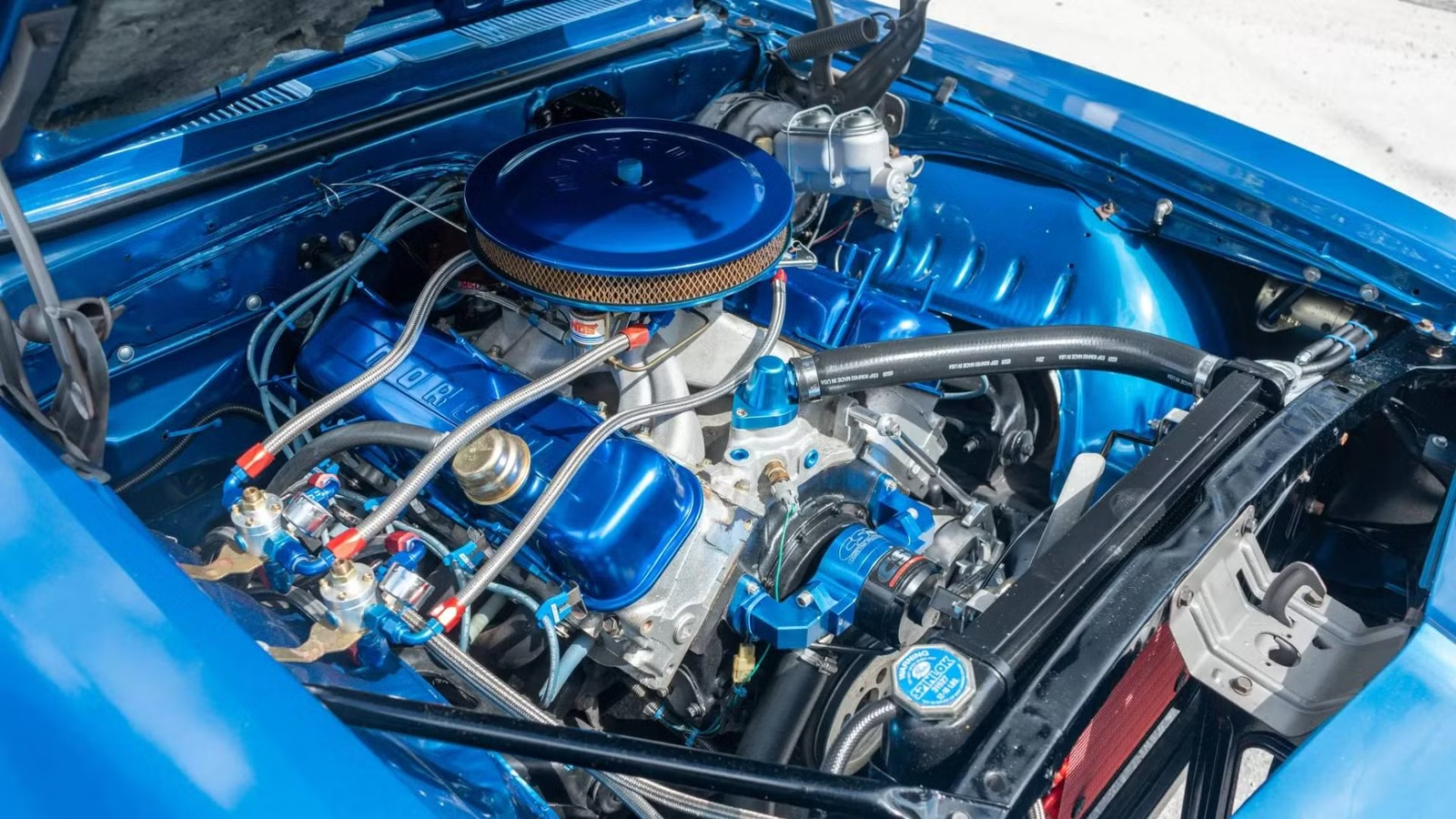
When it comes to building restomods with American engines under the hood, you effectively have three mainstream options. You have Mopar HEMIs in modern and classic flavors, Ford small-blocks with much the same, or, you can go with a choice of tens of thousands of wrenchers, modders, and tuners, usually without having to think about it much. There are tons of reasons why you might opt for the choice in question instead of something else, but the hidden truth you might’ve never even considered makes it one of the most practical choices you could think of. In a sea of great engines, these traits make the choice fairly obvious, on the Chevy side.
Chevy V8s, Big-Block, Small-Block, Either One’s a Guaranteed Win

Whether you choose a classic Gen-I 350 small-block, a gigantic 454 big-block, or a modern LS or LT crate engine, the Chevy family offers bulletproof reliability and a capacity to accept way more horsepower than you might expect. Still, basic performance data only tells you half the story, because Chevy’s true edge is multi-faceted, and not rooted to one or two aspects in particular.
Starting all the way back in 1955, Chevrolet’s small-block V8 architecture served as the standard for compact, muscle car engine design. Its clever deck height, tight bore spacing, and efficient oiling system meant builders could wring massive power out of an engine bay without adding unnecessary front-end weight. In the early days of the muscle car wars, that meant gigantic full-size B-body cars like the Impala could accept the engine just as easily as the comparatively tiny Nova. In a modern context, that means no panic attacks about shock tower clearances, the position of the oil pan, or modifications to the hood that you often find with HEMIs or Ford 351s.
When it comes to big blocks, Chevy brought the benefits of insane low-end torque and heavy-duty iron construction to the table, with the tiny caveat of a bit more weight at the front end. Whether swinging a forged crank in a high-deck 427 or assembling a drag-happy 454, transitioning from a small-block to a big-block was always a straightforward, well-documented path for tuners of all stripes. From a mechanical standpoint, this inter-family crossover was as impressive back then for OEM muscle cars as it is for tuners today. Better still, the list of upsides really does seem endless. It’s a sentiment that’s just as true of modern computerized LS and LT V8s as blocks from days of yore.

Some More Obvious Upsides

Anyone who’s taken a look at a parts catalog for places like Summit Racing or Speedway Motors will tell you the sheer, unmatched volume of off-the-shelf support available for a Chevy V8 makes everything else seem inadequate. Because Chevy cranked out small-blocks and big-blocks in abundance for over half a century, and for every kind of motor vehicle you could think of, the aftermarket didn’t just support the platform—it built a multi-billion-dollar cottage industry around making it more powerful. Even beyond cheap replacement parts, you can walk into any old parts store anywhere in the country, and find any part you could think of, right off the shelf, day-of, no questions asked.
In terms of performance, the options are practically limitless, almost overwhelming. Want a high-rise dual-plane intake, aluminum heads that flow like Niagara Falls, or a custom-grind camshaft? Every major speed shop on Earth stocks dozens of variations for a Chevy, big-block or small, usually at half the price of equivalent Ford or Mopar hardware. Because these parts are produced in such high quantities, you almost never run into steep “boutique taxes” that routinely price Ford and Mopar hardware out of reach. In practice, you can build a 500-horsepower big-block screamer for the same price it costs to build a bare-basic Dodge 383 from scratch.
From a wiring and plumbing perspective, it makes all the difference in the world to bringing the final product together. There’s not a single performance electronics supplier in these United States that doesn’t offer a DIY EFI wiring kit, distributor kit, or digital gauge cluster kit specifically for the Chevy V8 architecture. In some instances, you barely have to do so much as splice a single wire. It’s as close to a plug-and-play experience as you’re liable to find in the discipline of restomods. Still, these are far from the only upsides of picking a Chevy block over anything else. If you ask us, the most underrated upside of opting for Chevy hardware is far simpler, but makes a huge impact.
The Universal Bellhousing: One Pattern To Rule Them All

Decades ago, Chevrolet’s engineers had a stroke of genius that still follows their V8 engines to this day. In short, Chevrolet standardized its rear mounting framework, using the exact same bellhousing bolt pattern across small-blocks, big-blocks, and continuing straight through to modern LS and LT engine families. This clever universal mounting blueprint is a game changer for restomodders, particularly those looking to pair their engines to an automatic gearbox with overdrive. Regardless of specifics, any combination of Chevy V8 and gearbox can bolt right together, usually with little more than a set of jack stands, some wrenches, and a few of your buddies.
While you might run into one or two electronic gremlins stepping up to modern four-speed overdrives like the 4L60E or 4L80E, the sheer physical compatibility means the hurdles begin and end once those issues are sorted. For simpler transmissions like Tremec T-56 manuals or 700R4 automatics, the job is so simple, you could complete 75 percent of the job in one afternoon, and the rest of it the following day. Sure, you may still need a new crossmember or a newly shaped transmission tunnel—there’s no escaping that in some cases—but it’s as close to smooth sailing as you’re ever going to come across if you’re into this line of work.
Try pairing a Mopar LA V8 block to a B/RB transmission, and you’ll suddenly understand why every master tech you’ve ever come across swears like a sailor when they think you’re not looking. Not to mention that viable overdrive gearboxes compatible with vintage Mopar engines are so limited, you’re bound to have your jaw hit the floor as soon as you run the eBay query. Ford is no better, offering separate bellhousing patterns for FE big-blocks, 385s, Windsors, Clevelands, and modern Coyotes. The problem is so prevalent that entire companies subsist on supplying adapter kits for Mopar and Ford owners to pair their engines to GM transmissions. At the end of the day, people are going to have their preferences, but the practical-minded among us are going to turn to Chevy when they realize just what kind of pickle they’re bound to get into choosing otherwise.
The Ultimate Budget-Friendly Restomod Blueprint

At the end of the day, Chevy didn’t just make powerful engines for the working man. They designed an interconnected, modular drivetrain system that does more for the budget-conscious builder’s bottom line than any other OEM in the world. It’s a phenomenon practically unheard of among any other OEM, and one that simply can’t be replicated thanks to decades of third-party support.
By removing the need for welding torches, fabrication snafus, and downright ludicrous amounts of custom driveline adaptation, Chevy gives you the freedom to spend your project budget where it really matters. You know, on suspension, brakes, paint, and pure, usable horsepower. Oh, and hot rod flames—they add at least thirty horsepower, and we won’t hear a word to the contrary.
Source: Novak Conversions

Related posts




Latest Post


No Comments