
The Racing Engine Chevy Never Meant To Sell Escaped In Just 69 Camaros
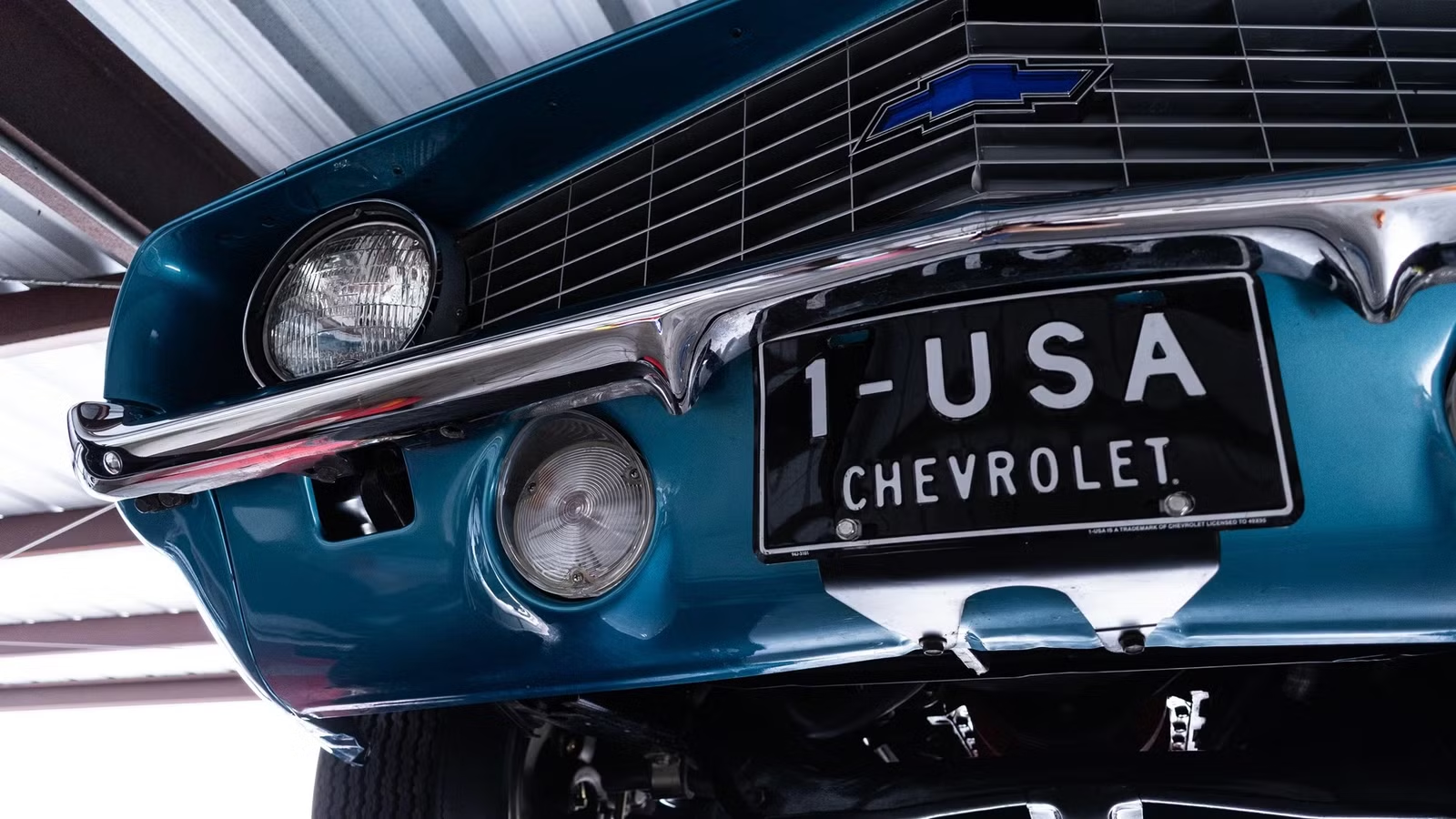
In 1969, Chevrolet let one of its wildest racing engines escape into a tiny batch of factory-built street cars. Corporate rules should have stopped the project, and common sense should have stopped the dealer who ordered 50 of them, while the price nearly finished the job. Instead, drag racers bought the cars, changed them, broke them, and scattered their rare parts across the country. The result became a muscle-car mystery in which paperwork can carry six-figure value and one aluminum V8 can turn an old body shell into an archaeological dig.
Chevrolet Had Rules Designed To Keep This Engine Out

General Motors had placed a firm ceiling over its performance divisions. In the late 1960s, the company generally barred engines larger than 400 cubic inches from passenger cars smaller than its full-size models. The company could place a 427 in a Corvette or a big Impala, Biscayne, or Bel Air. A smaller car had to make do with less displacement, at least through the normal ordering system.
Chevy hardly left smaller-car buyers without options. Its dealers could sell serious hardware, including the 375-hp L78 396. The Z/28 offered a sharp, high-revving package built around road-racing rules, while dealer-prepared machines from shops such as Yenko Chevrolet pushed well beyond the factory catalog. Still, the official limit mattered – dealers could swap larger engines after delivery, but a dealer conversion did not always carry the same racing-class status, documentation, or assembly-line credibility as a factory combination.
That distinction mattered most in National Hot Rod Association competition. NHRA Stock and Super Stock categories depended on production specifications, shipping weight, engine ratings, and factory availability. A racer could not simply install Chevrolet’s strongest engine and call the result a production model. The desired combination needed an approved identity and enough factory-built examples to satisfy homologation rules.
One Dealer Ordered 50 Cars He Had Almost No Chance Of Selling

Fred Gibb ran a Chevrolet dealership in La Harpe, Illinois, a small town with an unusually large appetite for fast cars. Gibb viewed racing as a way to sell Chevrolets and build his dealership’s name. In 1968, he had already worked with Chevrolet product manager Vince Piggins to obtain 50 Chevy II Novas that paired the L78 396 with a Turbo-Hydramatic automatic transmission. Chevrolet did not normally offer that combination, but NHRA racers wanted it. The project taught Gibb that corporate rules sometimes had doors hidden behind the filing cabinets.
His next idea carried far more risk. Gibb wanted Chevrolet’s exotic aluminum racing engine in a smaller factory car for Super Stock competition. The NHRA required a production run of 50 examples, so one experimental vehicle would not solve the problem. Gibb had to commit to the full minimum order, and that meant agreeing to take 50 specialized cars before knowing their final retail price or whether ordinary customers would buy them. A dealership in a town of roughly 1,500 people had effectively ordered enough race cars to start its own traffic jam.
Chevy approved the request through its Central Office Production Order system. COPO paperwork usually handled combinations outside the standard dealer menu, including fleet equipment, special paint, and other unusual specifications. In this case, it let Chevrolet place restricted performance hardware on the assembly line without adding a shiny new option to every showroom brochure. The completed cars received normal factory VINs, warranties, and legal road-car status. Their mechanical roots, however, reached directly into Chevrolet’s racing program.
The COPO 9560 ZL1 Camaro Was Chevrolet’s Factory Phantom

That remarkable car was the 1969 Chevrolet Camaro ZL1, built under COPO 9560. Chevrolet assembled 69 of these Camaros after other dealers learned about the project and placed 19 additional orders. The Camaro Research Group’s surviving production list traces the 69 cars through 41 ordering or selling dealers. Some broader accounts mention 71 factory ZL1-powered vehicles because Chevrolet also built two 1969 Corvettes with the ZL1 option, but that wider number describes two models.
The 9560 deserves separation from the other famous 1969 COPO Camaro. COPO 9561 installed the iron-block L72 427, officially rated at 425 horsepower. Chevrolet built roughly 1,000 of those cars, including the examples that Yenko Chevrolet converted into its better-known 1969 Yenko Camaros. COPO 9560 used a different and far more expensive engine.
Its ZL1 427 used an aluminum block, aluminum cylinder heads, iron cylinder sleeves, four-bolt main bearing caps, a solid-lifter camshaft, and a large Holley carburetor. Chevy developed the basic architecture from its L88 and Can-Am racing work, where lower weight could help a car brake, corner, and accelerate more effectively. The company officially rated the production engine at 430 hp, while period testing described roughly 550 hp at 6,400 rpm and as much as 700 hp in racing form. The complete engine weighed about 520 pounds, around 160 pounds less than an iron big-block and close to small-block territory.

Chevrolet built 47 of the 69 COPO 9560 Camaros with four-speed manual transmissions and 22 with Turbo-Hydramatic automatics. Gibb’s original 50-car order included 30 M21 four-speeds and 20 automatics. Then the invoices arrived: COPO 9560 alone added about $4,160 after related charges, pushing a typical car’s sticker to roughly $7,269. A base V8 Camaro cost less than $3,000, and the ZL1 engine option essentially cost more than the car that surrounded it. Gibb sold only 13 from his initial allocation and returned the other 37 to Chevrolet, which redistributed them through performance dealers around the country.
Drag Racing Turned The Surviving Cars Into Forensic Puzzles

Many buyers did not purchase ZL1 Camaros for gentle Sunday drives. Organized drag racers took about 20, according to period-based histories, while other owners removed engines for separate projects. Some racers changed springs, shocks, rear gears, transmissions, exhaust systems, wheels, and tires. They stripped interiors, added safety equipment, repainted bodies in team colors, and cut panels when new parts or larger tires demanded room. Engines failed, replacement blocks went in, and original engines moved into other cars.
Identification makes the problem harder. A 1969 Camaro VIN confirms basic facts such as model line, body style, assembly plant, and whether the car started with six- or eight-cylinder power, but it does not spell out the engine’s displacement, output, or COPO status. Some ZL1 examples wore simple steel wheels and small hubcaps, making them look closer to rental-counter transportation than a hand grenade with windshield wipers. Experts therefore compare known COPO records, dealer invoices, shipping data, body broadcast sheets, hidden VIN stampings, Fisher body numbers, trim tags, axle codes, transmission codes, engine dates, casting details, and stamped suffixes.

That evidence separates authenticity from originality. A documented COPO 9560 body remains a real ZL1 Camaro even when its factory-installed engine disappeared during decades of racing. It may now carry a correct replacement aluminum ZL1 block, a later service engine, or an ordinary big-block. At the same time, a genuine 1969 ZL1 engine may survive far from the Camaro that received it at Norwood Assembly.
Auction results show how sharply that proof can affect value. RM Sotheby’s sold ZL1 number 53 for $404,250 in 2016; it had drag-racing history, period photos, and a correct replacement block. Barrett-Jackson sold number 61 for $770,000 in 2023. A Hugger Orange example brought $1,094,500 in 2020, while ZL1 number 2 reached $1.43 million at Mecum’s Indianapolis sale in May 2026 despite using a correct replacement engine.
The ZL1 Became Priceless Because It Failed At Its Original Job

A remarkable story, to be sure. Corporate restrictions kept the engine out of normal production, but Gibb used COPO paperwork to circumvent them. NHRA rules forced the 50-car commitment. Chevrolet’s engine price scared away buyers. Racing then consumed, altered, or separated many of the cars that reached customers. Its rarity grew from a row of practical failures rather than a carefully managed success.
That history gives the car a very strange pull. Chevy’s most technically exotic 1969 Camaro became one of its worst showroom propositions. Fred Gibb could not sell his full order at a time when the cars sat new on dealer lots. More than half a century later, collectors inspect welds, stampings, old photographs, and yellowed invoices with the care normally reserved for buried cities. The car that once needed a discount now needs an investigation.
Modern low-production performance cars arrive with press releases, social-media campaigns, serialized badges, and owners who wrap the seats before driving home. The ZL1 Camaro followed the reverse route – it slipped through obscure paperwork, landed at dealerships as painfully expensive inventory, and often headed straight for a drag strip where preserving matching numbers ranked somewhere below winning the next round. Chevrolet never planned a legend – it built a racing tool, struggled to sell it, and watched racers use it exactly as intended. That failure allowed just 69 COPO 9560 Camaros to escape – and made every surviving clue valuable.
Source: Chevrolet, Hagerty, RM Sotheby’s, HotRod

Related posts


Latest Post


No Comments