
Cadillac Is Following VW And Audi Into Chinese Platform Territory
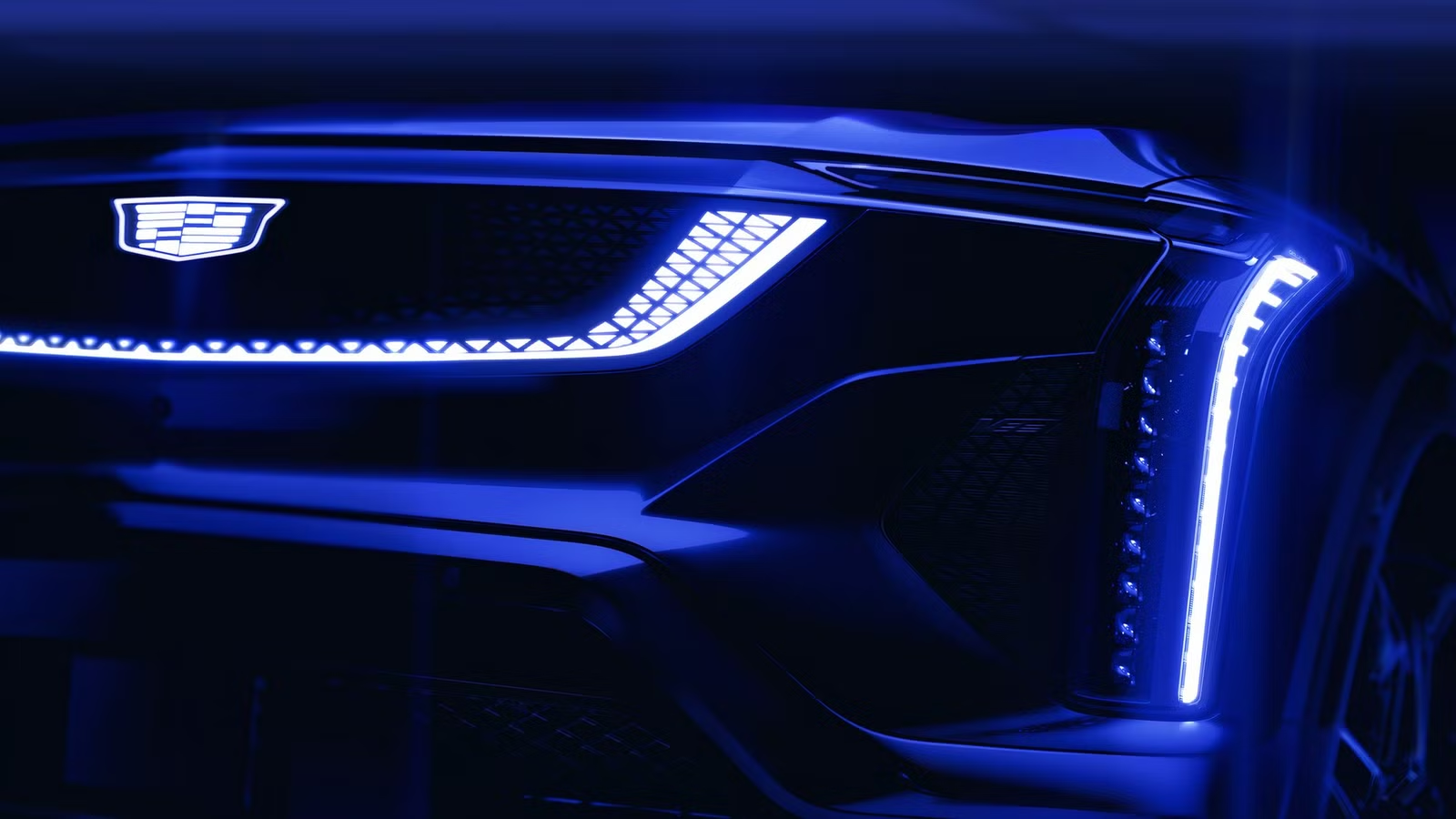
General Motors is reportedly exploring a split-platform strategy for the next-generation Cadillac Optiq — one architecture for American buyers, and a Chinese-developed alternative for the model sold locally in China. The move, confirmed by Reuters, would mark a significant shift in how GM engineers its global EV lineup, even as US-market Optiq customers would see no change under the floorpan.

The current Optiq rides on GM’s BEV3 platform — better known as Ultium — which it shares with the Chevrolet Blazer EV and Buick Electra E4. For the China-market next-gen model, GM is considering swapping that foundation for the Xiao Yao architecture developed at the SAIC-GM PATAC engineering center. That’s a locally built, locally optimized platform already proving itself in the Chinese market. American buyers, who picked up roughly 12,187 Optiq units last year, would keep the BEV3 underpinnings they already know.
What The Xiao Yao Platform Brings to the Table
The Xiao Yao architecture isn’t an unknown quantity. GM’s Buick Electra E7 and L7 — developed in collaboration with SAIC at the PATAC center in Shanghai — already run on it, and the results have been notable. The platform supports a 900-volt charging system and is flexible enough to underpin battery-electric, plug-in hybrid, and extended-range powertrains. That kind of multi-powertrain versatility matters in a market where consumer preferences shift quickly and the charging infrastructure landscape looks very different from the US.

The Buick Electra E7 cleared more than 10,000 units in its first month on the Chinese market, and GM is already planning to export the model to South Korea — a sign the platform is earning its keep. If the next-gen China-market Optiq follows the same path, the Xiao Yao underpinnings could give Cadillac a locally competitive product without the overhead of adapting a US-spec platform for Asian market conditions.
GM Is Following a Path VW and Audi Already Mapped

This bifurcated approach isn’t unique to GM. Volkswagen, Audi, and Renault have all made similar moves, leaning on Chinese R&D infrastructure to develop locally optimized platforms rather than exporting their home-market architectures wholesale. The logic is straightforward: Chinese engineering centers can develop and iterate faster for that specific market, at lower cost, and with deeper knowledge of local regulations, consumer expectations, and supply chains.
For GM, the SAIC-GM PATAC center is the hub of that strategy. It’s already delivering results with the Buick Electra lineup, and extending that work to a Cadillac product would be a natural next step. Other GM China-market EVs — the Buick Electra E5 and E4 — run on the company’s Ultium platform, so this wouldn’t be a clean break from GM’s existing architecture globally. It would be a deliberate, market-specific divergence.
What This Means for Optiq Buyers on Each Side of the Pacific

For American Optiq buyers, the practical answer is: nothing changes. The US-market model stays on BEV3, the Ultium-derived platform GM has been building out across its domestic EV lineup. The Optiq starts at $50,000 and has found a foothold in the entry-luxury EV segment — 12,187 units sold last year is a real number, not a rounding error — and GM has no apparent reason to disrupt that with a platform swap that would require re-engineering for US safety standards, supply chains, and customer expectations.
For Chinese buyers, a locally developed platform could mean a product that’s better tuned for that market from the ground up — faster charging via the 900V system, powertrain options matched to local demand, and potentially a lower price point driven by reduced development and logistics costs. Whether those advantages translate to stronger Cadillac sales in a fiercely competitive Chinese EV market is the open question. The brand is already under pressure there, as it is across the broader Western automaker landscape.
The report frames this as exploration, not a done deal — GM hasn’t confirmed the platform swap officially. But the direction is clear: as Chinese automotive R&D matures and local competition intensifies, building a China-specific product on Chinese-developed hardware is increasingly the pragmatic call. Cadillac’s Optiq may end up as the luxury brand’s proof of concept for that strategy.
Source: Autoevolution, Reuters

Related posts





Latest Post


No Comments