
The Touring Motorcycle That Does Almost Everything Exceptionally Well
Touring motorcycles have always asked riders to choose what they’re willing to give up. Big luxury tourers can make an interstate disappear beneath you, but they’re also enormous machines to maneuver through a parking lot. Adventure tourers add comfort and versatility, although their off-road hardware isn’t always ideal for riders who never leave the pavement. Then there are sport-tourers, which can be spectacularly fast but don’t always remain quite as inviting when a Sunday morning blast turns into eight hours in the saddle.
Touring Bikes Usually Make You Choose Your Compromise

Those divisions exist because long-distance riding asks a motorcycle to do several contradictory things at once. It needs stability without becoming cumbersome, comfort without becoming vague, luggage capacity without turning into a barge, and enough performance to make the interesting roads worth seeking out. Traditional tourers lean toward comfort, sport-tourers toward performance, and adventure bikes toward versatility. Getting all three into one motorcycle without blunting their strengths is much harder.
That’s why the most interesting touring machines aren’t necessarily the ones with the largest engines, biggest windscreens, or longest equipment lists. A motorcycle that’s outstanding in one area can become exhausting somewhere else. For riders who commute during the week, chase corners on weekends, travel with luggage, occasionally carry a passenger, and spend almost all their time on pavement, outright specialization can actually make a bike less useful.
A Flashy Spec Sheet Doesn’t Always Make A Better Road Bike

Adventure touring proved that upright ergonomics, roomy cockpits, decent wind protection, and suspension capable of shrugging off battered pavement make for a great combination. Those qualities work just as well on broken city streets and neglected highways as they do on gravel. But if dirt riding isn’t part of the plan, a 19- or 21-inch front wheel, heavily treaded tires, and serious off-road geometry can solve problems the owner doesn’t actually have.

A smarter approach is to keep the parts of the adventure-bike recipe that make everyday riding better, then combine them with hardware designed specifically for pavement. Seventeen-inch wheels open the door to proper sport tires, sharper geometry makes cornering more immediate, and stronger road brakes make much more sense when the bike’s toughest terrain is an interstate expansion joint. That’s where an increasingly convincing category starts to emerge.
The “Sport Crossover” Might Be The Sweet Spot

A sport crossover essentially takes a sport-touring chassis and gives it some of the comfort and suspension compliance people love about adventure bikes. The formula means 17-inch wheels, an upright riding position, meaningful suspension travel, wind protection, luggage, and modern electronics without pretending the motorcycle needs to survive Dakar. Done correctly, it can attack a mountain road in the morning and carry two people several hundred miles that same afternoon.
The difficult part is balance. Horsepower doesn’t automatically make a good tourer, just as a comfortable seat doesn’t make an exciting motorcycle. The engine, chassis, suspension, brakes, ergonomics, electronics, and luggage all have to complement each other. Get one ingredient badly wrong and the whole thing becomes another compromised all-rounder. Get them working together, though, and you end up with a motorcycle that’s difficult to categorize for all the right reasons.
The Suzuki GSX-S1000GX+ Does Almost Everything Exceptionally Well

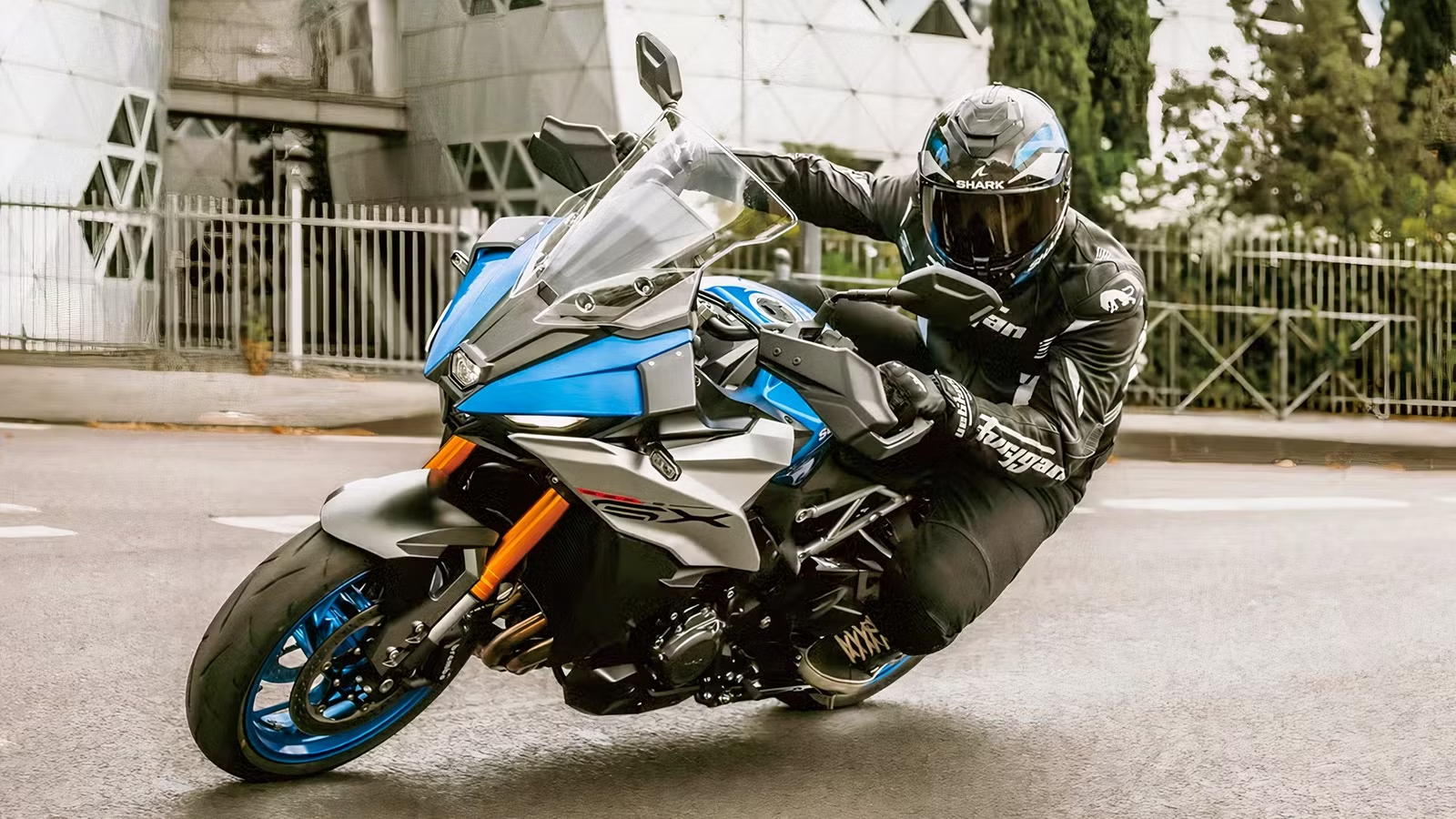
That motorcycle is the Suzuki GSX-S1000GX+. Priced from $18,749, Suzuki essentially combined the core architecture of the GSX-S1000GT+, the upright ergonomics and stance associated with the V-Strom 1050, and hardware derived from the GSX-R family to create what it calls a Luxury Crossover. Underneath is an aluminum twin-spar frame and aluminum swingarm, paired with 17-inch cast-aluminum wheels wearing 120-section front and 190-section rear Dunlop Roadsport 2 tires. Brembo radial four-piston calipers bite dual 310-millimeter front discs, while a Nissin single-piston caliper works a 240-millimeter rear disc. ABS is standard. The bike holds 5 gallons of fuel, has a 33.3-inch seat, 6.1 inches of ground clearance, and weighs 511 pounds without the side cases fitted.
Its Superbike Roots Are Still Very Much Alive

The engine is a 999cc liquid-cooled DOHC inline-four based on Suzuki’s long-running GSX-R architecture. Bore and stroke measure 73.4 by 59.0 millimeters, while compression sits at 12.2:1. The engine makes a claimed 150 horsepower at 11,000 rpm and 78.2 pound-feet of torque at 9,250 rpm, with a broad delivery designed to keep the GX+ strong through the midrange while still rewarding riders who chase the upper end of the tach. Ride-by-wire throttle and revised cam profiles help make that delivery usable rather than simply explosive.
Power reaches the rear wheel through a close-ratio six-speed transmission and 525 chain, while Suzuki’s Clutch Assist System increases plate pressure under acceleration and works as a slipper clutch on deceleration. A bi-directional quickshifter is standard, allowing clutchless upshifts and downshifts. It’s a thoroughly proven powertrain rather than Suzuki chasing novelty, and that’s arguably exactly what you want underneath a motorcycle expected to cover serious mileage.
The Suspension Technology Makes The Formula Work
Suzuki Advanced Electronic Suspension is arguably the defining piece of the GX+. Both ends provide 5.9 inches of travel, considerably more than the sportier GSX-S1000GT, while electronically controlled damping uses information from the IMU, wheel-speed sensors, and suspension stroke sensors for appropriate damping. The goal is to maintain support during aggressive riding without making rough pavement a punishment.
Active Damping Control provides Hard, Medium, Soft, and customizable User settings, while electronically adjustable rear preload lets the rider compensate for passengers and luggage without reaching for tools. Also, Suzuki Road Adaptive Stabilization can automatically detect uneven surfaces and alter suspension behavior and throttle response accordingly. That lets the GX+ gain the compliance people enjoy about adventure bikes without surrendering the sharper responses expected from 17-inch road hardware.
Suzuki Packed In Nearly Every Rider Aid It Has

The Suzuki Intelligent Ride System ties everything together. It includes selectable riding modes, traction control, lift mitigation, Roll Torque Control, ride-by-wire throttle, Motion Track Brake System, Slope Dependent Control, Easy Start, Low RPM Assist, and Smart Cruise Control. Cruise control even remains engaged while the rider changes gear using the quickshifter, a small detail that suddenly becomes very useful when you’re several hours into a highway stint.
Settings are managed through a 6.5-inch full-color TFT display, which also connects to Suzuki’s mySPIN smartphone app for maps, calls, contacts, music, and calendar functions. Suzuki hasn’t added electronics simply to make the feature list longer. Most of them directly address the GX+’s mixed mission, whether that’s keeping the chassis settled on bad pavement, simplifying long highway rides, or changing the motorcycle’s behavior when luggage and a passenger arrive.
The Best Part Is That Suzuki Didn’t Forget The Touring Part

The GX+ backs all that performance with genuinely useful touring equipment. Two 25.7-liter side cases are standard and can be removed in seconds, with their locks keyed to the motorcycle’s ignition key. A center stand and aluminum rear carrier are also standard, as are hand guards, rubber-mounted handlebars, a wind-tunnel-developed adjustable windscreen, and redesigned rider and passenger seats intended to improve long-distance comfort.
Of course, like all things in life, there are compromises. The 33.3-inch seat won’t suit every rider, 511 pounds before the cases go on isn’t lightweight, and this clearly isn’t the motorcycle for someone planning serious off-road travel. But those limitations are also part of why the concept works. Suzuki hasn’t tried to make it competent everywhere. It concentrated on what road riders actually do: commute, tour, carry luggage, bring a passenger, cross rough pavement, chase corners, and occasionally pretend the next on-ramp is qualifying.

That’s a narrower definition of versatility than the adventure-bike world usually sells, but perhaps a more useful one. The GSX-S1000GX+ doesn’t need a 21-inch front wheel or knobby tires to prove it can do almost everything. By focusing on the places most touring motorcycles actually spend their lives, Suzuki has built something more valuable: a bike that doesn’t merely tolerate several different jobs, but manages to be exceptionally good at nearly all of them.
Source: Suzuki Cycles

Related posts





Latest Post


No Comments