
This 205-HP Superbike Arrived Ready To Humiliate Almost Everything
The early 2000s were a great time to be alive for sportbike fans across the globe. Japanese and European two-wheeler giants were incessantly rolling out their new or updated track weapons, stunt riding culture was on the rise, and movies like Biker Boyz and Torque did their part in popularizing the sportbike culture. Japanese brands were working overtime perfecting their inline-four formula while Italian marques like Ducati and Aprilia were busy pumping as much character into their motorcycles as they could. Amidst all this, a completely fresh player entered the fray in 2009, making everyone stand up and take notice.
It Set a Benchmark In More Than One Area

It was not just another newcomer in the sportbike segment. It went on to become a game-changer unlike anything the sportbike category had seen in years, and that was for a few good reasons. It did not nail just one aspect of the sportbike class, but there were multiple tricks up its sleeve.
The electronics suite, for one, was segment-defining, as it brought goodies like lean-sensitive traction control and race-derived ABS to the masses. Power output crossed the 190 horsepower mark, beating its rivals by a significant margin. And that fire-breathing powerplant sat in a chassis that was hard to fault in terms of stability and responsiveness. What’s even more interesting is that it did not show up looking like anything else available in the market back then. The stance, silhouette, and certain design elements were so unique to it that there was no mistaking it for anything else.
The 2009 Shockwave That Nobody Saw Coming


True sportbike aficionados may have guessed the motorcycle by now. For those who couldn’t, the motorcycle in question is the BMW S 1000 RR. The one which, in its first generation, came with an oddball of a fascia with twin asymmetrical headlamps, compact dimensions, oodles of electronic aids, and a screamer of an inline-four motor.
It all started with BMW Motorrad, the German brand previously known for its Boxer-twin engine and the versatile GS adventure tourer, taking the wraps off the S 1000 RR as a race prototype in 2008. Sporting BMW’s signature white, red, and blue livery, every element on the motorcycle spoke of BMW’s serious engineering efforts. The twin-spar chassis was paired with conventional telescopic USD front forks, a major departure from BMW’s long-running Telelever front end. Even the shaft drive had made way for a conventional chain drive.
The S 1000 RR was not just BMW’s candidate for the popular consumer sportbike market, but it was also the Bavarian brand’s entrant into the World Superbike championship. The 2009 edition of WSBK saw BMW make its debut in the elite class racing series with the race-spec S 1000 RR. Its initial motorsport run didn’t go as well as the company may have expected, and 2013 was when the factory racing team pulled out of the competition. The production model, however, went on to become a sales success.
The Technical Arsenal That Rewrote the Rules

The S 1000 RR had a lot going for it in the technical department, with the engine being one of the main highlights. And it was not just the 193 hp figure that became the talk of the motorcycling fraternity, but how it was achieved was also worth paying attention to.
The biggest trick here was the very over-square layout of the engine. The bore and stroke measured 80mm and 49.7mm, respectively, which meant it had the biggest bore size among all superbikes—it was 2mm bigger than the Yamaha R1’s bore. This meant the S 1000 RR had a ballistic top-end rush, which is truly what superbikes stand for. BMW knew it had to go the hardest in the area that mattered the most for litre-bike riders and didn’t leave any stone unturned. It revved up to a staggering 14,200rpm, and this was achieved through the use of finger followers. Compared to a more conventional ‘bucket and shim’ system, finger followers allow a higher rev limit. The result was the stock S 1000 RR going on to win all dyno wars and drag races against its immediate rivals in their stock form.
With the 2019 model update, BMW decided that an insane top-end rush alone was not enough and that low- and mid-range torque delivery should also be improved, for better real-world rideability. To serve this purpose, ShiftCam tech was introduced for its heavily reworked 999cc, inline-four powerplant. It comprises dual cam profiles with varying intake valve timing and lift. Below 9,000rpm, the torque cam with smaller lift delivers more usable torque, suitable for more relaxed riding. Once the engine surpasses the 9,000rpm mark, the system switches to the power cam with larger lift and longer duration, allowing the engine to breathe more freely and pull ferociously all the way to its 14,600rpm redline.
Standout Elements That Made It Special

When the production-spec S 1000 RR debuted for the masses in 2010, it stood out in more regards than just the staggering performance numbers. Courtesy of the full arsenal of electronic safety aids, riders could extract maximum performance and have a lot of fun without feeling like they were always fighting for their lives. For starters, it was the first production superbike to get an optional quick shifter. That meant riders could enjoy the relentless acceleration without the disruption of having to let go of the throttle and pull in the clutch to upshift. The lean-angle-sensitive traction control gave riders more confidence to be more generous with their throttle inputs while leaned over through a corner or at exits. Although the S 1000 RR was not the first bike to get lean-sensitive TC – the 2007 Ducati 1098R limited-run homologation special holds that crown – the RR was the first mainstream production bike to bring the wizardry to the general public.

Another quality that set the S 1000 RR apart from most other superbikes is how compact it looked at the time of its debut. The supersport-like dimensions made it slightly more approachable and less intimidating than most of its contenders. In fact, some of the early test prototypes of the RR were seen wearing the Yamaha R6 bodywork to conceal the bike’s true identity and hardware. Even when the R6 panels were replaced with the fairing kit designed for the BMW, many believed it was a near-600 rather than a full-fledged 1000. So the more compact-looking proportions of the motorcycle were clearly not accidental. Ironically, a quick look at the spec sheet reveals that the S 1000 RR’s wheelbase was the longest in its class, certainly to favour better straight-line stability.
The mismatched, twin-pod LED headlamp of the S 1000 RR was another talking point. The unconventional fascia attracted polarizing opinions about its design. Even the colour options that were available for the standard variant at the time of its debut garnered mixed reactions. Less so for the Sport variant, as it featured BMW’s signature tri-color paint scheme and looked more appealing.
Evolution Through The Generations

BMW never sat on one generation of the S 1000 RR for too long and kept it evolving, either to stay ahead of the competition or to match up with times. The oddball design was retained until 2018, but meaningful upgrades were given to keep improving it with each generation.
The first major update came in 2012, when the wheelbase was shortened, the steering head angle was revised, and an updated rear shock and steering damper were introduced. While the peak power output of 193 hp remained unaltered, the state of tune was revised to extract stronger mid-range. It was in 2015 that BMW raised the performance bar by revising engine internals and rating the peak power at 199 hp. Adding more spice to the recipe, the weight was reduced by 8.8 lbs, mainly through a new exhaust, and the motorcycle tipped the scales at 386 lbs. More electronics, including cruise control and launch control, were also introduced, while the fairing and headlamp underwent minor styling revisions, although the asymmetrical front-end design remained. The 2017 update received a mild tweak to its engine to comply with stricter Euro4 emission norms, and lean-sensitive traction control, which was optional before, was made standard.

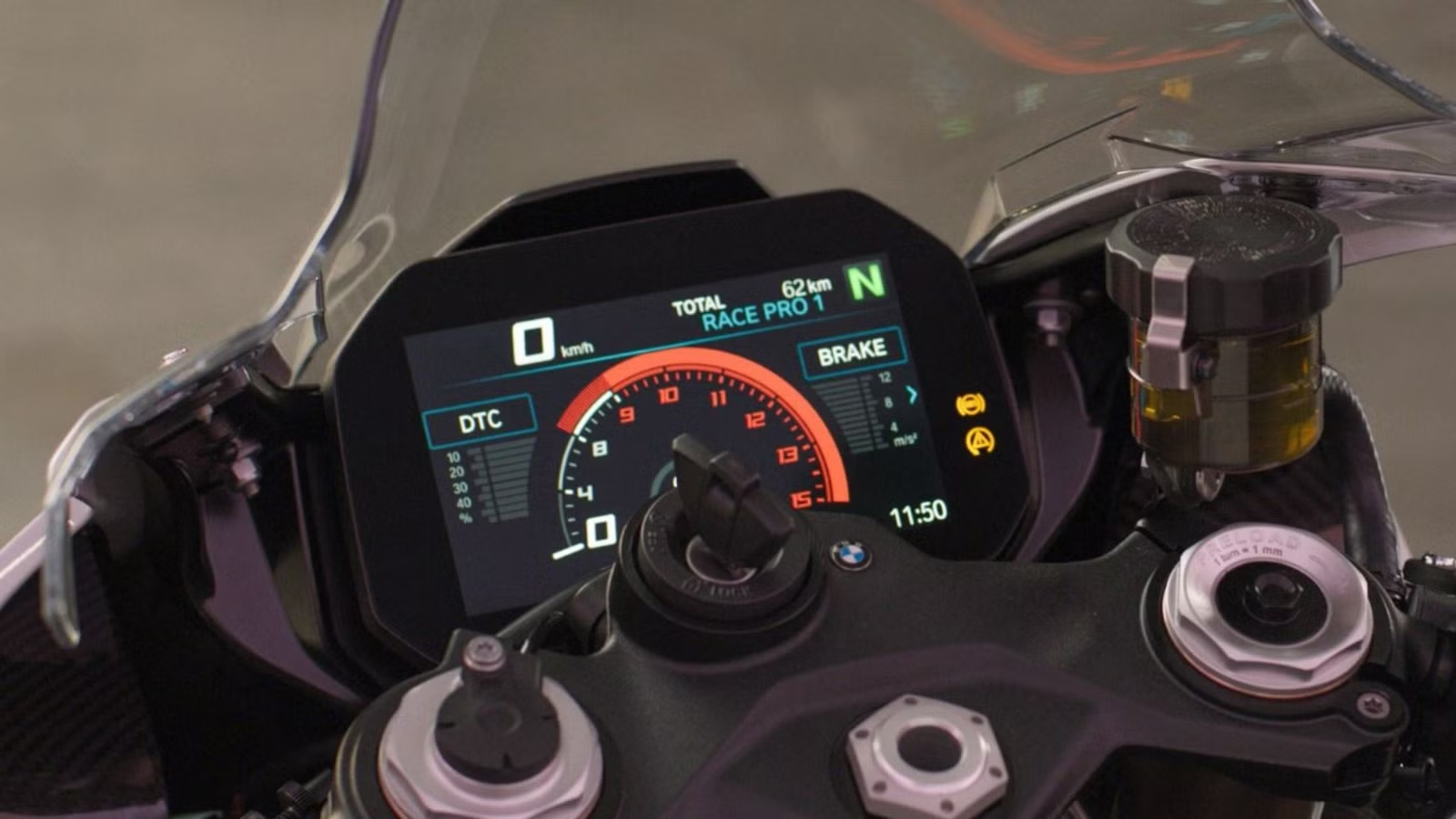
The biggest overhaul for the S 1000 RR came in 2018 when BMW gave the motorcycle significant changes for the 2019 model year. The mismatched headlamp was dropped in favour of a more sinister-looking, symmetrical headlamp design, and the rest of the bodywork was redone to look sharper and sportier. More significant changes were made under the skin—the chassis was altered for weight reduction and better handling, and a six-axis IMU-assisted electronics package was incorporated. Rounding off the changes were a new rear suspension, electronic semi-active forks and shock, launch control, wheelie control, a full-color LCD dash option, and much more. Above all, the power output went up significantly to 207 hp, but the motorcycle was no longer a benchmark, courtesy of the entry of bikes like the Ducati Panigale V4 and Aprilia RSV4 1100 Factory, which were producing well above 210 hp.
Where The S 1000 RR Stands Today

Look at the S 1000 RR today, and the major evolution it has undergone is immediately recognizable, the outrageous winglets flanking its headlights being representatives of the same. With every imaginable electronic rider aid, it also feels light-years ahead of the model that kick-started the S 1000 legacy more than a decade ago. The platform spawned a few other more practical options like the S 1000 R and XR along the way, offering similar character but in a more usable package.
Courtesy of the onslaught of highly competitive sportbikes from Italian and Japanese manufacturers over the years, the S 1000 RR is no longer winning the horsepower game at 205 hp. In fact, the landscape has become so competitive in 2026 that you can randomly pick a sportbike from the market, and it will have almost everything that its direct rivals do, along with similar levels of road and track capabilities. Nevertheless, the BMW still holds the bragging rights of being the model that pushed its contenders to consistently strive for improvement and raise the bar.
What the S 1000 RR now presents is a brilliant balance of everyday usability and track credentials. The dealer network and its reputation with regard to reliability happen to be better than many contenders, especially those coming from Italy. And all of this comes for a competitive base MSRP of $19,975, which is either on par with or lower than the competition.

Related posts
Latest Post


No Comments