
The Perfect Budget Motorcycle For A First-Time Shopper
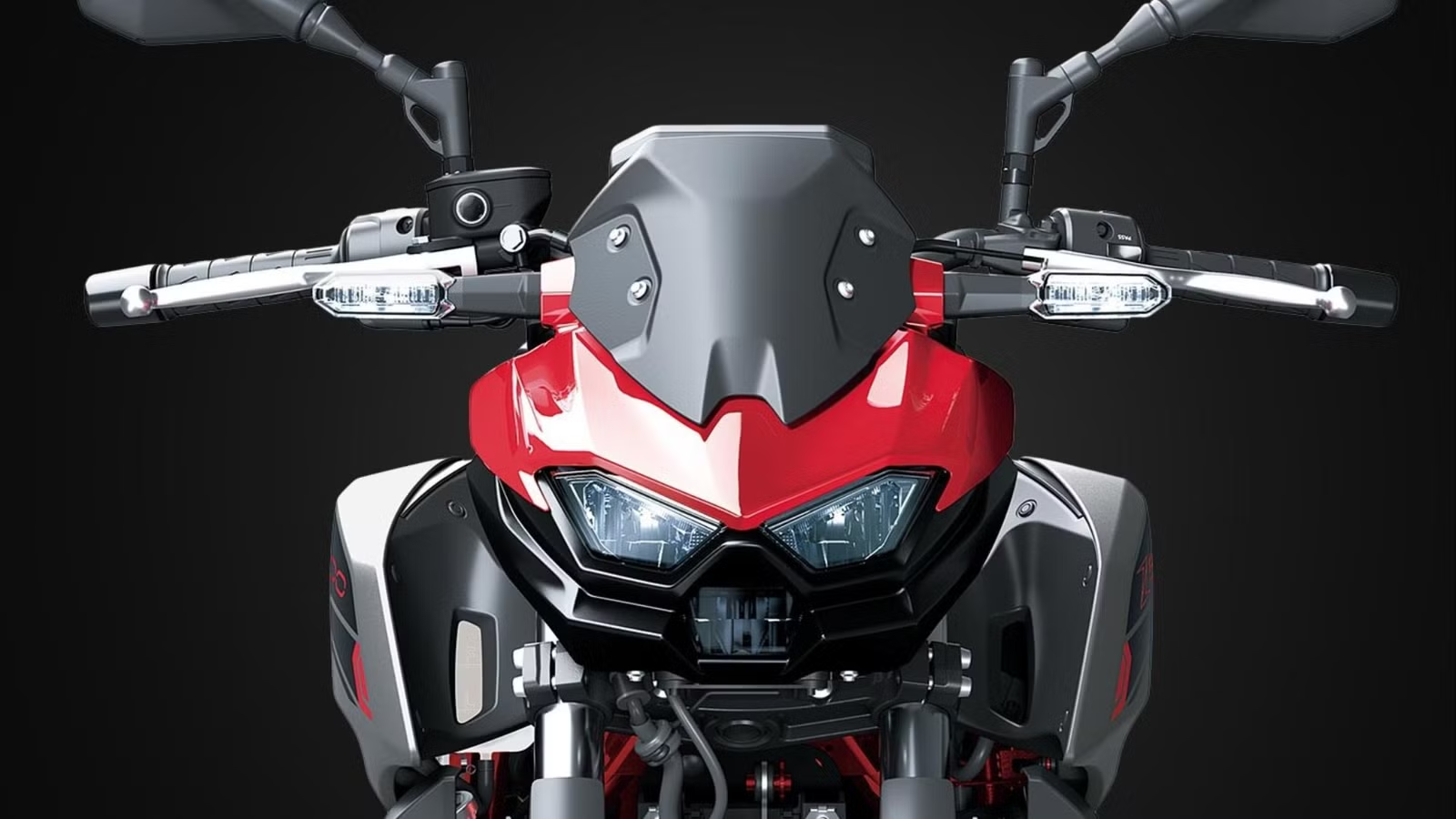
Buying your first motorcycle is one of those decisions that stays with you. Get it right and you’ll be hooked for life; get it wrong and you’ll either stall out on the learning curve or wince every time the repair bill arrives. The good news is that the current market offers more capable, affordable options than ever — but that abundance also makes the choice genuinely confusing. Cruiser or naked? Sport bike or adventure bike? Let’s work through it logically.

Adventure bikes are out because they are usually tall and heavy. Sport bikes not only have an abysmal steering lock, but they also force you into an uncompromising riding position that can be a deterrent to learning, long rides, and exploring off the beaten path. Of course, dropping a sports bike can be a costly affair, with fairings taking the brunt of falls. Cruisers make a good case for themselves with their short seat height and stability, but switching to other formats later becomes a learning curve in itself.
That brings us to the naked motorcycle — with its relatively upright riding position, a seat height that ranks second lowest (cruisers still claim the top spot), wide handlebars that require less effort to steer, and generous steering lock. There is plenty of choice among small-displacement machines in this class, but we think one stands out above the rest for budget-conscious first-time buyers.
You Can’t Go Wrong With The Kawasaki Z500
Starting Price: $5,699

The Z500 sits at the entry point of Kawasaki’s full-size motorcycle lineup. The only cheaper Kawasakis are the Ninja 500 (available without ABS) and the Z125 Pro monkey bike. The W230 is priced similarly to the Z500, but while it will feel more approachable at first, it won’t push the learner to develop their skills as effectively. The Z500 is a tried-and-tested platform that traces its roots to the long-running Ninja 250, yet the 500 cc iteration brings modern refinement to that proven old-school reliability.
The parallel-twin engine makes pulling away from a standstill straightforward, thanks to its 180-degree firing order. Power is adequate at 51 horsepower — arguably a touch generous if you’re a complete newcomer. A six-speed transmission with an assist-and-slipper clutch is standard, though a quickshifter is not offered. The Z500 comes exclusively with ABS, which is a sensible call by Kawasaki. It weighs under 340 pounds, further boosting its accessibility. If there is one gripe with the Z500, it’s the limited color choice: a single black-and-grey scheme with green accents.
Kawasaki Z500 Engine Specs
|
Engine Configuration |
180-degree parallel twin, liquid cooling, DOHC, 4 valves per cylinder |
|
Displacement |
451 cc |
|
Bore x Stroke |
70.0 x 58.6 mm |
|
Compression Ratio |
11.3:1 |
|
Power |
51 HP @ 10,000 RPM |
|
Torque |
31.7 LB-FT @ 7,500 RPM |
|
Fuel System |
Electronic Fuel Injection |
|
Transmission |
6-speed manual transmission with assist and slipper clutch |
Here’s What Makes The Z500 So Good For A Beginner
Not Just History But No Shortage Of Useful Features

Manufacturers often treat entry-level models as an afterthought, but Kawasaki hasn’t done that here. The Z500 may get “just” an LCD display, yet it’s one of the clearest, most thoughtfully laid-out instruments in its price bracket. It’s a reverse-LCD unit, and Kawasaki has cleverly incorporated color through the warning lamps — red, green, orange, and blue — so it never feels dull or monochromatic.
If you want a TFT color display, you can have one with the Z500 SE. This variant adds a meaningful package on top of the base Z500: the color display, smartphone connectivity, LED turn signals, a radiator cover, belly pan, pillion seat cover, tank pads, knee pads, frame sliders, and a USB charging port. It also comes in a red, gray, and black color scheme with distinct graphics.
As with the standard model, only one color option is offered for the Z500 SE ABS. The premium over the base bike is $700, bringing the list price to $6,299. Beneath the bodywork, a trellis frame keeps weight in check. Conventional front forks handle their duties competently and are far less expensive to service than inverted units. Out back, a preload-adjustable monoshock does the work. On the subject of adjustability, the Z500 features Kawasaki’s Ergo-Fit system, which lets riders dial in handlebar and footpeg positions to match their height. Finding the right rider triangle can make a significant difference to confidence, and it’s well worth the investment.
Kawasaki Z500 SE Key Features

- TFT color display
- USB-C charging port
- Belly pan
- Tank pads
- Knee pads
- Radiator guard
- Frame sliders
- Pillion seat cover
- Exclusive red color scheme
Kawasaki Z500 Hardware Specs And Weight
|
Front Suspension |
41 mm telescopic front forks, 4.7 inch travel |
|
Rear Suspension |
Horizontal back link monoshock with adjustable preload, 5.1 inch travel |
|
Front Tire And Wheel |
110/70 17 |
|
Rear Tire And Wheel |
150/60 17 |
|
Front Brakes |
310 mm semi-floating disc, two piston floating caliper |
|
Rear Brakes |
220 mm disc with single piston floating caliper |
|
Curb Weight |
366 LBs (wet) |
An Attractive Sugomi Design Makes Matters Sweeter
It Is Fancy Enough To Grab Eyeballs

Kawasaki’s Sugomi design language can be polarizing in its more extreme forms, but the company has wisely dialed it back for the Z500. Entry-level bikes need broad appeal, and the Z500 walks that line well. The complaint about limited color options stands — and the absence of Kawasaki’s signature green is still a miss — but the overall execution is commendable. Proportions are spot-on: a substantial-looking tank, a brooding headlamp cluster, a high subframe that appears to float above the rear wheel, and conventional suspension and a chunky muffler that keep the look grounded rather than overwrought. A standard TFT display would have made the package even more compelling, but you can’t have everything at this price point.
Notable Kawasaki Z500 Design Features
- Trellis frame
- Rear shock mounting and placement
- Three-pod headlamp is unique
- Ergo-Fit is unique to segment
- LCD display is extremely well designed
Kawasaki Z500 Dimensions
|
Length |
78.5 inches |
|
Wheelbase |
54.1 inches |
|
Rake |
24.5 degrees |
|
Trail |
3.6 inches |
|
Seat Height |
30.9 inches |
|
Ground Clearance |
5.7 inches |
Other Motorcycles Good For Beginners On A Budget
Competition Is Fierce In The Segment

The Z500 exists in a crowded space. A couple of contenders worth addressing before we get to the main comparison: the Benelli 302S isn’t worth the money — a better, cheaper version of it exists under a different badge, and that’s the one we’ve included here. At the other end of the scale sit the KTM 250 Duke and 390 Duke, but these are performance-focused machines with aggressive power delivery for their displacement.

That edge might seem trivial to an experienced rider, but to a beginner, a single-cylinder KTM won’t feel as forgiving as a smoother parallel twin. The KTMs also pack considerably more electronics, which means ongoing maintenance costs will run higher than the Z500’s. The Honda CB500F is another strong option but is priced too high for most beginners to justify — it does offer comparable specs to the Z500, with advantages like separate-function inverted forks and dual front brake discs.
Kawasaki Z500 vs. Rivals
|
Kawasaki Z500 |
Yamaha MT-03 |
QJ Motor SRK400 |
CFMoto 450NK |
|
|
Price |
$5,599 |
$4,999 |
$4,799 |
$5,399 |
|
Engine |
451 cc parallel twin |
321 cc parallel twin |
400 cc parallel twin |
449 cc parallel twin |
|
Firing Order |
180 degrees |
180 degrees |
360 degrees |
270 degrees |
|
Power |
51 HP @ 9,000 RPM |
41.4 HP @ 10,750 RPM |
40.9 HP @ 9,000 RPM |
50 HP @ 9,500 RPM |
|
Torque |
31.7 LB-FT @ 6,000 RPM |
22 LB-FT @ 9,000 RPM |
27.2 LB-FT @ 7,500 RPM |
28.8 LB-FT @ 7,600 RPM |
|
Curb Weight (Wet) |
366 LBs |
373 LBs |
414 LBs |
364 LBs |

That leaves us with our core Z500 rivals. The Yamaha MT-03 is an entertaining small bike but could use more power to stay engaging once the initial learning phase is over. The QJ Motor SRK400 looks the part but its higher curb weight blunts performance — though some riders will appreciate its inline-four-style exhaust note. Finally, the CFMoto 450NK offers more kit than the Z500 for less money, but matching the Kawasaki’s long-term maintenance and repair costs will be a challenge given the components it uses.
Sources: Kawasaki, Yamaha, QJ Motor, CFMoto

Related posts


Latest Post


No Comments