
The Camaro That Made Ford Step Up Its Game
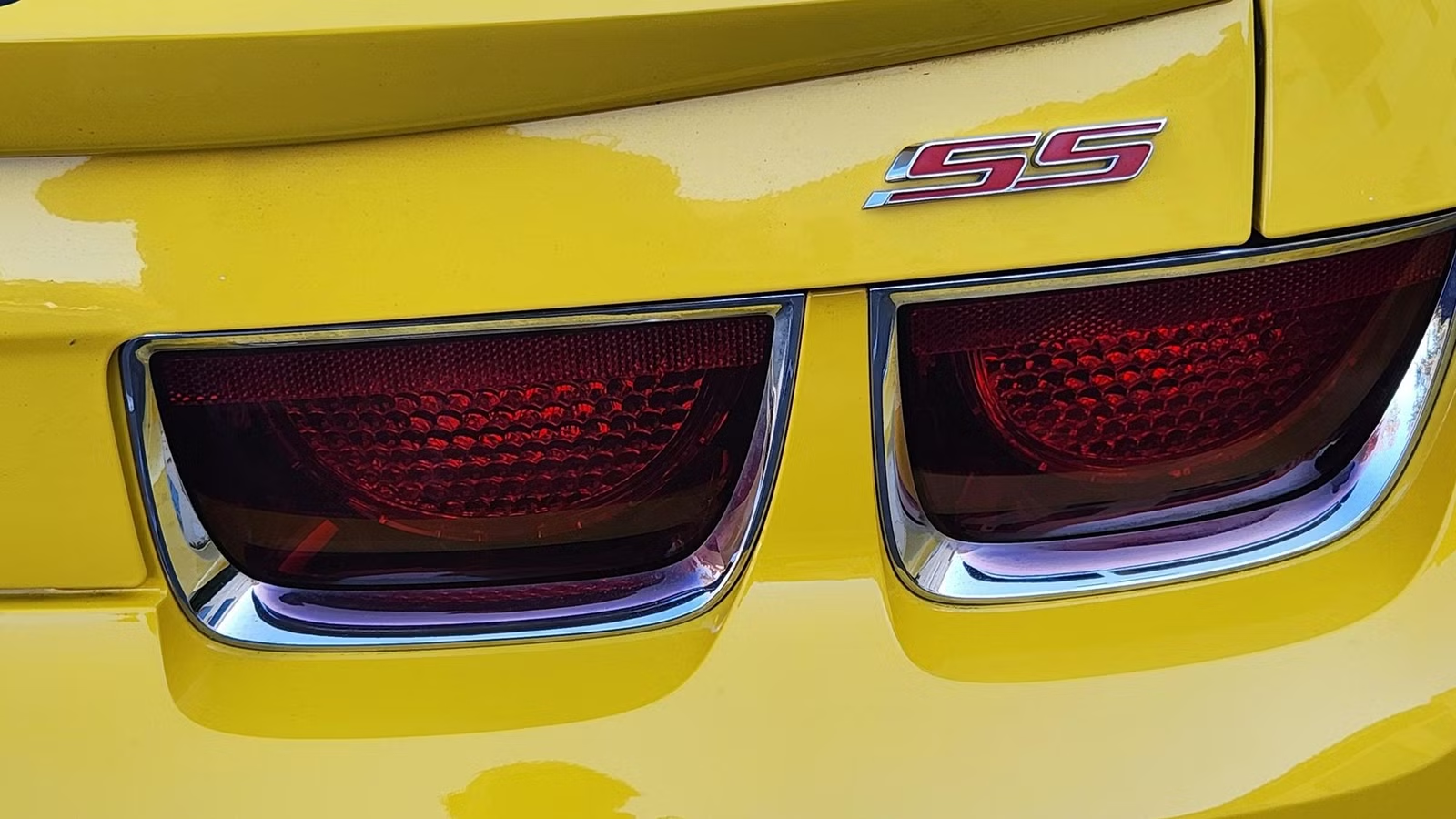
By the dawn of the 21st century, the pony car segment had evolved into a stagnant, rather stale affair. Of the big three, Chevrolet discontinued the Camaro in 2002, and the Dodge Challenger was yet to arrive in its modern avatar. Ford had an absolute monopoly on the domestic sports coupe market. But with almost no competition on the horizon, the Blue Oval stopped innovating. The reason: they simply didn’t have to.

The market had become very complacent, and the car leading the charge had more show than go, with underpowered retro cars that prioritized historic styling cues over cutting-edge technology. Enthusiasts were left wanting more than just lazy coupes. And they were eagerly waiting for a savior to inject some life into the segment. Well, their prayers were answered, and for the 2010 model year, a brand-new low-slung, visual and performance masterpiece was launched that didn’t just reignite the segment but completely rewrote what domestic performance looked like.
Why Modern Muscle Cars Lost Their Identity
The “Pony Car Wars,” during the era of dominance, stopped being an engineering exercise and became more of a marketing showcase. Automakers quickly realized that they could coast on brand recognition alone. They normalized putting subpar technology in heritage-inspired bodies and charging a premium for it. In this process, the pure focus on dynamics, power, thermal management, and handling faded, giving way to a greater focus on nostalgia-driven lifestyle branding.

The car in question, the biggest offender, was the 2010 Ford Mustang GT. It received a sharper and heavily revised exterior design towards the end of the decade, but the mechanical underpinnings remained shockingly outdated. Under its hood was the aging 4.6-liter three-valve Modular V8, an ancient cast-iron block that produced 315 horsepower and 325 lb-ft of torque. For the top-of-the-line performance coupe in 2010, these figures were underwhelming, as it lacked the power-to-weight ratio of even V6-powered European sports cars.
That was thanks to the Mustang’s rear suspension, a solid live rear axle that was used on pickup trucks. Global sports cars had already spent decades refining the formula for an independent rear suspension setup. With its truck-like suspension, the S197-gen Mustang would bounce and hop on uneven pavement. When cornering on imperfect tracks, it had a habit of breaking traction unpredictably under heavy acceleration. All this meant the car lost its mechanical prowess and prioritized straight lines over modern dynamic capabilities.
Enter the Zeta Platform: Australia’s Secret Weapon for Saving American Muscle

On the other hand, General Motors was quietly working on a secret weapon across the Pacific Ocean. Instead of using existing cheap front-wheel-drive economy platforms or its heavy-truck platforms, GM, for its upcoming performance coupe, leaned on its Australian division, Holden, and used a highly sophisticated architecture: the Zeta platform.
The Zeta architecture was engineered specifically to handle high-torque, rear-wheel-drive applications while delivering European-style chassis dynamics. Unlike its domestic rival, the Zeta platform featured a sophisticated, fully independent, multi-link rear suspension system, and at the front, a multi-link MacPherson strut setup. This setup gave it a completely new feel for what a modern muscle car could be like, allowing it to combine American brute force with smooth European dynamics.
GM married this excellent modern engineering base with a striking body shell designed by SangYup Lee, staying close to the original 2006 concept. The design language was aggressive, futuristic, yet instantly recognizable. That being said, a world-class platform was only as good as the heart that powered it. The powertrain was absolutely the make-or-break for this ambitious car. And with that in mind, GM dropped an engine into the chassis that completely disrupted the domestic muscle car market.
The 2010 Camaro SS: Inside the LS3 Masterpiece

GM unveiled the fifth-generation Chevrolet Camaro SS for the 2010 model year, and it instantly became a hit, redefining performance expectations and establishing a new benchmark for affordable American performance. Under the hood was an all-aluminum, naturally aspirated 6.2-liter LS3 V8 that could be paired with a 6-speed manual or an automatic transmission. The pushrod powerplant was derived directly from the C6 Corvette lineage. It featured a high-flowing, nodular-iron crankshaft and high-performance cylinder heads derived from the race-bred LS7.
Comparison of the 2010 Ford Mustang GT vs 2010 Chevrolet Camaro SS
|
Performance Spec |
2010 Ford Mustang GT |
2010 Chevrolet Camaro SS |
|---|---|---|
|
Engine |
4.6-Liter V8 |
6.2-Liter LS3 V8 |
|
Power |
315 HP |
426 HP (+111 HP) |
|
Torque |
325 LB-FT |
420 LB-FT (+90 LB-FT) |
|
Rear Suspension |
Solid Live Axle |
Fully Independent |
|
0 to 60 MPH |
5.1 Seconds |
4.6 Seconds |
The LS3 engine produced 426 hp and 420 lb-ft of torque when equipped with the Tremec TR-6060 manual gearbox. It didn’t merely edge out the Mustang in performance — it completely dominated it. It ran the 0–60 mph sprint in 4.6 to 4.8 seconds and crossed the quarter-mile in 13 seconds flat at 111 mph. The massive horsepower gap to the Mustang made it completely obsolete overnight.
Ford’s Response With The 5.0 Coyote V8

The dominance of the 426-hp LS3 Camaro sent Ford into overdrive; the automaker had to react to this threat to the Mustang. Ford realized that the 4.6-liter Modular V8 was outmatched and could not compete in this new horsepower landscape, so executives fast-tracked a new engine program to save the Mustang.
Ford’s response arrived just one model year later, in 2011: the 5.0-liter Coyote V8. It featured an all-aluminum block with dual overhead cams (DOHC), four valves per cylinder, and Twin Independent Variable Cam Timing (Ti-VCT); the first-generation Coyote produced 412 hp. It was a modern answer to GM’s LS3.
To assert dominance and reclaim engineering superiority over the Zeta-underpinned Camaro, Ford went a step further in the 2012 model year by reviving a historic moniker: the Boss 302. The Coyote’s output was raised to 444 hp by adding a high-flow “runners-in-the-box” intake plenum, CNC-machined cylinder heads, and a revised valvetrain to take on the Camaro SS. This competition reignited the technological and dynamic war that enthusiasts had long wanted.
The Lasting Legacy of the 2010 Camaro SS

The fifth-gen Chevrolet Camaro SS remains a historic turning point in modern muscle car history. It was more than just a commercial comeback for General Motors. It was a disruptor that ignited the horsepower wars of the 2010s. This fierce battle produced some iconic cars, including the Shelby GT500, the supercharged Camaro ZL1, and the Dodge Hellcat.
Today, the Camaro is a highly accessible, durable performance car in the enthusiast market that is easy to modify; it offers excellent value for the dollar, and the LS3 handles aftermarket parts with ease. With an average price of just under $38,000, it’s the kind of car any gearhead can appreciate.
More importantly, it remains a true analog masterpiece of its era. It combines hydraulic steering, a clutch, and a shifter with the naturally aspirated rumble of a V8 — qualities that today’s silent, turbocharged, drive-by-wire cars cannot replicate. The 2010 Camaro SS is a classic from an era when Detroit was forced to make muscle cars great again.
Source: Ford, Chevrolet, Cars&Bids, Classic.com

Related posts



Latest Post


No Comments