
The 10 Most Reliable American Cars That Deserve More Respect
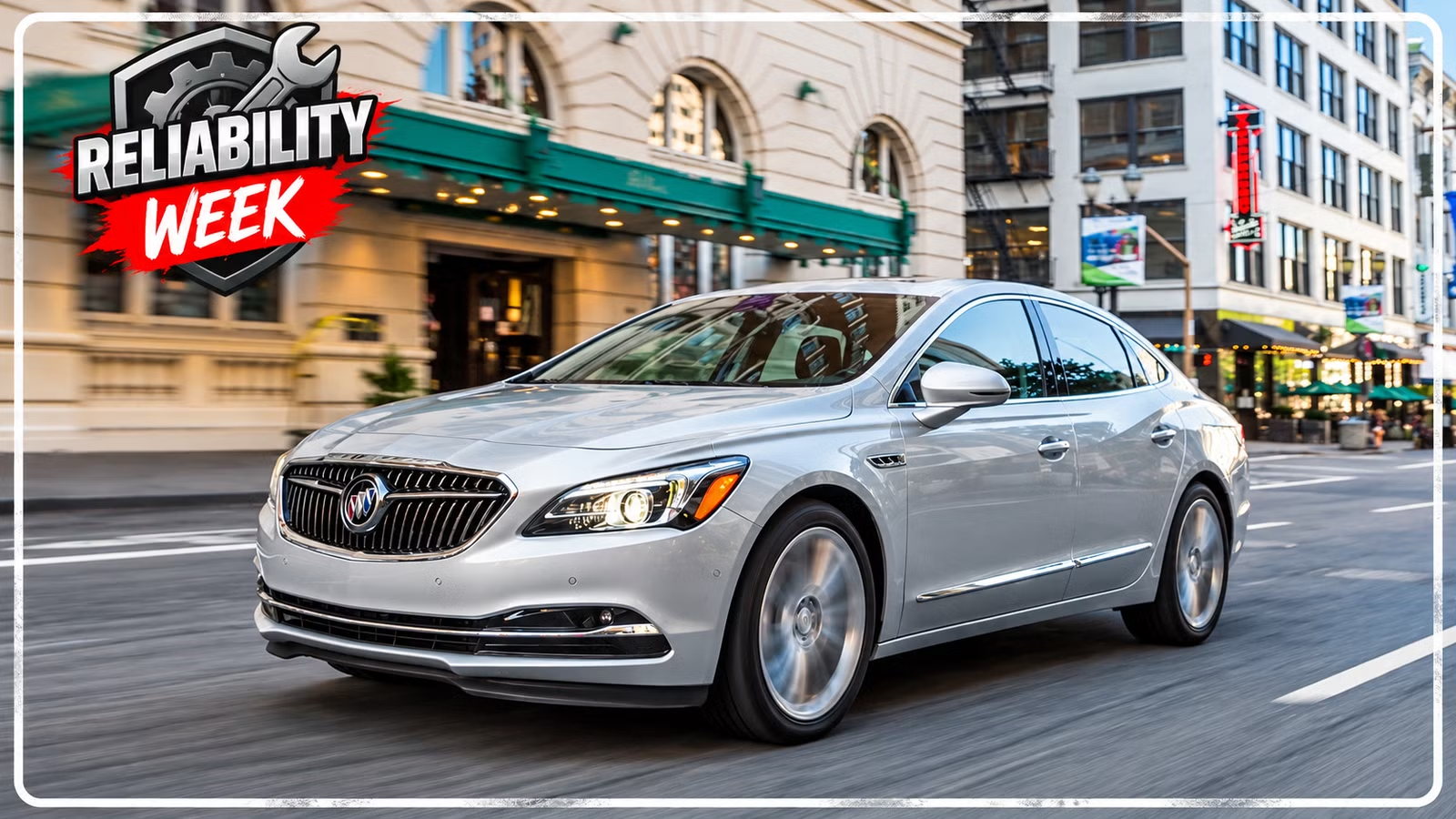
While American cars may never get the same media attention as Japanese automakers when it comes to reliability, that doesn’t mean there aren’t reliable American vehicles out there. Indeed, there is a wide variety of highly rated American vehicles in terms of reliability, from sports cars and luxury sedans to minivans and everything in between. We sought out some of the most reliable American vehicles of the last two decades or so, ranked by their J.D. Power Quality & Reliability scores. While these 100-point scores are model-level rather than trim- or engine-specific, we’ll dive deeper to detail which powertrains are the best picks if reliability is your key consideration.
10
2009 Cadillac Escalade
J.D. Power Quality And Reliability Score: 81/100

The 2009 Cadillac Escalade might be the oldest American model on our list, but who said newer is always better? The 403-horsepower 6.2-liter L9H V-8 powering the Escalade is one of the last truly great and simple American V-8 engines.

After 2009, the L9H was replaced by the L94, which added active fuel management, effectively undermining the once-class-leading reliability of the Chevy small-block. The L9H powering the Escalade is the most versatile and powerful pre-AFM Gen IV LS-based Chevy small-block. With the capability of running on full E85 or a blend of ethanol and gasoline, you can save on the fuel costs that are inevitable with an SUV as large as an Escalade.
9
2016 Ford F-150
J.D. Power Quality And Reliability Score: 81/100


With 14 distinct generations of the Ford F-Series truck, it can become a bit overwhelming to decide which one to buy. Here’s why the 2016 Ford F-150 might be one of the best available options. Of all the available configurations, the most reliable variant of the 2016 F-150 was the one powered by the 5.0-liter Coyote V-8 and equipped with the six-speed automatic transmission.

Just like the Escalade in our previous entry, this powerful 385-horsepower Coyote V-8 is fully flex-fuel capable. This gives you more options when it comes to fuel, and in the long run, E85 can support reliability because its higher octane rating provides increased knock protection and can help maintain safer combustion temperatures. The later 10-speed automatic that debuted in the 2018 F-150 has proven to be more inconsistent and problematic than the simpler six-speed automatic found in the 2016 model year.
8
2019 Dodge Grand Caravan
J.D. Power Quality And Reliability Score: 81/100

If you want an American car that offers the most functionality of almost any vehicle on the market while also providing strong reliability, the 2019 Dodge Grand Caravan is a minivan worth considering for the next decade or more. Back in 2011, the 283-horsepower 3.6-liter Pentastar V-6 mated to a six-speed automatic transmission became the sole powertrain for the fifth and final generation of the American minivan, and Stellantis, Dodge’s parent company, hasn’t looked back since.

This same V-6 engine is still being used in the Chrysler Pacifica and a variety of other Stellantis products today. The Dodge Grand Caravan was discontinued after the 2020 model year, and there realistically weren’t many major changes to the platform after the 2017 model-year refresh, when the 6.5-inch touchscreen became standard equipment. The cheaper you can find a Grand Caravan, the better, and as long as it’s a 2011 or newer model, you won’t be missing out on the majority of its redeeming durability qualities.
7
2016 Chrysler 300
J.D. Power Quality And Reliability Score: 83/100

If you want a Mercedes luxury sedan experience without the crazy maintenance and repair costs, a 2016 Chrysler 300 might be exactly what you’re looking for. The second and final generation of the 300debuted in 2011, shares some suspension architecture with the W220 Mercedes S-Class and W211 Mercedes E-Class, and is known for its impressive ride quality.

If you want both reliability and power, the 363-horsepower 5.7-liter Hemi V-8 powering the 300C variant is one of Stellantis’ best modern engines. The same Pentastar V-6 found in the Grand Caravan is also available in the 300’s Touring, Limited, and 300S models for those shoppers who don’t care as much about power. As long as you opt for a 2015 refreshed model or newer, you won’t miss any key platform upgrades. Notable changes include a significantly upgraded safety suite with features such as adaptive cruise control, a newer seven-inch electronic instrument cluster, and the eight-speed automatic transmission.
6
2011 Ford Ranger
J.D. Power Quality And Reliability Score: 86/100

Remember when trucks were simple? The 2011 Ford Ranger is perhaps one of the last truly “simple” compact American trucks that will run forever without costing an arm and a leg every time something breaks. 2011 was the final model year of the compact Ranger in the U.S. When the Ranger nameplate returned after an eight-year hiatus in 2019, it was no longer a compact truck, but rather a midsize truck derived from the global-market Ranger.

The 2011 Ranger was offered with a two-door, six-foot bed; a two-door, seven-foot bed; or a four-door, six-foot bed configuration. In 2011, the seven-foot bed was exclusively limited to fleet buyers, but these versions do still exist on the used market. You could choose either a 143-horsepower 2.3-liter inline-four or a 207-horsepower 4.0-liter V-6, both offered with a standard five-speed manual transmission or an optional five-speed automatic. You might think those are pretty modest numbers for a truck, and you’d be right. But the Ranger’s conservative nature is what makes it so reliable compared with significantly more complex and expensive modern trucks.
5
2019 Dodge Charger
J.D. Power Quality And Reliability Score: 87/100

Another American legend that still provides impressive performance, strong comfort, and great reliability is the 2019 Dodge Charger. The seventh generation of the Charger is closely related to the second-generation Chrysler 300. Among their shared qualities are the Pentastar V-6 in the base trims and the 5.7-liter HEMI V-8 in the R/T trims. Then, if you want truly shocking levels of performance, there are still the SRT models, which include the 470- to 485-horsepower 6.4-liter HEMI V-8 and the absurd 707-horsepower supercharged 6.2-liter HEMI V-8 found in the SRT Hellcat models.

The 2015 model year brought the most significant facelift of the entire generation, which included completely updated exterior styling and a thoroughly reworked interior. Details include a new seven-inch digital instrument cluster and an available 8.4-inch touchscreen infotainment system, while all powertrain configurations were now linked to one of the leading transmissions on the market, the ZF eight-speed automatic. As long as you opt for a 2015-or-newer model, you won’t be missing out on the best this generation of Charger has to offer in terms of both quality and reliability.
4
2018 Buick Envision
J.D. Power Quality And Reliability Score: 90/100

The first-generation Buick Envision, which debuted in North America in 2016, is one of the most underrated American compact SUVs. For the 2018 model year, the Envision received its first facelift, bringing revised exterior styling and interior updates. Shoppers have the option of two powertrains: a FWD variant with a 197-horsepower 2.5-liter inline-four mated to a six-speed automatic and a premium AWD variant with a 252-horsepower 2.0-liter turbocharged inline-four paired with a newer nine-speed automatic.

The base naturally aspirated powertrain is certainly more reliable, cheaper to maintain, and more fuel-efficient than the turbocharged variant, but that comes at the cost of performance. Not to mention, the turbo-four requires premium fuel, adding to ownership costs. However, real-world testing has shown that the turbo-four is capable of outperforming its EPA rating of 22 mpg combined, especially during steady highway cruising.
3
2019 Buick LaCrosse
J.D. Power Quality And Reliability Score: 90/100

The third and final North American generation of the Buick LaCrosse debuted in 2017 and had a short-lived production run, ending after the 2019 model year. Since 2018, the LaCrosse has offered two distinct powertrains: a FWD variant with a mild-hybrid 194-horsepower 2.5-liter inline-four mated to a six-speed automatic, and a FWD or available AWD variant with a 310-horsepower 3.6-liter V-6 mated to a nine-speed automatic.

To no one’s surprise, the mild-hybrid inline-four provides better fuel economy at 29 mpg combined, while the AWD V-6 variant achieves 23 mpg combined. However, because neither engine is turbocharged, both are capable of running on regular 87-octane fuel. The V-6 model certainly feels like the more premium experience befitting a luxury sedan, but its tradeoffs are subpar fuel economy and higher upkeep costs. Either way, the 2019 Buick LaCrosse, especially with the V-6 engine, provides an experience comparable to many German luxury sedans for a fraction of the cost, while also remaining nearly invisible in traffic.
2
2019 Chevrolet Impala
J.D. Power Quality And Reliability Score: 91/100

The tenth and final generation of the Chevrolet Impala debuted for the 2014 model year and shares many similarities with the Buick LaCrosse. However, there are some differences. With the 2019 Impala, the base 197-horsepower 2.5-liter inline-four is paired with a six-speed automatic transmission but not a mild-hybrid system. The high-performance 305-horsepower V-6 option is also available in the Impala, but there is no AWD option, and you are restricted to the older and less efficient six-speed automatic rather than the newer nine-speed found in V-6-equipped LaCrosse models.

The base inline-four achieves 25 mpg combined, while the optional V-6 provides 22 mpg combined. With the Impala, you trade the increased fuel efficiency of the mild-hybrid system found in the LaCrosse for the cost efficiency and simplicity of the standard non-hybrid inline-four. Because even the V-6 Impala is limited exclusively to the six-speed transmission, it also loses out on fuel economy by about two mpg on the highway compared with the nine-speed-equipped LaCrosse.
1
2023 Chevrolet Corvette
J.D. Power Quality And Reliability Score: 92/100

The top dog on our list is the C8-generation Chevrolet Corvette, which has proven to be one of the most reliable sports cars available. The 2023 Corvette scored an impressive 92/100 in the Quality & Reliability category, one of the highest scores we have seen despite analyzing hundreds, if not thousands, of vehicles and model years across all segments. The 2023 Corvette was exclusively offered in RWD configuration and paired with an eight-speed dual-clutch transmission.

The eighth generation of America’s mid-engined sports car also offered two powertrain options: the base Stingray, equipped with a 490-horsepower 6.2-liter LT2 V-8, and the track-focused Z06, which produces 670 horsepower from its 5.5-liter flat-plane-crank V-8. Both of these V-8 engines are modern engineering miracles considering their power-to-weight and displacement-to-power ratios, yet they have also proven to be quite reliable by high-horsepower sports car standards. Fuel efficiency is not great for either, with the Stingray achieving 19 mpg combined and the Z06 achieving 15 mpg with the base aero package, but considering the power and excitement they provide, it’s a reasonable trade-off.
Sources: OEMs, J.D. Power

Related posts


Latest Post


No Comments