
This ’90s Superbike Had Major Anger Issues
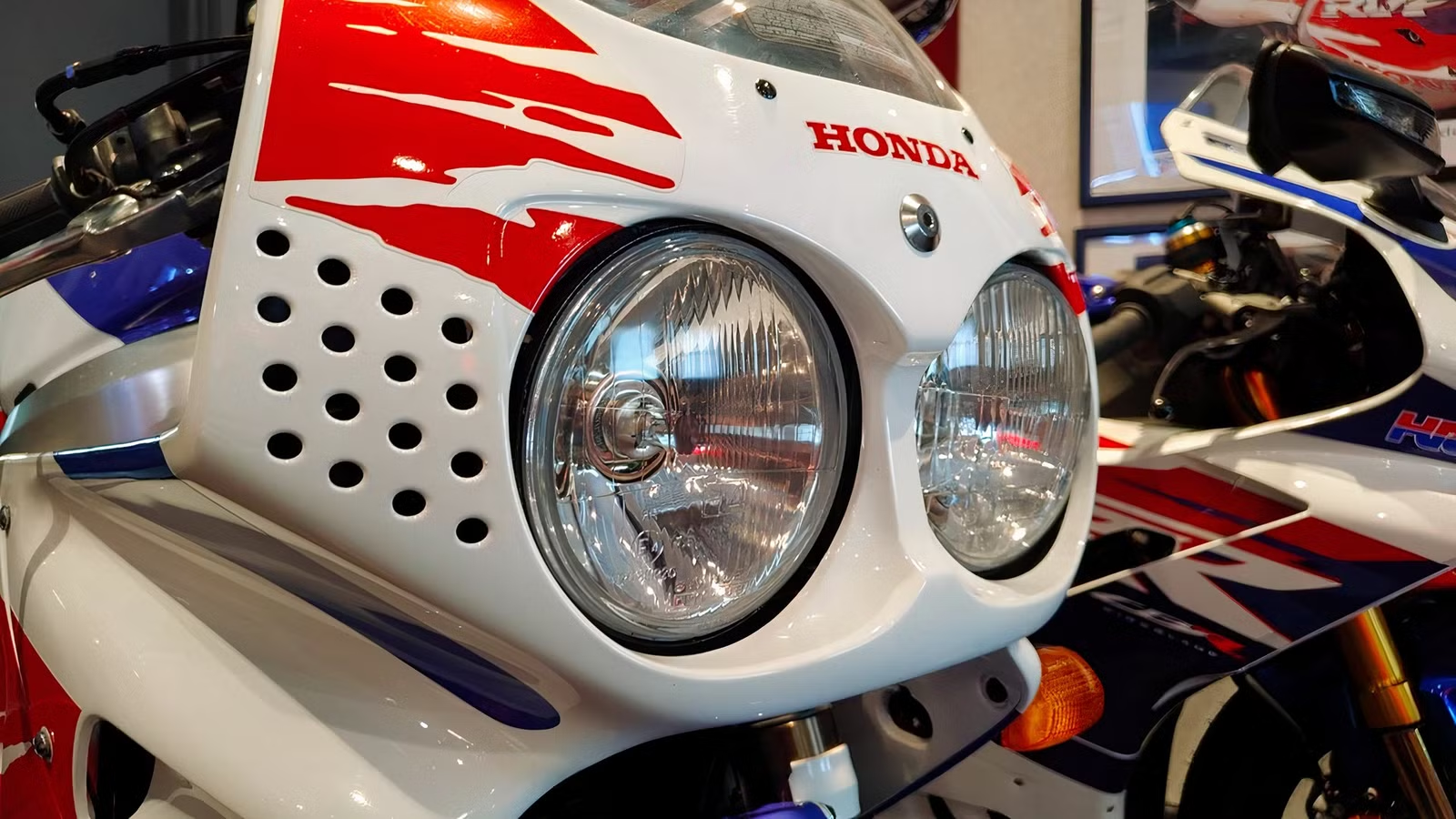
Honda has been on my mind a lot lately. I recently had the pleasure of wrenching on a couple of Hondas from the 1970s that a friend of mine is restoring. I also had the luck of stumbling upon the owner of the largest private collection of Honda motorcycles in America. The company’s history has always fascinated me, from its early roots to its dominance with the adorable and unassuming Super Cub. While I have never owned a Honda, I’ve ridden several, and I understand the passion for these motorcycles.

While my friend would say that Honda is the greatest for their reliability and dedication to making affordable bikes for the working man, I think you can expand on that by saying their ability to make these affordable fun machines while occasionally reinventing an entire class of motorcycles is what truly makes Honda a remarkable company. In the 70s, Honda nearly wiped out the British motorcycle industry with the CB750, and again in the 90s, they brought something fresh to the table that made the entire industry reevaluate how to build a sport bike.
The Era When Honda Could Do No Wrong
The 1990s began with sport bike manufacturers still working out what a modern performance motorcycle was supposed to be. The big Japanese machines were getting faster every year, but they were also getting larger and heavier, particularly in the 1,000cc-plus class. Honda was already building very capable motorcycles, yet despite Honda’s success, Tadao Baba, working in the company’s R&D department, looked in that direction and saw the problem was that more power was not necessarily making the motorcycles better at being sport bikes.

Baba had been watching Honda’s CBR1000F being used on the track, and the motorcycle’s basic compromise was obvious. It had plenty of speed in a straight line, but its size made it harder to get the most out of it once the road started turning. Baba wanted something that could make serious power while still feeling light and compact underneath the rider. That meant starting over with what an open-class sport bike needed to be.
Honda’s Experience Set The Stage

Honda already had plenty of experience developing motorcycles around a strong central idea. Its history runs from the practical Super Cub and CB series to the highly specialized machines produced through Honda Racing Corporation, and that racing knowledge was becoming increasingly useful in production motorcycles. Baba’s new project drew heavily on that experience, particularly in how Honda approached weight, chassis design, and testing.
The interesting part was how far Baba was willing to take the weight issue. The original concept was a 750cc machine, but Honda already had motorcycles filling the 750 and 1,000cc classes, so the team created something in between. Using the CBR750’s basic engine architecture and increasing the stroke produced 893cc, to give the new motorcycle enough torque and performance without requiring a larger and heavier powerplant.
The 1992 Honda CBR900RR Fireblade Rewrote The Superbike Rulebook

The CBR900RR Fireblade arrived for 1992 after roughly four years of development under Baba’s direction. The engine produced around 122 horsepower. Though that power figure was impressive even when compared to a number of rivals putting out less with more displacement, the horsepower was never the main story. The motorcycle was designed to weigh roughly what a 600cc supersport weighed, giving the engine considerably less mass to move and the rider considerably less motorcycle to manage.
That philosophy extended into almost every part of the design. Honda used a lightweight twin-spar aluminum frame, centralized the heavier components, and even reduced the front wheel from the increasingly common 17-inch size to 16 inches in the pursuit of lower weight and faster steering. It sounds like an odd idea now, but it gives you an idea of how seriously Honda took Baba’s basic idea of “wherever the motorcycle didn’t need mass, there shouldn’t be any.”
Radical Weight Loss Humiliated Heavyweight Competitors

Baba’s approach can be summed up with a simple comparison he used during development: a heavy object is easier to control when it is held close to your body. Honda applied the same thinking to the Fireblade, bringing the motorcycle’s heavier components toward the center and keeping things such as the exhaust, brakes, and lighting as compact as possible. The result was not just a lower number on the scales, but a motorcycle designed to feel smaller when the rider actually changed direction.
Honda spent years testing that idea against the motorcycles already on the market. Factory riders took the Fireblade to different circuits and ran it against 750cc and 1,000cc competitors, making changes until the new bike consistently delivered quicker lap times. What surprised testers was that the Fireblade could be faster without feeling like it demanded the same physical effort from the rider.
A 122-Horsepower 893cc Inline-Four Delivered Violent Midrange Punch

The 893cc inline-four was important, but it was never supposed to carry the entire project. Honda had effectively taken the 750cc engine concept and given it more stroke, increasing displacement and torque while keeping the engine compact enough for the new chassis. That gave Baba the performance he needed without turning the motorcycle into another large open-class machine.
This is why the original Fireblade’s specification sheet can be misleading when viewed on its own. It didn’t produce the most horsepower in the class, and Honda knew it. The advantage was that the engine was moving a motorcycle that was much lighter than its rivals, so the Fireblade’s performance came from the entire package rather than from one big number.
Analogue Carburetion And Minimal Flywheel Weight

The original SC28 used four carburetors and a conventional mechanical throttle, which gave it the direct feel expected from a performance motorcycle of the period. There was nothing between the rider’s hand and the engine in the way modern electronic systems manage throttle response. What you asked for with the throttle was, within the limits of the carburetors and engine tuning, what the motorcycle gave you.
That mechanical connection suited the Fireblade’s basic character. The engine could build and shed revs quickly thanks to a light wight flywheel, while the low overall mass meant changes in speed were felt immediately. It was another part of the larger formula Baba was chasing: make the motorcycle compact, keep the weight down, and let the rider feel the results.
Chassis Geometry Engineered With A Vicious Temper

The Fireblade’s handling came from more than its low weight. The aluminum twin-spar frame was developed through years of testing, and Honda used computer-aided design and manufacturing as part of that process to refine the structure while keeping the frame itself remarkably light. The short wheelbase and compact layout were intended to make the motorcycle easier to turn, not simply smaller for the sake of appearance.
The result was a motorcycle that testers immediately noticed felt different from the larger superbikes surrounding it. The Fireblade could be placed into a corner with comparatively little effort, and its centered mass helped it respond when the rider changed direction. This was the part of Baba’s idea that became so important to later sport bike design. Performance could no longer just be how quickly a motorcycle could accelerate, but how little work it took to make that performance useful.
The Controversial 16-Inch Front Wheel And Ultra-Short Wheelbase

The 16-inch front wheel was one of the clearest examples of Honda’s willingness to ignore convention. A 17-inch front wheel had become industry standard, but Honda was willing to go smaller because the engineers were chasing lower weight and quicker steering. The change worked, although it also contributed to the extremely fast and somewhat scary steering response that became one of the original Fireblade’s defining traits.
Early testers noticed that response immediately. The combination of the short wheelbase, small front wheel, and low overall mass made the Fireblade feel exceptionally quick, to the point that some testers believed a steering damper would have been useful. That nervousness was part of the trade-off for the same chassis response that made the motorcycle so effective on a circuit.
Violent Tank-Slappers Without A Factory Steering Damper

The original Fireblade left the factory without a steering damper, and that omission quickly sparked the reputation that this superbike might have some anger issues. The ultra-light chassis was exceptionally quick to respond, and bumps or other disturbances at the front could expose just how little inertia there was in the steering. Some early road testers felt that Honda had pushed the setup far enough to warrant additional damping.
It’s important to note that this feature was not an accident. Honda had deliberately built a motorcycle that reacted instantly to the smallest rider inputs, and the very same short-wheelbase fury that made the front end volatile on choppy roads was why the machine dominated track apexes. The Fireblade’s original chassis was a trade-off, but it was a very deliberate one.
Surviving An Original SC28 Demands Serious Respect

Living with an original 1992–1995 Fireblade today requires a very different approach than riding a modern sport bike. There is no six-axis IMU, traction control, or electronic wheelie control to help you. The SC28 gives the rider very little assistance, which means it comes down entirely to the rider’s skill level. Modern sport bikes are considerably more forgiving in this respect.
The collection’s owner, a former racer, put the bike’s significance into perspective. “It’s hard to say anything about the Fireblade that hasn’t already been said because a lot has been said. Sure they had 120 horsepower, which was good for the time, but it comes down to the fact that no one had ever seen or ridden anything that performed like this bike before.”
That became particularly clear standing in a private collection filled with original early Fireblades. In person, the bikes still look very modern for machines designed more than 30 years ago. Several examples were lined up in showroom condition, and seeing them together made me feel as though I had time-traveled, experiencing firsthand how different the Fireblade must have looked when it first arrived in 1992.
Source: Honda, Honda Racing Corporation (HRC), J.D. Power Motorcycles, NHTSA

Related posts
Latest Post


No Comments