The EV Lease Deal That’s Almost Too Good To Ignore This Fourth Of July
8 minutes reading
Friday, 3 Jul 2026 16:01 0 63 autotech
Now that the Fourth of July 2026 holiday weekend is officially in full effect, there are a lot of good reasons to kick the season off with a brand-new electric car purchase. Of course, we acknowledge that this can be a monumental financial burden for many prospective consumers, but thankfully, there are a couple of competitive and attractive leasing and financing deals applied to a bunch of thrilling and compelling options, some of which might be remaining 2025 model years which are yet to be sold. One product stands out as the best deal to consider.
It’s not the cheapest vehicle option, but it finds the best balance between affordability and value for money. This Japanese EV sits on an American-designed platform, resulting in an attractive combination of good performance, impressive efficiency ratings, and enjoyable comfort levels. It’s been available on the market for a little over two years now, and it’s already been skyrocketing to the higher end of the sales charts, proving it to be a solid inaugural fully electric crossover for the U.S. This is exactly why we think this new lease deal for July 2026 is one that you should seriously consider if you’re in the market for a well-rounded electrified option, but don’t want to take the risk of a full long-term purchase. The brand has applied lease deals throughout the range, but one specific trim benefits from the best value.
Black 2024 Honda Prologue Plugged Into ChargerHonda
Leasing an EV in 2026 offers a vital financial and technological safety net compared to buying, primarily due to the severe depreciation risks and the elimination of the federal EV tax credit for retail purchases. Because electric vehicle technology is advancing rapidly, buying a new EV risks locking you into an asset that could face accelerated obsolescence on the secondary market. Continuous improvements in battery energy density, thermal management, and standardizations like the widespread integration of the North American Charging Standard further bolster EV appeal.
Additionally, market data from 2026 indicates a sharp drop in used EV residual values as a massive wave of off-lease vehicles hits wholesale auctions, threatening to leave outright buyers underwater on their vehicle loans. By leasing, you effectively transfer this volatile residual value risk to the captive finance company; you pay smaller monthly payments tied only to the vehicle’s predictable short-term depreciation, retain full factory warranty coverage over the entire possession period, and maintain the flexibility to seamlessly walk away or upgrade to the latest powertrain tech in two to three years.
The Honda Prologue Secrets EV Buyers Are Just Discovering
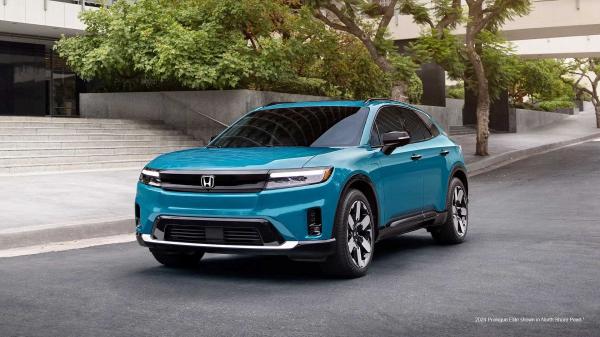
The Honda Prologue’s secret is being the most approachable first-time EV buyer option with familiar design and practical features.
As of July 4th 2026, California and other EV-popular states have access to an attractive $269 lease deal for the single-motor 2026 Honda Prologue EX over 36 months with $5,099 due at signing. The brand’s featured lease for the entire country is a $329 per-month deal with $5,099 due at signing for a 36-month period on the dual-motor EX trim. Honda applies a 10,000-mile annual distance limit to both of these deals. If you’re looking to finance a new 2026 Honda Prologue, you can also take advantage of Honda’s 0.99 percent APR deal over 24 to 60 months.
Buying A New Prologue Remains A Substantial Investment
If you decide to opt for a brand-new model, you can expect to pay $39,900 for the base front-wheel-drive EX variant. Following this is the $44,200 Touring and $50,400 Elite. The dual-motor upgrade adds $3,000 to the final price, and you also need to consider the mandatory $1,495 destination and handling fee that the brand applies to all models. Honda keeps the trims structured and distinctive, so there aren’t a lot of optional extras and packages that you can consider, apart from the usual accessories and cosmetic alterations.
Base Trim Engine
EV
Base Trim Transmission
Automatic
Base Trim Drivetrain
Front-Wheel Drive
Base Trim Horsepower
220 HP
Base Trim Torque
243 lb.-ft.
Base Trim Fuel Economy Equivalent (city/highway/combined)
113/94/104 mpge
Base Trim Battery Type
Lithium ion (Li-ion)
Make
Honda
Model
Prologue
The entire range comes standard with a comprehensive warranty package, including 36-month or 36,000-mile basic coverage. You also get 60 months or 60,000 miles worth of powertrain warranty, while Honda covers all scheduled maintenance in a 24-month or 24,000-mile period. There’s also 36 months or 36,000 miles worth of roadside assistance and a 36-month corrosion warranty with unlimited miles. The battery gets an eight-year or 100,000-mile warranty coverage.
Honda Prologue Specifications And Real-World Range
Honda didn’t reinvent the wheel with the Prologue. They just built a solid, well-rounded electric SUV—and honestly, that’s all anyone needs.
Honda keeps the Prologue range very focused by offering two motor configurations with fixed power outputs. The base model employs a front-mounted single motor producing 212 horsepower and 236 pound-feet, while the all-wheel drive option increases this to 288 horsepower and 333 pound-feet by adding a second motor to the rear axle. Honda doesn’t quite issue a claimed 0 to 60 MPH times for either drivetrain option, but it indicates that you can expect a 6.0-second result for the dual-motor configuration. Edmunds‘ testing reveals that you can expect it to cover this distance in about 6.2 seconds. We can’t find any performance test results for the single-motor configuration.
Powered By GM’s Ultium Technology
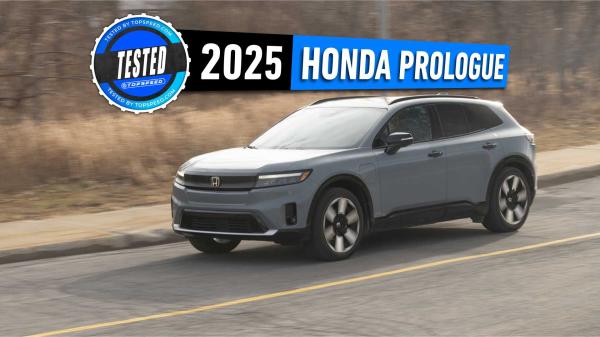
2025 Honda Prologue Front MotorGuillaume Fournier | TopSpeed
As expected, the EPA estimates the base front-wheel-drive Honda Prologue to be the most efficient model of the lot. You can expect this to return a 34 kWh per 100 mile energy consumption estimate on the combined cycle. The 85 kWh Ultium lithium-ion battery pack holds enough energy to carry it for 296 miles before needing to be plugged in for a recharge. The dual-motor configuration worsens consumption to 36 kWh per 100 miles and range to 281 miles, but if you upgrade to the Elite and its bigger wheel option, you’ll have to put up with a 37 kWh per 100 mile consumption average and 273-mile range claim. If you’re looking for strong towing characteristics, the Prologue may disappoint, as both drivetrain options can only pull 1,500 pounds.
Review: One Feature Allows The Honda Prologue To Be More Appealing Than Its GM Twins
Even if it’s not a “real” Honda, the 2025 Prologue manages to hold its own.
The standard equipment levels across all Prologue trim derivatives are indicative of its higher pricing. The base EX comes standard with a 10-way electrically adjustable driver’s seat, six-way manually adjustable passenger seat, front seat heating, fabric seat upholstery, and dual-zone climate control. Upgrading to the Touring adds leather upholstery, electrical adjustments for the passenger, illumination for the instrument panel, an auto-dimming rearview mirror, and LED foglights. You also get a handy set of roof rails, and a welcome light with a rear kick sensor.
The top-of-the-range Elite includes a key card, heads-up display, front ventilated seats, and extra illumination for the footwells, cupholders and front and rear door panels. All derivatives feature an 11-inch digital instrument cluster and an 11.3-inch touchscreen infotainment system with wireless Apple CarPlay and Android Auto. You also get a wireless smartphone charger and HondaLink connectivity, supported by OnStar. The base EX features a six-speaker audio system, but the Touring and Elite benefit from a 12-speaker Bose premium audio system.
The Prologue’s Unfortunate Market Reception
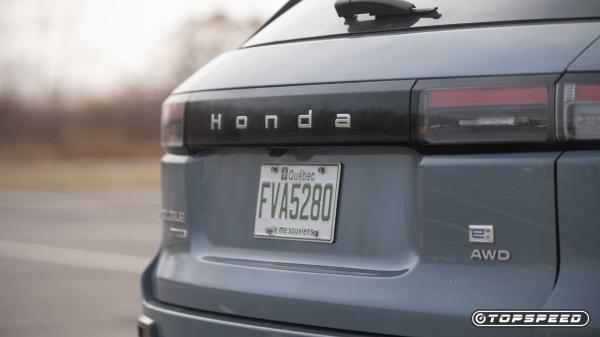
Rear-view of the Honda PrologueHonda
Being an electric SUV, the Honda Prologue is also subject to noticeably poor depreciation rates, further motivating the decision to lease rather than buy. After five years of ownership, iSeeCars estimates that the model will lose $35,365 or 53.5 percent of its initial purchase value, which falls in line with other electric SUVs competing in this segment.
Existing and former owners of the Honda Prologue have taken to the Edmunds Consumer Review section to give it a 3.4/5 overall score, based on 34 reviews. Standout pros of the American-built Japanese EV SUV are its interior spaciousness, comfortable ride quality, and enjoyable driving experience. Unfortunately, it loses serious points for its glitchy technological features, reliability and manufacturing quality concerns, and troublesome electrical system.
Regarding ownership costs, CarEdge reveals that you’re likely to spend $62,721 on the EV over five years. Included in this is a $36,125 depreciation estimate. Additional costs include $13,825 on insurance, $2,335 on electricity, and $1,589 on general maintenance. The 2026 Prologue isn’t subject to any recalls, but 2025 models do have one for a rearview camera that may display a distorted or blank image. Honda dealers will replace the rearview camera, free of charge.
Sources: Honda, The EPA, iSeeCars, CarEdge, and Edmunds.














No Comments