
The ‘Outdated’ Pushrod V8 That Survives 1,000 HP When Modern Engines Grenade
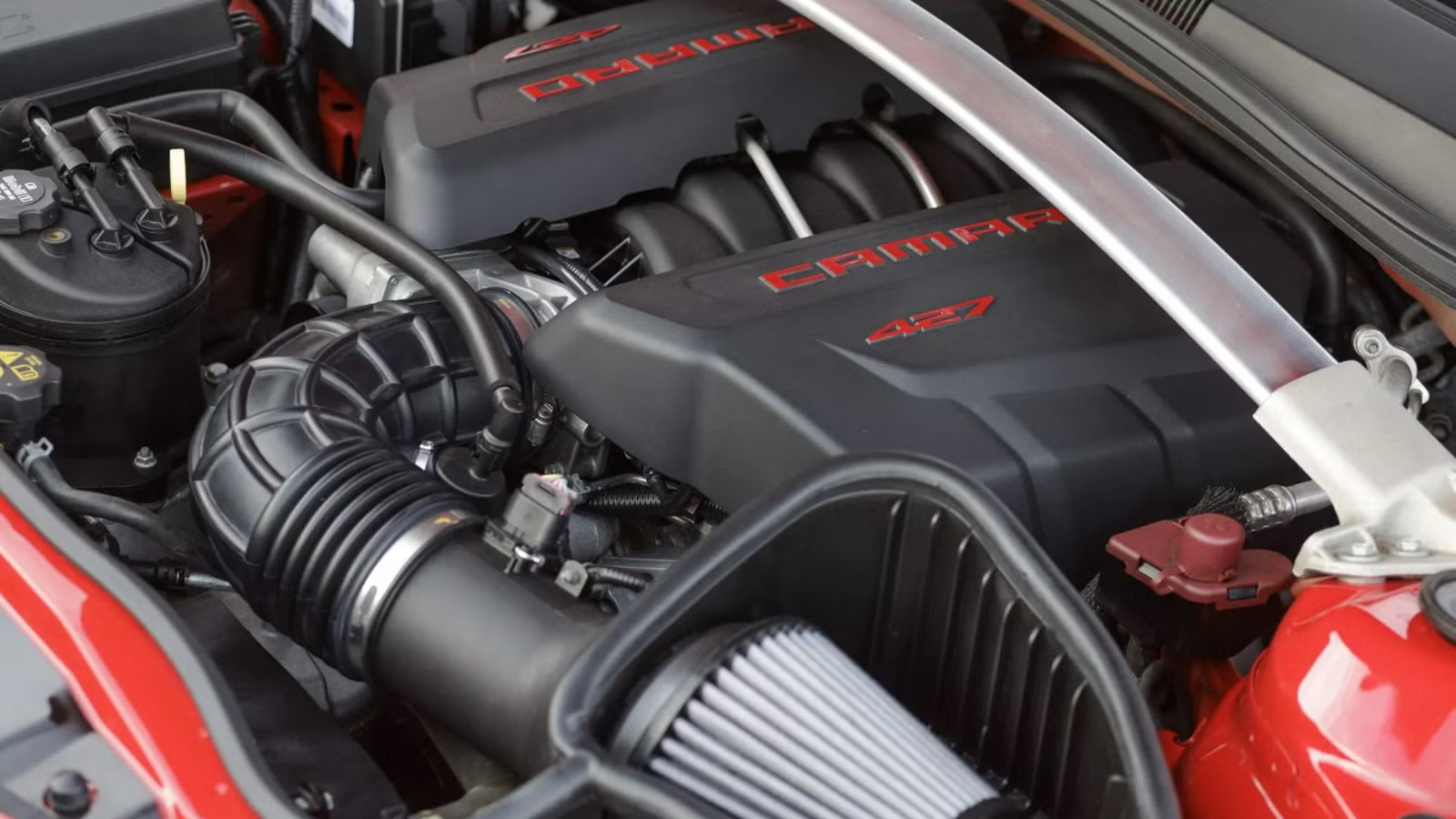
When talking about some of the best engines in the world, there are numerous contenders from Japan and Europe with highly sophisticated designs. Engines with dual overhead cams, independent variable valve timing, twin-scroll turbochargers, and high-pressure direct injection. But for decades, an unexpected, seemingly archaic contender from Chevrolet has consistently humbled the most sophisticated engines on the planet. While modern high-tech engines can destroy internal components when pushed well past factory limits, a two-valve-per-cylinder, single-cam, pushrod V8 can comfortably hit four-digit horsepower figures on stock bottom ends. America’s supposedly outdated V8 doesn’t just compete with today’s top-tier performance engines; in many ways, it outperforms them.
Modern High-Performance Engines Aren’t So Great For Big Power

On paper, modern high-performance engines are absolute masterpieces in mechanical engineering. From the factory, these cars have been optimized to make as much power as efficiently as possible while still having great fuel economy and abiding by current strict emissions. However, the exact qualities that make modern factory engines so impressive are often the very things that make them terrible for aftermarket tuning and big power.
When modern automakers design an engine, every component is rigorously stress-tested and optimized down to the gram using hyper-precise computer modeling. There is virtually no “wasted” metal or intentional over-engineering left on the table. The engine is built to survive its factory horsepower output and perhaps have some margin beyond that, and nothing more.
More Technology Means More Complications

The issue with making power in modern engines is their complexity. They have already been designed to meet stringent global emissions targets, maximize fuel economy, adhere to sound regulations, and are tightly packed in the engine bay. Unfortunately, every addition made to satisfy these parameters introduces a potential point of failure when you start introducing more cylinder pressure. Dual Overhead Camshaft (DOHC) cylinder heads are a prime example. While four valves per cylinder allow an engine to breathe exceptionally well at high RPMs, the cylinder heads are massive, heavy, and extremely wide, making them more complex.

Instead of a single camshaft buried safely inside the engine block, a DOHC V8, for example, has four separate cams, longer timing chains, and the list goes on. In the pursuit of weight savings, many modern engines and their internals are made of thin, lightweight parts. You have to spend a lot of money reinforcing these parts if you have any intentions of making more power. But while the European and Japanese competitors were making their engines more complex, General Motors took a completely different path in the late 1990s.
GM’s New Small-Block Became One Of America’s Greatest Performance Engines

By the mid-90s, the automotive world was getting ready to bury the traditional American pushrod V8. Competitors like Ford were transitioning to high-tech modular engines, and GM was expected to follow suit. Instead, GM engineers doubled down on the much simpler pushrod design, and in 1997, they unveiled a new redesign of their iconic V8 formula. The result was the Gen III Small-Block V8, better known as the LS engine. It was an instant icon that completely redefined what a light, compact, and ultra-durable engine could be, and it would go on to become one of the most legendary engine families ever made.
The LS Engine Quietly Rewrote The Small-Block Rulebook

The first iteration came in the form of the LS1 in 1997 with the debut of the C5 Chevrolet Corvette. The 5.7-liter LS1 shared almost nothing with the original 1955 Small-Block Chevy it replaced, save for its classic 4.40-inch bore center spacing. GM engineers recognized that sticking with an overhead valve (OHV) pushrod design allowed them to keep the engine compact, lightweight, and structurally rigid, provided they modernized every structural element surrounding it.
GM engineers chose to retain the pushrod layout because of space. The LS engine was vastly smaller and significantly lighter than its DOHC competitors. In fact, an all-aluminum LS V8 was physically smaller and lighter than many 3.0-liter inline-six and V6s. This ultra-compact, high-strength design would quickly evolve into a modular family of engines that powered everything from daily family haulers to America’s fastest supercars.
Front-Wheel-Drive Sedan To The Supercharged ZR1

One of the most remarkable traits of the LS platform was its versatility. General Motors produced millions of LS-based engines for different applications and configurations. They were both lightweight aluminum blocks for sports cars and high-strength cast-iron blocks for work trucks. As the architecture evolved through its third and fourth generations, it achieved legendary milestones across various platforms.
When the LS1 debuted in the 1997 C5 Corvette, it made 345 hp and 350 lb-ft of torque. It immediately transformed the Corvette into a world-class supercar killer, offering phenomenal throttle response, incredible fuel economy on the highway thanks to its low-end torque, and its ease of modifications that quickly caught the attention of the drag racing community.
To demonstrate the extreme flexibility of the pushrod design, GM engineered the 5.3-liter LS4 for transverse, front-wheel-drive vehicles. With a shortened crankshaft, a unique low-profile accessory drive, and a specific bellhousing pattern, this 303-hp V8 was stuffed sideways into mid-size sedans like the Chevrolet Impala SS, Monte Carlo SS, and Pontiac Grand Prix GXP. This was possible because the compact V8 could fit in engine bays originally designed for transverse V6 engines.
The Largest Displacement LS7

For the track-focused C6 Corvette Z06, GM released the LS7, a hand-built, 7.0-liter (427 cubic-inch) naturally aspirated masterpiece with a few upgrades. It had lightweight forged titanium connecting rods, hydroformed exhaust manifolds, and a race-derived dry-sump lubrication system. The LS7 produced 505 hp and 470 lb-ft of torque, revving reliably to a screaming 7,000 RPM. To this day, many purists regard the LS7 as the greatest naturally aspirated pushrod engine ever put into production.
The Supercharged LS9

The pinnacle of factory LS engine arrived with the LS9, which was the supercharged heart of the C6 Corvette ZR1. The 6.2-liter LS9 had a reinforced aluminum block, an Eaton 2.3-liter supercharger, forged steel crankshaft, titanium connecting rods, and forged aluminum pistons. It made 638 hp and 604 lb-ft of torque; it was an absolute monster of an engine that remained solid even under heavy track abuse.
The LS Became The First Choice For 1,000-HP Builds

While factory numbers are impressive, the LS earned its true legendary status in the aftermarket world. It has become the default choice for engine swaps because making power is easy with stock components. Where modern high-tech engines require an engine rebuild to survive 1,000 hp, a stock-bottom-end iron-block LS (such as a 4.8-liter or 5.3-liter pulled from an old Chevrolet Tahoe or Silverado) can achieve four-digit horsepower with surprising ease. But why are these engines so ridiculously durable?
It starts with the combination of a deep-skirt design, thick cylinder walls (especially in iron truck blocks like the LQ4, LQ9, or LY6), and six-bolt main caps to secure the bottom end, which means the engine does not flex or distort under extreme cylinder pressures. Factory cast-iron crankshafts in standard truck engines can handle 900 to 1,000 wheel horsepower without snapping or wearing main bearings prematurely. Finally, the stock cylinder heads are capable of flowing enough air to support 1,000 horsepower when paired with forced induction.
Its Brilliant Simplicity Made It Easy

Beyond structural integrity, the LS is simple to work on. With only one camshaft located in the center of the block, valve timing adjustments and cam swaps can be performed in an afternoon without pulling the engine or wrestling with complex timing chains and phasers. Furthermore, these engines are readily available. GM produced tens of millions of LS-family engines over nearly two decades. Because the basic architecture has remained the same across cars, trucks, and SUVs, engine builders can easily source a $500 junkyard engine for their build. They gap the factory piston rings to handle heat, install a set of aftermarket head studs and stiffer valve springs, bolt on a massive turbocharger or supercharger, and reliably hit 1,000 hp on E85. You do need a few more mods, but no other engine on planet Earth offers that level of power per dollar.
No Other Modern V8 Has Matched The LS Formula

There are a lot of incredible V8 engines, yet none have managed to replicate what the LS platform offers. When compared to its direct rivals, the advantages of the LS become clear. Ford’s Coyote V8 is an extraordinary engine, but its dual-overhead-cam design makes it physically large. It is bigger than a 426 Hemi (7.0-liter), making it difficult to stuff into a smaller chassis without extensive metal fabrication. Chrysler’s Gen III Hemi makes fantastic power, but its valve train and factory pistons are significantly less forgiving and can give up when exposed to extra boost. Even Chevy’s own successor, the direct-injected Gen V LT engine family, makes it a little more complex to make big power. It is more expensive and labor-intensive than it was on the simpler Gen IV LS.
Why The LS Still Wins

Chevrolet Performance officially discontinued the LS9 crate engine in May 2026, seemingly marking the close of a legendary chapter of pushrod performance. But GM also announced the new 6.7-liter LS6 launched with the Corvette Grand Sport. It still has the same OHV design and two valves per cylinder count. The new LS6 has the hardware and displacement to become a serious big-power platform. But the LS remains completely unmatched in every major category.
It is compact, light, readily available, affordable, and has limitless aftermarket support. With the right parts, this engine will easily handle double or triple the power with the stock block. The dual-overhead-cam technology, variable valve timing, and direct injection certainly have their place in modern vehicles that aim to maximize power and efficiency. But when the goal is raw, reliable, tire-shredding power that won’t blow a hole through your engine block or your bank account, the LS simplicity reigns supreme. Decades after its introduction, the “outdated” pushrod LS V8 isn’t just surviving; it’s still dominating.
Sources: General Motors

Related posts





Latest Post


No Comments