
The Roadster That Quietly Became A Modern Classic
The mid- to large-displacement retro motorcycle market in the U.S. has never been short on good-looking machines. Round headlights, brushed engine covers, and paint schemes borrowed from models decades ago — it’s a formula every major manufacturer has copied now. The problem is that some of them seem to make their strongest argument while parked. They look fantastic outside a coffee shop, but the charm can fade when the road starts winding, or a highway stretch turns into an hour of wind and engine noise. Style outruns substance more often than the segment likes to admit.
The Retro Roadster Segment Sells Nostalgia As A Feature

Triumph didn’t just build old-looking bikes — it built an entire “Modern Classics” family and stamped the name on everything from the Street Twin to the Bonneville T120. BMW leans just as hard into its own mythology, treating the R12 nineT’s air-cooled boxer twin like a museum piece you’re lucky enough to ride. Yamaha went with “Legend Reborn” as the actual marketing line for the XSR900, in case anyone missed the point. Heritage isn’t just a design cue in this segment; it’s the sales pitch.
One Retro Bike Never Needed a Heritage Ad Campaign

Kawasaki skipped that playbook entirely. Dig through the company’s own literature, and you won’t find “roadster” or “Modern Classic” anywhere near this bike’s name — Kawasaki calls it a Retro Sport, the same dry, functional label it’s used since 2018. No branded sub-lineup, no vintage-tinged tagline. And yet several motorcycle reviewers across the world have called it “one of the purest and most underrated retros” one can buy today without Kawasaki ever aiming for that compliment.
The Z900RS Is A Rare Inline-Four Modern Classic
Base Price: $12,899


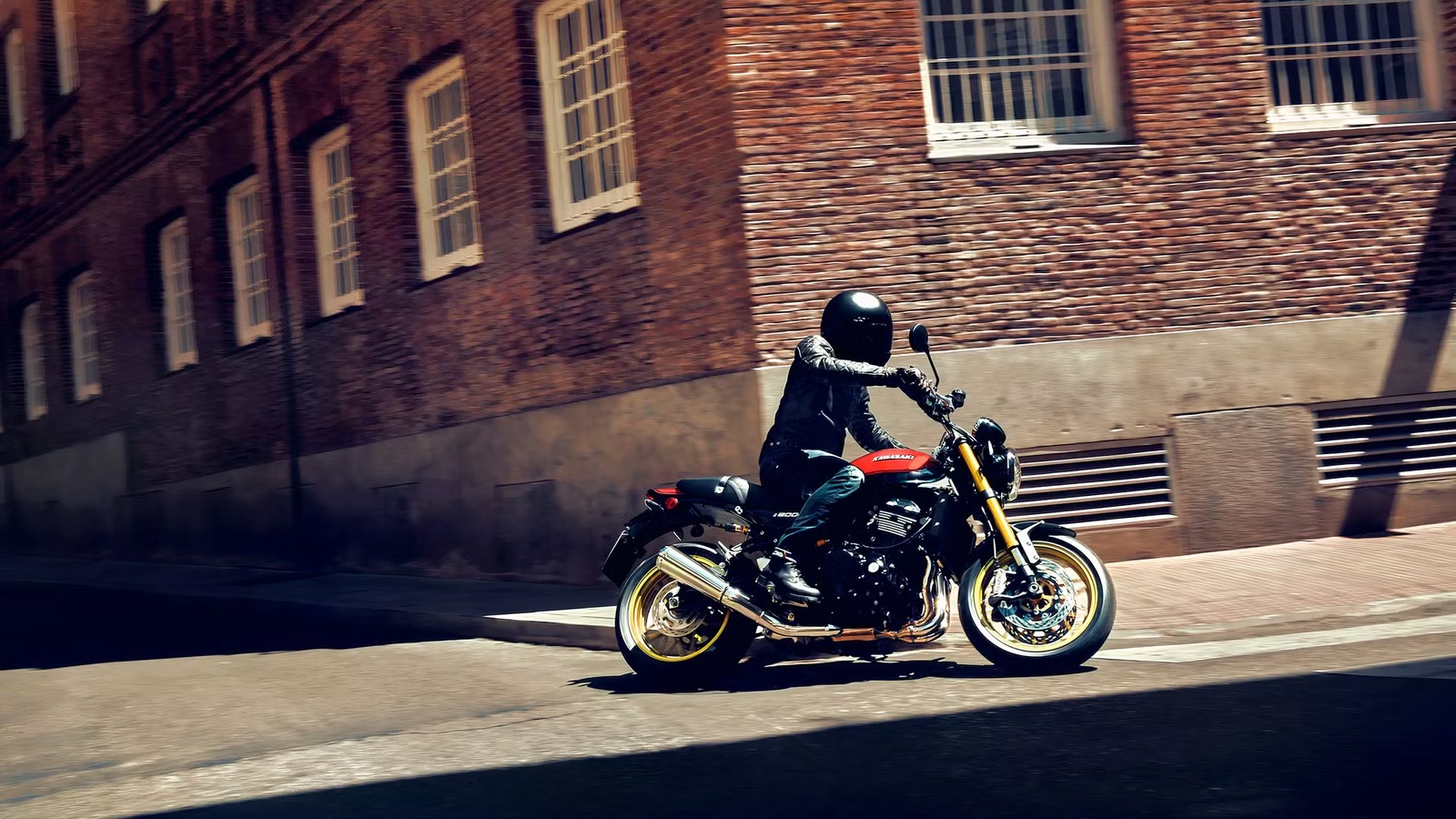
Meet the Kawasaki Z900RS, priced from $12,899 for the base ABS trim in the US for 2026. Kawasaki didn’t chase this segment by grafting a round headlight and a teardrop tank onto a leftover streetfighter chassis, a shortcut more than one rival has taken. It built the RS around its own inline-four platform from the ground up and tuned the chassis specifically for the job, leaving the marketing department mostly out of the room. The result reads less like a costume and more like a coherent motorcycle — modern performance wrapped in proportions that haven’t dated, mostly because they were never chasing a trend to begin with.
A Z1-Bred Inline-Four Tuned For The Street, Not The Track

At the center of it sits a 948cc, liquid-cooled, DOHC inline-four with a compression ratio bumped to 11.8:1 from 10.8:1, plus an assist-and-slipper clutch that lightens the lever pull in traffic. Kawasaki’s own figures put output at 115 horsepower at 9,300 rpm and 73 lb-ft at 7,700 rpm for 2026, up from the 111 horsepower the previous-generation engine made. The latest iteration comes with several meaningful updates, including an up/down quick-shifter, a crankshaft that’s roughly 10 percent lighter, revised cam profiles, and a fresh exhaust tune.
None of that is about chasing a bigger peak number for a spec sheet. The lighter crankshaft and revised cams let the engine spin up quicker without feeling frantic, while recalibrated fueling, closer gear ratios, and a new 43-tooth rear sprocket pull the meaningful part of the torque curve down into the rpm range most riders actually live in — around town, merging onto the highway, rolling out of a corner.
Exhaust Tuning As Acoustic Art

Kawasaki has always built decent-sounding bikes almost by accident, a byproduct of its engine architecture rather than deliberate design. For 2026, that changed. The company ran a dedicated sound-development process on the Z900RS, reshaping the 4-into-1 header layout and fitting a new stainless-steel megaphone-style muffler with a redesigned pre-chamber. Engineers tuned the packing material, fiber density, and perforation pattern inside the silencer specifically to emphasize lower frequencies at idle and low-to-mid revs, chasing a deep, bass-heavy note reminiscent of the original Z1’s four-into-one system, without tipping into something obnoxious at a steady highway cruise.
Modern Electronics Hiding Behind Analog Dials

A new 6-axis IMU underpins Kawasaki Traction Control and Kawasaki Cornering Management Function, both lean angle aware for 2026, alongside cornering ABS and electronic cruise control. The SE trim adds a handlebar-mounted USB-C outlet, and Bluetooth connectivity through Kawasaki’s Rideology app carries across the whole range. All of it sits behind a pair of classic analog dials, a speedometer and tachometer, with a small multifunction LCD screen wedged between them. No dominant TFT slab, no menu-diving required mid-ride.
Design Details Inspired By The Legendary 1972 Z1 Without Overplaying It

Justifying the “modern classic” tag, the visual references to the 1972 Z1 Super Four are everywhere if you know where to look, and largely invisible if you don’t. The 4.4-gallon teardrop fuel tank echoes the original almost line for line. The stubby “ducktail” rear cowl, the round LED headlight, the double-stitched seat, and the knee grips molded into the tank’s flanks all pull directly from the Z1’s silhouette, too. Even the cylinder head gets in on it. Kawasaki machined a set of cooling fins into the casting purely for looks, since the engine is liquid-cooled and doesn’t need them. Lastly, the Fireball colorway on the SE trim, red and black with gold wheels, is a direct callback to one of the original Z1’s most famous paint jobs.
Base, Café, And SE: What Each Trim Actually Changes

The base ABS trim comes in Ebony only, with a 32.8-inch seat height. Step up to the Cafe ABS, and you get a small front cowl, a black drop handlebar, a stepped 32.3-inch seat, a brushed exhaust finish, and graphics that nod to Kawasaki’s old Mach-series two-strokes rather than the Z1. The SE ABS is built for riders who’ll actually use the extra performance: an Öhlins S46 rear shock with remote preload adjustment, Brembo M4.32 radial calipers with steel-braided lines, and gold-finished fork tubes, stacked on top of everything the base bike already offers.
A Trellis Frame And Chassis Built For Everyday Roads

Underneath the retro bodywork sits a high-tensile steel trellis frame, engineered specifically to wrap around that teardrop tank shape without giving up modern rigidity — not a compromise inherited from an older platform. A fully adjustable 41mm inverted front fork and Kawasaki’s horizontal back-link rear suspension handle the damping duties, the latter mounting the shock almost flat instead of upright to keep weight centralized near the bike’s midpoint. Braking comes from dual 4-piston radial-mount monoblock calipers gripping 300mm discs up front, a single-piston caliper on a 250mm disc out back, and a Nissin ABS unit as standard, with Brembo hardware taking over on the top-spec SE trim. Dunlop’s Sportmax GPR-300 tires wrap a set of cast wheels at both ends.
Comfortable Enough To Be A Daily Bike

At a claimed 476 pounds curb weight, the Z900RS isn’t the lightest thing in its class on paper. But it is said to carry that weight low enough to feel lighter than the spec sheet suggests, especially threading through city traffic. The single-piece seat draws particular praise, called out as among the most comfortable in the entire naked-bike category, not just the retro corner of it. Pair that with an upright, relaxed riding position, and there’s a real case for this being the rare retro that works as well on a five-day commute as it does parked outside a coffee shop on a Saturday morning.
Overall, it isn’t the loudest motorcycle in the retro class, the most exotic or the most aggressively marketed. It simply gets an unusual number of things right at once. It looks like something that could have been parked outside a Kawasaki dealership in 1972, but it rides like a motorcycle designed for 2026. Which, eventually, is probably why nobody had to convince anyone it was a classic. It just became one.
Source: Kawasaki

Related posts

Latest Post



No Comments