
The Forgotten Italian Homologation Special That Rewired Moto Guzzi’s Identity
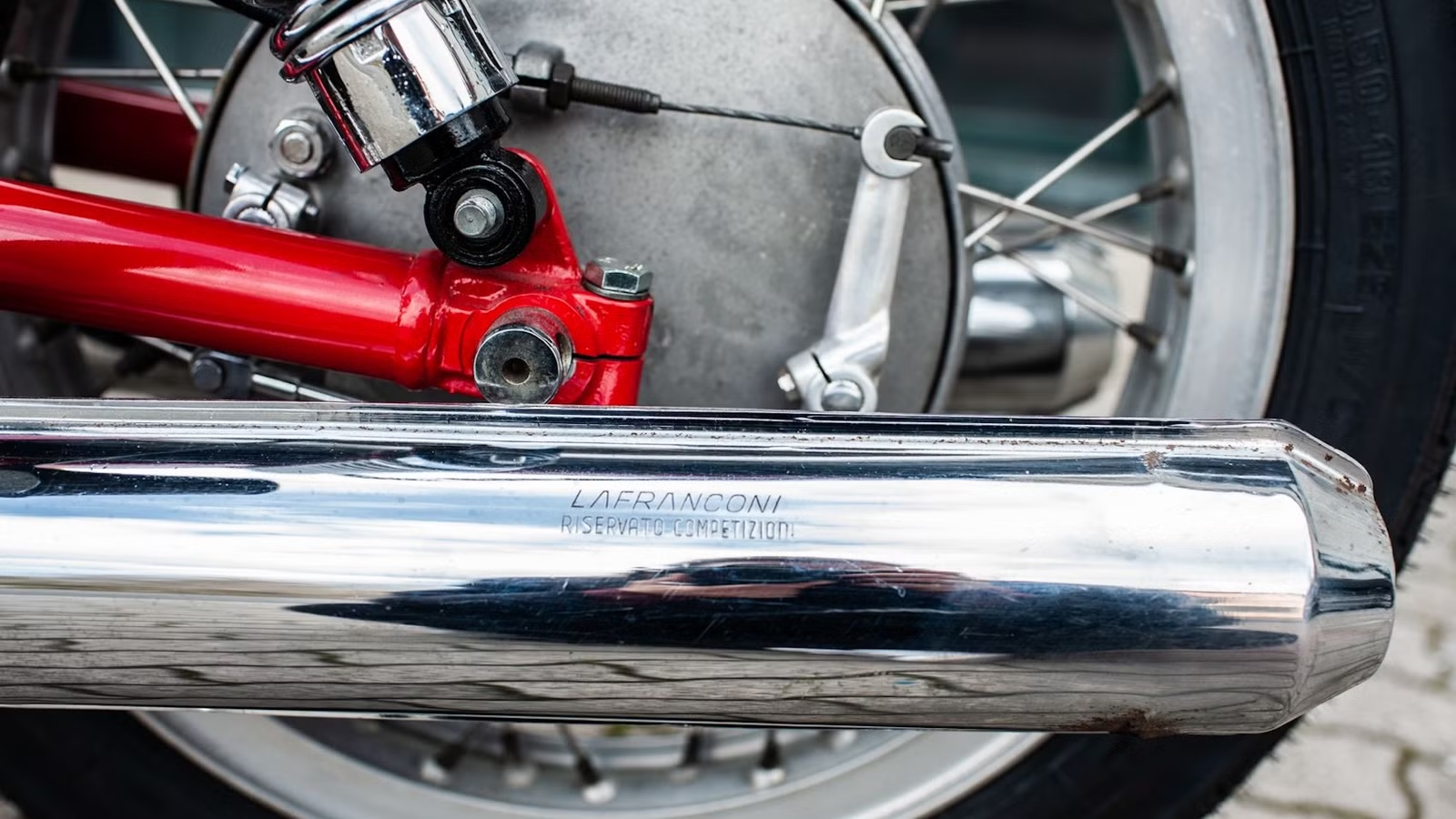
In December 2023, an eye-catching Moto Guzzi motorcycle arrived at Gooding & Company’s Southern California auction house. It was a 1971 sports bike with lime green bodywork and a bright red frame. Experts said it would go for $30k–$50k. But when all the bids were in, Moto Guzzi frame number VK11126 had sold for $95,700.

What the experts overlooked was that this wasn’t a regular Moto Guzzi with a bright racing livery from the factory. It was a mechanically exceptional piece of history that rewired the company’s entire identity.
You Might Have Bet Against Moto Guzzi In 1970
No company in Europe has been continually producing motorcycles longer than Moto Guzzi out of Mandello, Italy. Carlo Guzzi and two colleagues dreamed of starting a motorcycle company while serving in WWI. When motorcycle racer Giovanni Ravelli died in a plane crash, Carlo became even more determined to found the company in his honor.

Moto Guzzi had some early success in motorcycle racing. But by the time Carlo Guzzi died in 1964, he’d long since retired and his company was floundering. The Italian government took over in 1967, pivoting to inexpensive mopeds. In an effort to win a lucrative police contract, Moto Guzzi engineered a transverse-mounted V-twin engine which would become its signature powerplant. The air-cooled engine featured one cylinder on either side of the gas tank and used a driveshaft to spin the rear tire.

Guzzi’s earliest V-twin was a 700-cc, 45 hp unit that proved reliable enough to catch the attention of multiple police forces. It helped that it was a torquey engine and the “flying V” design allowed Guzzi to mount it low in the frame, resulting in a stable cruiser. Most famously, the California Highway Patrol began buying big Moto Guzzi cruisers in the early 1970s.
While such contracts stabilized Moto Guzzi economically, the company had strayed far from its early days winning races. In 1970, Moto Guzzi might have been the last company you’d expect to throw its helmet into the superbike wars.
Enter Lino Tonti

Lino Tonti was an Italian racing motorcycle designer. Despite obvious talent, his career floundered for two decades. First, he joined F.B. Mondial and was instrumental in breaking MV Augusta’s Moto GP winning streak. But then Mondial made a back-room deal with MV Agusta, Gilera, and Moto Guzzi to pull out of racing in 1957. Tonti signed on with Bianchi and designed competitive racing motorcycles until Bianchi went out of business in 1967.
Giulio Carcano, who had designed Moto Guzzi’s racing bikes during its golden era, was just retiring. The company offered Tonti the job. He had his work cut out for him, building a new sports bike from the company’s heavy cruiser parts bin.

When Tonti signed on, Guzzi’s 700 cc V-twin was rated at just 50 horsepower. He developed sand cast engine cases and polished motor internals. Eventually, he built a 70 horsepower tune of the same engine. He also built a special five-speed gearbox to increase top speed. But his crowning achievement was engineering a light racing frame that could fit the company’s big V-twin engines. He prototyped the “Tonti frame” out of thin-walled chrome-molybdenum to further reduce weight. But after engineering all the components of a contender, Tonti had one more challenge: putting the superbike world on notice.
The Forgotten British Motorcycle That Invented Speed Marketing Half A Century Before The Ninja
Imagine buying a bike and getting a certificate the company founder had signed after personally testing its top speed.
The 1971 Moto Guzzi V7 Sport ‘Telaio Rosso’

|
Model |
1971 Moto Guzzi V7 Sport ‘Telaio Rosso’ |
|---|---|
|
Engine |
748 CC OHV V-Twin 4-Stroke |
|
Carburetors |
Twin Dell’Orto VHB 30s |
|
Output |
72 BHP at 7,000 RPM |
|
Transmission |
5-Speed Manual With Shaft Drive |
|
Brakes |
Hydraulic Drums, Double-Sided Front |
|
Front Suspension |
Telescopic Fork |
|
Rear Suspension |
Swing-Arm With Twin Shock Absorbers |
Carcano’s original V-twin engine had an electrical generator mounted atop the crankcase. Tonti opted for an alternator on the crankshaft nose, enabling a frame so low that it looked like a completely different motorcycle than Guzzi’s cruiser lineup. To illustrate the difference, Guzzi painted this first run of “Tonti frames” bright red and used them for a limited run of special edition racing-prepped bikes.

The “Telaio Rosso,” which literally translates to “red frame,” weighed just 454 pounds. Its tuned engine was rated at 72 bhp. Sources say the sturdy shaft could deliver 52 of those ponies to the rear wheel. With five tall gears, it claimed a 125 mph top speed.
Moto Guzzi built 150 Telaio Rosso bikes, and likely kept many of them for racing. Factory records show it delivered 104 of these bikes—all with red frames and bodywork finished in a lime green that was impossible to ignore. These motorcycles were destined for privateer motorcycle racers, motorcycle magazines, or other VIPs. After this homologation run, the Telaio Rosso was officially qualified for FIM and Italian production motorcycle racing. Tonti’s new bike would even lead the first 10 hours of the 24-hour endurance race at the Le Mans circuit.
The Honda Motorcycle That Secretly Birthed The Superbike Era
Before superbikes became a category, Honda built the machine that changed everything forever.
Rewiring Moto Guzzi’s Identity

Once Moto Guzzi finally finished its run of Telaio Rosso superbikes, it finally began assembling the 1971 V7 Sport for the general public. The Telaio Rosso wasn’t just a unique paint scheme, but a truly different motorcycle mechanically. Later V7 Sport motorcycles used standard thick steel frames.
The V7 Sport’s output may also have been a bit lower. Moto Guzzi claimed the 700cc maxed out at 67.3 hp at 6,900 rpm and 58.3 lb-ft at 4,400 rpm. That said, the company may have downplayed output numbers because of the 844 cc version of the engine already in the works.

For the 1976 model year, Tonti introduced the first generation of the Moto Guzzi Le Mans. It is widely considered Guzzi’s first superbike. The Le Mans was famous for its 80 hp at 7,300 rpm and a claimed 126 mph top speed. But Tonti achieved nearly this top speed five years earlier, with his racing homologation Telaio Rosso.
This Forgotten Le Mans Superbike Hit 130 MPH With A 850cc V-Twin
No one expected an Italian company building police bikes to create one of the most unique performance machines of the decade.
The Value Of A Piece Of History

When Telaio Rosso frame number VK11126 sold for $95,700 in 2023, its high value was certainly a shock. The same year, frame number VK11248 (pictured) sold at Bonhams in the UK for the equivalent of $42,500 USD. With the V7 Sport and Le Mans offering a similar analog riding experience, buyers are obviously paying the Telaio Rosso premium for the history of these bikes. A V7 Sport (VK13223) built into a convincing Telaio Rosso replica sold in 2024 for just $9,655.
The limited run of Telaio Rosso racing bikes represents an intriguing chapter of Moto Guzzi history. Tonti’s first major Guzzi project signals a huge departure from the bikes that came before and a return to racing. It’s a technologically advanced machine that rewired Moto Guzzi’s identity, charting the company’s course for decades.

Related posts





Latest Post


No Comments