
The One Motorcycle To Rule Every Road
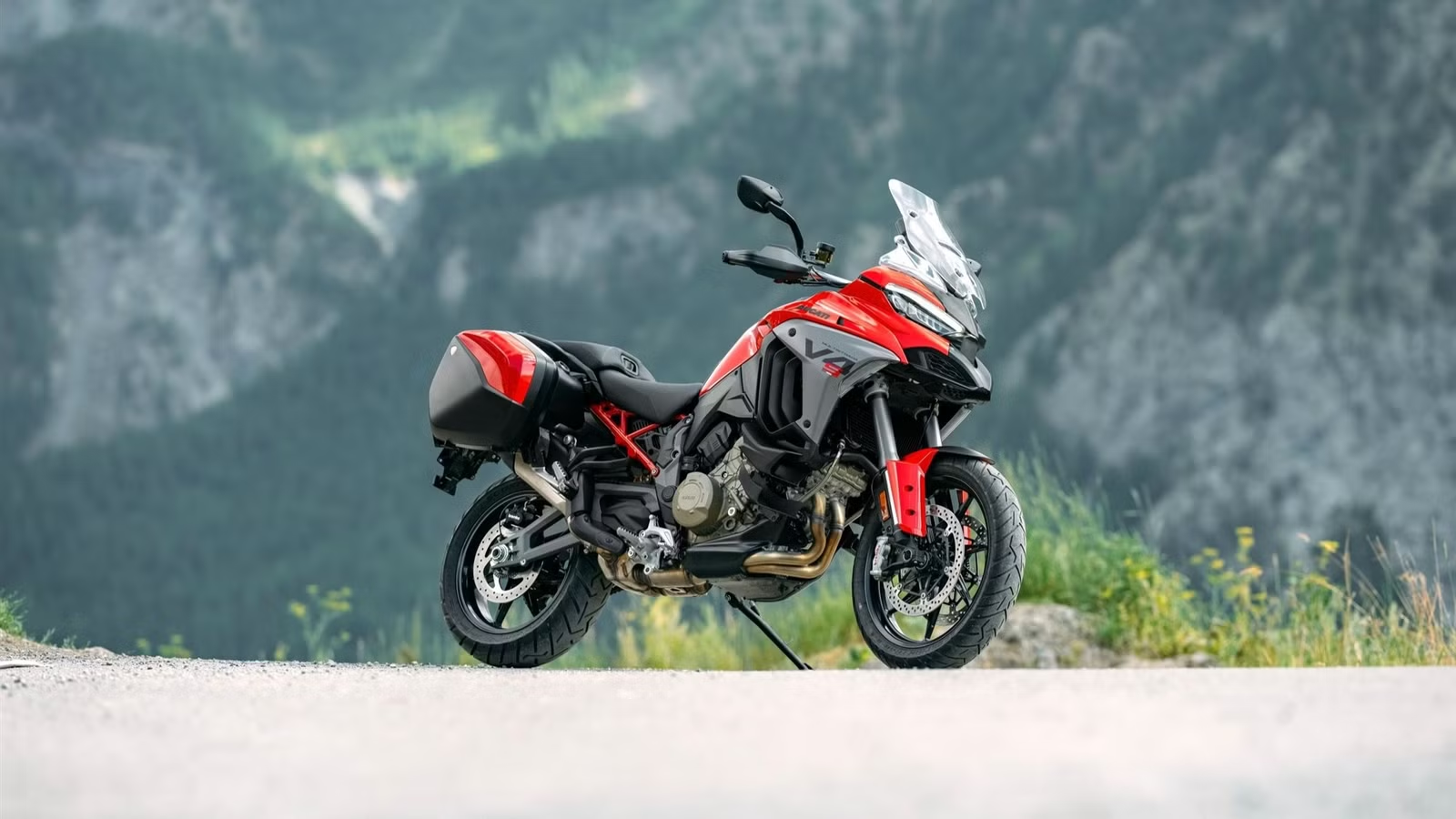
Finding a genuinely bad motorcycle these days is harder than ever — the industry has raised its game to the point where almost every bike does its intended job well. The real challenge arrives when you want one machine that does everything well. Cruisers won’t hustle, dual-sport and naked bikes aren’t built for long tours, and sport bikes sacrifice comfort at the altar of speed. That narrows the field to sports tourers and adventure bikes.

Both classes cover a breathtaking range of abilities, and your preference will come down to whether you prioritize high-speed touring on smooth tarmac or need the confidence to tackle broken pavement and dirt roads. Sports tourers excel on asphalt but aren’t genuinely usable off it — so the crown has to go to an adventure bike. After riding and researching the segment thoroughly, we’re convinced one machine stands above the rest.
The 2026 Ducati Multistrada V4 S Is Your Compadre For All Adventures
Starting Price: $29,995
The Multistrada has been around for just over two decades, and in that time it has gone from strength to strength. It is now a range of motorcycles powered by either two or four cylinders, and while it once offered a highly off-road-focused variant, that torch has been passed to the DesertX. The Rally variant remains, but the core Multistrada is designed to traverse all kinds of roads with a measure of off-road capability thrown in — fitting, since its name is Italian for ‘many roads.’ The Ducati Multistrada V4 S, with its advanced chassis, suspension, engine, and electronics tying everything together, is the one motorcycle to rule every road.
Ducati Multistrada V4 S Highlights
- Granturismo engine with industry-leading service intervals
- 170 horsepower output
- Front + rear radar
- Ducati Skyhook electronic suspension

Ducati Multistrada V4 S Engine: Setting A New Standard
Bye Bye, Desmodromic Valvetrain
In 2025, Ducati abandoned its Desmodromic valvetrain in favor of conventional valve springs. That might sound like a step backward, but for a motorcycle like the Multistrada it is unambiguously a step forward. The V4 Granturismo weighs less than the V-twin it replaced, is less mechanically complex, and delivers service intervals and costs that are miles ahead of the old engine. The layout is a familiar 90-degree V4 with a ‘twin pulse’ firing order that mimics the character of a V-twin.
It also features a counter-rotating crankshaft, which benefits handling when you’re pressing on. The biggest practical gain from the valve springs, however, is the service schedule: routine services fall every 9,000 miles or 24 months. The dreaded valve clearance checks? A remarkable 37,000 miles — or after every fourth service, up to a maximum of eight years.
Ducati Multistrada V4 S Engine Specifications
|
Engine Configuration |
Granturismo 90 degree V4 with twin pulse firing order, liquid cooling, DOHC, 4 valves per cylinder |
|
Displacement |
1,158 cc |
|
Bore x Stroke |
83 x 53.5 mm |
|
Compression Ratio |
14.0:1 |
|
Power |
170 HP @ 10,500 RPM |
|
Torque |
92 LB-FT @ 8,750 RPM |
|
Fuel System |
Electronic Fuel Injection |
|
Transmission |
6 speed manual transmission, two way quickshifter, hydraulic assistance for clutch, slipper clutch |
|
Final Drive |
Chain drive |

The gearbox is a six-speed unit with a short first gear and a tall sixth. The short first helps with traffic, hill starts, and crawling through tough terrain, while the tall sixth ensures better comfort and fuel efficiency on the highway. The Granturismo engine can also deactivate the rear bank of cylinders under certain conditions, effectively turning it into a parallel twin to reduce consumption and keep both engine and rider cooler. Drive to the rear wheel is by chain.
A two-way quickshifter is standard on the Multistrada V4 S, and a ride-by-wire throttle and six-axis IMU unlock ride modes, engine brake control, and cornering traction control. Dual-direction radar — facing both forward and rearward — brings adaptive cruise control to the features list, while blind-spot detection makes highway riding even more relaxed.
Weight Saving With The Chassis, Too
Exceptional Electronics As Well

Ducati used an aluminum monocoque chassis for the Multistrada — conventional for the brand, but conventional is a virtue on a motorcycle like this, offering better reliability and repairability on the road. The rear subframe is a trellis unit and accommodates luggage mounting as well. Unlike previous full-size Multistradas, the current generation uses a double-sided swingarm, which reduces weight while improving strength and cornering grip.
Ducati Multistrada V4 S Chassis Specs And Dimensions
|
Chassis |
Aluminum monocoque |
|
Front Suspension |
50 mm inverted forks, fully adjustable, electronic adjustment; 6.7 inch travel |
|
Rear Suspension |
Single shock, fully adjustable, electronic adjustment; 7.1 inch travel |
|
Front Tire And Wheel |
120/70 ZR19 |
|
Rear Tire And Wheel |
170/60 ZR17 |
|
Front Brakes |
Dual 330mm semi-floating discs with radial-mount Brembo Stylema four-piston fixed calipers, radial master cylinder |
|
Rear Brakes |
265 mm disc with Brembo two-piston floating caliper |
|
Length/Width/Height |
97.2/39.4/52.7 inches |
|
Fuel Tank Capacity |
5.8 Gallons |
|
Wheelbase |
61.7 inches |
|
Rake |
24.5 degrees |
|
Trail |
4.0 inches |
|
Seat Height |
33.1 inches (standard) |
|
Ground Clearance |
8.6 inches |
|
Curb Weight |
509 LBs (wet) |
The suspension on the Multistrada V4 S is fully adjustable with electronic control at both ends, integrated with the ride modes for optimized results. It also features a lowering function that makes getting the bike off its side stand easier. Massive 330 mm twin discs at the front, gripped by superbike-spec Brembo Stylema calipers, handle braking duties — more than capable of hauling a fully loaded Multistrada down from speed.
A six-axis IMU feeds a comprehensive electronics suite that includes cornering ABS, wheelie control, and electronic combined braking. Notably, the combined braking system works with either lever — pulling just one will also actuate the brake at the opposite end if the bike determines it’s necessary. A total of 70 sensors distributed across the motorcycle feed the ECUs data to support the rider, a philosophy Ducati says it carried over directly from the Panigale.
Ducati Multistrada V4 S Features
Laundry List Of Standard Features, And Even More Accessories

As the pinnacle of the Multistrada lineup, the V4 S comes with an impressively long list of standard equipment. The 6.5-inch TFT display offers Bluetooth connectivity and turn-by-turn navigation, and serves as the interface for configuring the extensive parameters governing the engine, throttle, brakes, traction control, adaptive cruise control, and suspension. Rearward-facing radar also feeds blind-spot warnings to the display.
Heated seats and grips are included, as are adaptive cornering headlamps. A dry clutch is available as an accessory for those who want a more traditional Ducati experience — though it’s an interesting choice on a machine built to handle all conditions. Riders who wanted a travel-focused package should note that the Multistrada V4 S Grand Tour, which bundled many touring accessories from the factory, has since been discontinued.
Ducati Multistrada V4 S Features
- Spoke rims are optional
- 6.5-inch TFT display
- Radar facing both ends
- Heated grips and seat
There’s Tough Competition To Beat
The Multistrada faces some very well-established rivals. Among the lesser-discussed contenders, the Harley-Davidson Pan America 1250 Special makes a credible attempt but needs more outright performance when the tarmac runs out. That leaves the segment’s long-standing benchmark, the BMW R 1300 GS, with its impressive technology including variable valve timing and shaft drive.
The Triumph Tiger 1200 GT Pro also brings shaft drive and a distinctive three-cylinder character to the segment. But neither machine comes close to matching the Multistrada’s outright performance. Then there’s the KTM 1290 Super Adventure S, which carries on the spirit of the old V-twin Multistrada: high-strung, performance-focused, and exciting in a way that doesn’t always prioritize service intervals or long-term reliability.
Ducati Multistrada V4 S vs. Rivals
|
Ducati Multistrada V4 S |
BMW R 1300 GS |
KTM 1290 Super Adventure S |
Triumph Tiger 1200 GT Pro |
|
|
Engine |
90-degree V4, counterrotating crank |
Boxer twin, intake VVT |
75-degree V-twin |
Inline three-cylinder, T-Plane crankshaft |
|
Displacement |
1,158 cc |
1,300 |
1,301 cc |
1,160 cc |
|
Power |
170 HP @ 10,500 RPM |
145 HP @ 7,750 RPM |
160 HP @ 9,000 RPM |
147 HP @ 9,000 RPM |
|
Torque |
92 LB-FT @ 8,750 RPM |
110 LB-FT @ 6,500 RPM |
101.7 LB-FT @ 6,500 RPM |
95 LB-FT @ 7,000 RPM |
|
Quickshifter |
Standard |
Standard, optional automatic gearbox |
Standard |
Standard |
|
Curb Weight |
509 LBs (wet) |
523 LBs (wet) |
500 LBs (wet) |
540 LBs (wet) |
Sources: Ducati, BMW, KTM, Triumph

Related posts
Latest Post


No Comments